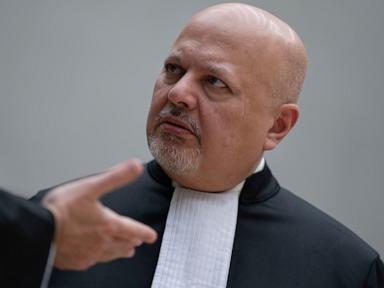
The heavy oak doors of the international courtroom do not slam. They close with a slow, pneumatic hiss, sealing away history behind thick panes of acoustic glass. Outside, the rain falls over The Hague, slicking the cobblestones where protesters often gather with cardboard signs that fade in the downpour. Inside, the air smells of old paper, floor wax, and a very particular brand of quiet tension.
Justice moves at the speed of glaciers. But sometimes, even glaciers fracture.
When the chief prosecutor of the International Criminal Court steps away from the desk, the headlines race around the globe in a blur of digital ink. Terms like institutional crisis, leadership vacuum, and jurisdictional mandate flicker across screens in Brussels, Washington, and Kyiv. Analysts on television adjust their ties and speak in measured, diplomatic tones about the architecture of international law.
They talk about protocols. They talk about statutes.
They rarely talk about the witness sitting in a safehouse three thousand miles away, staring at a blank television screen, wondering if anyone still remembers her name.
The Weight of the Chair
Consider what an international prosecutor actually does.
They do not patrol bombed-out streets. They do not carry sidearms or kick down doors in the dead of night. Their weapons are dusty archive boxes, intercepted radio transmissions, satellite photographs showing the precise scorch marks of artillery, and, most fragile of all, human testimony.
Imagine walking into a room where survivors have gathered. They are mothers who buried children in shallow graves, soldiers who deserted rather than pull the trigger on civilians, and officials who smuggled documents out in the linings of their coats. They look across the table at the prosecutor. Their eyes ask a silent question: Will this matter?
When the head of the court leaves office amid sudden upheaval or internal friction, that question turns sharp.
The machinery stalls. Investigators holding warrants in sealed envelopes look up from their desks. Prosecutors preparing for complex confirmation hearings find themselves navigating an administrative twilight zone. Every institutional shift at the top ripples down through the ranks, delaying the subpoena, postponing the interview, granting another month of impunity to those who believe they are untouchable.
The Architecture of Accountability
To understand why a change in leadership matters so intensely, we have to look past the political theatre and examine how this court was built.
Born out of the ashes of twentieth-century atrocities, the International Criminal Court was designed as a court of last resort. It operates on the principle of complementarity. It does not step in because it wants to; it steps in because local courts are broken, corrupted, or complicit. It is a safety net stretched across the globe, meant to catch the victims that national legal systems dropped.
But a net is only as strong as the hands holding the ropes.
When the chief prosecutor's office experiences abrupt transition, the operational momentum breaks. Think of it like a massive cargo ship navigating a narrow channel. If the captain leaves the bridge mid-turn, the ship does not immediately sink. But it drifts. The crew looks at one another, waiting for commands that do not come. The current pushes against the hull. Rocks that were safely cleared a moment ago suddenly loom dangerously close in the fog.
In the world of international justice, drift has a human cost.
Evidence degrades. Witnesses grow old, move, or lose faith and stop answering their phones. Digital data gets corrupted on servers in conflict zones where power grids fail daily. Perpetrators, sensing distraction at the top, quietly move assets, alter narratives, and test the new boundaries of international tolerance.
Beyond the Bureaucracy
We crave neat resolutions. We want stories where the villain is caught, the gavel falls, and the credits roll over a satisfying musical score.
Real life refuses to cooperate.
The departure of a chief prosecutor is rarely just a personnel change. It is a stress test for an entire global conscience. It forces us to ask an uncomfortable question: Is international law a permanent pillar of human civilization, or is it merely an expensive temporary shelter built by optimists during peacetime?
The answer depends entirely on resilience.
When the office door opens and a new leader steps inside, they inherit more than a stack of pending arrest warrants and budget spreadsheets. They inherit the fragile hope of every person who ever whispered a testimony into a digital recorder while hiding in a basement.
The rain continues to fall over The Hague. Inside the courthouse, the lights remain on. The investigators return to their desks, brushing the dust off archive boxes, picking up the phone, and dialing a number three thousand miles away.
The work continues. Not because the path is clear, but because the alternative is darkness.