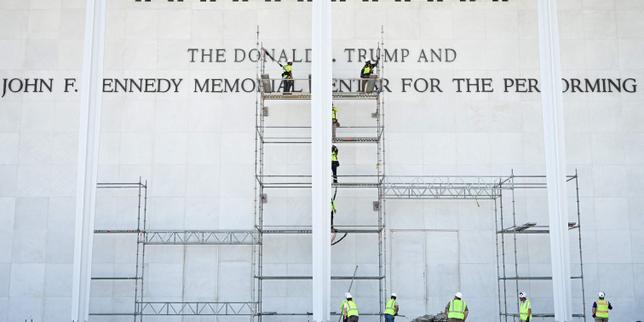
The rain over the Potomac River does not care about federal injunctions. It fell steadily on a recent afternoon, slicking the white Carrara marble of the John F. Kennedy Center for the Performing Arts, bleeding into the micro-fissures of a building that has quietly started to show its age.
Inside the executive offices, the mood was far more turbulent than the weather. A mid-level administrator, let us call her Sarah, stared at her computer screen. She had spent the last seventy-two hours deleting two words from digital letterheads, email signatures, and internal programming schedules.
Trump.
It takes only a few keystrokes to erase a name from a PDF. It takes heavy machinery to pry it off a building. Outside Sarah’s window, steel scaffolding was rising against the facade. Men in high-visibility vests stood on the metal planks, looking less like art preservationists and more like a demolition crew tasked with reversing a historical anomaly.
A deadline was ticking down to the minute.
The Weight of Marble
To understand how a battle over typeface on a building became a national crisis, one must look at what the Kennedy Center actually is. It is not just a theater. It is a living monument, established by an act of Congress to honor a assassinated president who believed that America’s superpower status was measured not just by its military might, but by its poetry, its symphonies, and its plays.
When Donald Trump returned to the White House, he looked at the massive structure on the Potomac and saw something else. A canvas.
Within months, the institutional machinery was overhauled. Democratic board members were replaced. Allies took their seats. The new leadership did what the president’s entities have always done: they rebranded. The building officially became the Trump Kennedy Center.
To the administration’s supporters, this was a necessary revitalization, a bold claim of ownership over a capital establishment that had long excluded them. To the artistic community, it felt like an eviction notice.
The reaction was immediate. Legendary musicians, authors, and actors began pulling out of scheduled appearances. Consultants resigned. The executive director of the National Symphony Orchestra packed her bags for Los Angeles. The message from the cultural elite was clear: you can have the building, but you cannot force us to perform inside it.
The Illusion of Irreparable Harm
The legal battle that followed was not born in a vacuum; it was triggered by a lawsuit from Representative Joyce Beatty of Ohio, a congressional board member who argued that a handpicked committee could not simply rewrite American history by fiat.
The defense mounted by the center’s new management was framed around an existential panic. The executive director argued in court filings that Donald Trump’s name had become the financial lifeblood of the institution. Without those gold letters on the marble, they claimed, major donors would flee, rendering the entire operation nonviable.
They spoke of water seeping into electrical vaults. They spoke of failing roof panels. The building, they argued, needed a massive, two-year total shutdown for renovations. They insisted it was a matter of basic safety.
But U.S. District Judge Christopher Cooper looked past the rhetoric.
In a searing ruling, Cooper noted a fundamental truth of the American system. Congress gave the center its name. Only Congress can take it away. The board had overstepped its legal bounds, executing a name change that was, by definition, unlawful. Furthermore, the judge found the hasty plan to shutter the nation's premier cultural center for two full years to be ill-informed and seemingly pre-ordained.
He gave the administration a firm deadline: June 12. Remove the name. Keep the doors open.
The Eleventh Hour
What followed was a masterclass in bureaucratic brinkmanship. The Justice Department waited weeks, letting the clock run out until less than thirty-six hours remained before the deadline. Then, they struck with an emergency appeal.
They argued public confusion. They claimed it made no sense to tear down the signage only to potentially put it back up if an appeal succeeded. They warned of a fundraising apocalypse.
On that final Friday, the tension in Washington was palpable. The Justice Department begged the D.C. Circuit Court of Appeals for a stay by 7:00 p.m.
The clock hit seven. The name was still on the building.
Then came the order. One page. Unsigned. A three-judge panel—comprising two Obama appointees and one Trump appointee—denied the emergency request with no noted dissents. The law, unmoving and dry, had held its ground against the storm of political willpower.
The View from the Edge
Donald Trump’s reaction was characteristically definitive. He suggested he would abandon his involvement with the institution entirely, stating on social media that unless he was free to do what he does best, he had no interest in continuing a hopeless journey. He even threatened to transfer the entire facility back to Congress, a move that left legal scholars scratching their heads, given that federal law already vests management in its trustees.
Back on the scaffolding, the workers continued their quiet labor.
Consider the sheer physical reality of that moment. A man with a chisel and a wrench, standing thirty feet in the air, tasked with removing the physical manifestation of an ego from a wall of state. Every turn of a bolt was a literal undoing of an administration's signature policy of architectural dominance.
This story is not truly about a name on a wall. It is about the friction between permanence and transience. Empires rise, and leaders believe their names will echo forever if they carve them deep enough into stone. But the institutions of a republic are designed to outlast the individuals who occupy them.
As night fell over Washington, the scaffolding remained, a temporary cage around a permanent monument. The letters will come down because the law commanded it, leaving the marble smooth, blank, and waiting for the next chapter of an ongoing American story.