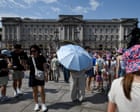
The rain in London doesn’t fall so much as it drifts, a fine gray mist that blurs the sharp edges of the Victoria Memorial. If you stand outside the iron gates of Buckingham Palace on any given Tuesday, you will see them. Hundreds of people from every corner of the globe, noses pressed against the metal, staring at a massive, silent block of Portland stone. They are waiting for something. A glimpse of a guard, a flutter of a flag, a sign of life.
To most of the world, this building is a postcard. It is a static symbol of unchanging tradition. But if you walk through the side entrances right now, past the security checkpoints and into the labyrinth of the East Wing, the illusion of timeless stillness shatters.
The air smells of sawdust, beeswax, and old plaster.
The sound isn't the crisp snap of a military march, but the whine of drills and the low murmur of structural engineers debating the load-bearing capacity of a floor laid down when Queen Victoria was a worried young mother.
Buckingham Palace is changing. Not just its plumbing—though miles of vulcanized rubber wiring and lead pipes are finally being ripped out—but its very philosophy. The grand old house is trying to figure out how to survive the twenty-first century without losing the magic that makes people stand in the rain just to look at its windows.
The Secret Geometry of Statecraft
We tend to think of palaces as museums where people happen to sleep. It is the opposite. A palace is a machine for soft power.
Consider a hypothetical diplomat named Elena. She has spent fourteen hours on a flight, her mind cluttered with briefing notes on trade tariffs, carbon taxes, and tense geopolitical alliances. She is exhausted, cynical, and guarded.
When Elena steps through the Grand Entrance of Buckingham Palace, the architecture begins to do its work. Her footsteps echo on the marble. She ascends the Grand Staircase, beneath the gazes of gilded portraits, flanked by historic tapestries. By the time she reaches the State Rooms, her posture has shifted. The environment has signaled to her, without a single word being spoken, that she is part of something much larger than a temporary political skirmish. She is participating in history.
This is the invisible work of the State Rooms. They are theater spaces where treaties are greased by the sheer weight of historical atmosphere.
But theater requires a backstage. For decades, that backstage has been failing. Behind the silk hangings and the masterpieces by Rembrandt, the building’s veins were clogging. Think about the anxiety of hosting a dinner party for your boss, then multiply that by every head of state on earth. Now imagine doing it while knowing the wiring behind the wall was installed before the Blitz and could spark at any moment.
The current ten-year reservicing project, a massive undertaking costing hundreds of millions of pounds, isn’t about luxury. It is about keeping the machine running. It is the architectural equivalent of open-heart surgery on a patient who refuses to lie down. Workers have had to lift thousands of historic floorboards, tag them with microscopic precision, map the labyrinth of ancient joists, and lay down miles of modern, fire-safe infrastructure, all while the daily business of the monarchy hums along just a few walls away.
The East Wing Shift
For generations, the East Wing has been the Great Shield. It is the front face of the palace, the part that features the famous balcony where the royal family gathers during moments of national celebration or grief. It was built by Thomas Cubitt in the mid-nineteenth century to accommodate Queen Victoria’s growing family, paid for by the sale of the Royal Pavilion in Brighton.
Until recently, it was largely a private domain. It housed offices for administrative staff, bedrooms for courtiers, and corridors filled with the immense, eclectic collection of Asian art acquired by King George IV. It was a place of hushed tones and closed doors.
Now, those doors are opening.
In a shift that speaks volumes about the modern monarchy's desire to appear accessible rather than aloof, tourists are being allowed into the Principal Corridor of the East Wing. It is a logistical nightmare wrapped in an ideological victory.
Imagine the friction. On one hand, you have the security apparatus of a working head of state. On the other, you have a family from Ohio who just wants to see the yellow drawing room and understand what Chinese imperial porcelain looks like up close.
Balancing those two realities requires more than just new tour guides. It requires a complete reimagining of the palace's internal geography. Offices are being consolidated and moved. Administrative staff who once occupied historic rooms with views of the Mall are being relocated to more efficient, modernized spaces within the complex. The palace is learning to share its space, recognizing that its ultimate survival depends not on how well it keeps people out, but on how graciously it lets them in.
The Ghost of George IV's Spending Spree
To understand why the East Wing looks the way it does, you have to understand George IV. He was a man of spectacular, ruinous tastes. He possessed an obsession with Chinoiserie—the European interpretation of Chinese and Japanese artistic styles—that bordered on manic.
When he remodeled the Royal Pavilion in Brighton, he filled it with staggering quantities of highly decorative furniture, pagodas, and silk wall hangings. When his successor, William IV, gave up the Pavilion, and Victoria decided to expand Buckingham Palace, those treasures were packed into crates and moved to London.
The East Wing was designed specifically to house them.
Walking down the Principal Corridor today, after its careful restoration, is an exercise in sensory overload. The intense reds, the vibrant blues, the delicate gold leafing on imperial dragons. It feels entirely un-English, a vibrant explosion of color hidden behind the austere, gray facade that faces the public.
Conservators spent months cataloging, cleaning, and restoring these pieces. It wasn’t just a matter of dusting them off. Organic materials like silk and lacquer degrade under the harsh glare of modern lighting and the moisture brought in by thousands of human breaths. The restoration required installing sophisticated, hidden climate control systems that protect the art without violating the aesthetic integrity of rooms designed in the 1840s.
It is a delicate dance between preservation and presentation. If the rooms are too dark, the public can't see them. If they are too bright, the fabric rots. The solution lies in advanced, fiber-optic lighting woven into the existing fixtures, mimicking the soft glow of candlelight while emitting zero destructive heat.
The Cost of Staying Relevant
There is a natural skepticism that arises whenever public money is spent on old stones. Why fix a palace when hospitals need funding? Why worry about the wiring in a royal ballroom when people are struggling to pay their heating bills?
It is a fair question. It is an argument that anyone who loves history must face honestly.
The answer lies in understanding what a nation keeps when it keeps its heritage. If Buckingham Palace were allowed to decay, if a catastrophic fire caused by faulty 1950s wiring were to destroy the East Wing, the loss wouldn't just belong to the Crown. It would belong to the collective memory of the country.
The palace is an economic engine. The millions of visitors who travel to London every year don't just stand outside the gates; they buy train tickets, they book hotel rooms, they eat in local restaurants, and they visit museums. The infrastructure of British tourism is anchored heavily by the stone walls of SW1A 1AA.
By investing in the physical structure of the palace, the state is protecting an asset that pays dividends far beyond the royal family's personal comfort. The current renovations ensure that the building can handle the physical wear and tear of increased public access. It is a transition from a private fortress to a public cultural hub, a slow-motion democratization of space that allows the public to claim ownership over the history contained within the walls.
The View from the Balcony
If you stand in the center of the East Wing's principal corridor and look toward the west, you see the quiet, private courtyard of the palace. If you turn east, you face the heavy timber doors that lead to the central balcony.
Behind those doors lies a small, surprisingly ordinary room. It is the staging area for history.
For over a century, since the tradition began, members of the royal family have waited in this room, adjusting uniforms and smoothing dresses, listening to the dull roar of tens of thousands of people waiting on the tarmac below. Then, the doors open, the light pours in, and they step out into the gaze of the world.
The physical balcony itself has required stabilization. The stone, battered by London’s acidic air and decades of damp weather, has been carefully treated by stonemasons who use techniques unchanged since the Middle Ages, supplemented by modern structural scanning.
When the next great national moment arrives, and the family steps out onto that ledge, the world will see the same familiar scene. The red tunics, the waves, the low flypast of aircraft. They won't see the carbon-fiber reinforcements beneath the stone, the fire-suppression systems hidden in the ceiling voids, or the complex web of digital cables running beneath the floorboards.
They won't see the thousands of hours of labor by electricians, historians, plasterers, and curators who spent years working in the dust to ensure that the stage remains secure.
The triumph of the Buckingham Palace renovation is that, when it is complete, the average observer won't notice that anything has changed at all. The building will simply endure, a functional piece of living history that managed to modernize its heart without losing its soul. The gray mist will still fall, the crowd will still watch the gates, and the great stone house will continue its quiet, complicated work of standing still in a world that never stops moving.


