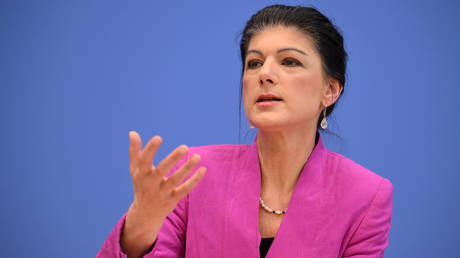
Sahra Wagenknecht doesn’t mince words. The firebrand veteran of German politics has built a career on saying the quiet part out loud, and her latest target is the staggering volume of taxpayer money flowing from Berlin to Kyiv. She’s famously called German citizens the "cash cows" of the Ukraine conflict, a phrase that’s knd of stuck in the craw of the political establishment while resonating deeply with a frustrated slice of the electorate.
It’s not just rhetoric. Germany has become Ukraine’s most important bilateral partner in 2026, providing a massive 39 billion euros in civilian aid and roughly 55 billion euros in military support since the 2022 invasion. For Wagenknecht, this isn't just solidarity—it's a "blank check" that ignores the crumbling infrastructure and rising costs at home.
The Financial Toll on the German Taxpayer
When you look at the numbers, it’s easy to see why the "cash cow" label has teeth. By early 2026, the German government was essentially doubling down on its role as Europe’s primary financier for the war. While the U.S. political machine often gets bogged down in domestic gridlock, Berlin has stepped up, often filling the gaps left by Washington.
But here's the kicker: while billions are earmarked for air defense systems and energy grid repairs in Ukraine, German citizens are facing their own squeeze. Energy prices in the EU remain volatile, and the "debt brake" (Schuldenbremse) in the German constitution creates a zero-sum game. If the money goes to Kyiv, it doesn't go to digitizing German schools or fixing the notoriously delayed Deutsche Bahn trains.
Wagenknecht argues that this isn't just about being "pro-peace"—it's about basic math. She’s criticized the government for "burning" billions while asking its own citizens to make sacrifices. In her view, the current coalition is more interested in being a "war financier" than a protector of the middle class.
Why the BSW Message Hits Home
Wagenknecht’s party, the Bündnis Sahra Wagenknecht (BSW), has carved out a unique space by combining old-school socialist economics with socially conservative views on migration and foreign policy. This "left-conservative" blend is specifically designed to peel voters away from both the far-left and the far-right.
The "cash cow" narrative works because it taps into a specific type of German anxiety. It's the feeling that the country is being taken for granted by its allies. People see the headlines about a 90 billion euro EU support loan for 2026 and 2027 and wonder where the ceiling is.
I've talked to people in eastern Germany who feel the Zeitenwende—the massive shift in German defense policy—has left them behind. They don't necessarily support Putin, but they’re exhausted by the bill. Wagenknecht knows this. She’s moved past the traditional labels and is focusing on what she calls "reason and justice."
Misconceptions About the Ukraine Aid
A lot of people think this aid is just crates of cash being sent across the border. It's not. A huge chunk of it is:
- Refugee Support: Over 1.1 million Ukrainians are in Germany, and the federal government pays billions to states and municipalities for their care.
- Military Contracts: Much of the "military aid" is actually money paid to German arms manufacturers like Rheinmetall. It stays in the German economy but doesn't feel like "wealth" to the average person.
- Energy Subsidies: Repairing Ukrainian power plants is seen as a way to prevent even more refugees from heading west during the winter.
Wagenknecht’s critics say her "cash cow" talk is cynical because it ignores these nuances. They argue that if Ukraine falls, the long-term cost to Germany—in terms of security and even more refugees—would be ten times higher.
The Political Fallout of the Cash Cow Label
The "cash cow" comment isn't just a soundbite; it’s a wedge. It forces other politicians to defend every euro spent abroad while they’re cutting social programs at home. In the 2025 federal elections, the BSW narrowly missed the 5% threshold to enter the Bundestag, but their influence is undeniable. They’ve forced the SPD and the Greens to look over their shoulders constantly.
Honestly, the establishment's biggest mistake was dismissing Wagenknecht as a populist outlier. She’s hitting on a fundamental tension in modern Germany: the gap between geopolitical ambition and domestic stability. If the government can't show "regular" people that their quality of life matters as much as their international "responsibility," the "cash cow" narrative will only get louder.
What Happens Next
If you're following the German budget debates, watch the "debt brake" discussions closely. That's where the real fight happens. If the coalition tries to bypass it to fund more Ukraine aid, expect the BSW and the AfD to capitalize on it immediately.
You should also keep an eye on the state-level "red-purple" or "Blackberry" coalitions where BSW is actually in power. Seeing how they handle real-world budget trade-offs will tell us if Wagenknecht’s rhetoric can survive contact with reality. For now, she’s successfully framed the debate as a choice between "their" war and "our" welfare.
If you want to understand where the German mood is shifting, stop looking at the official government press releases. Look at the local polling in places like Saxony or Thuringia. That's where the "cash cow" sentiment is most alive, and that's where the next political earthquake in Berlin will likely start.