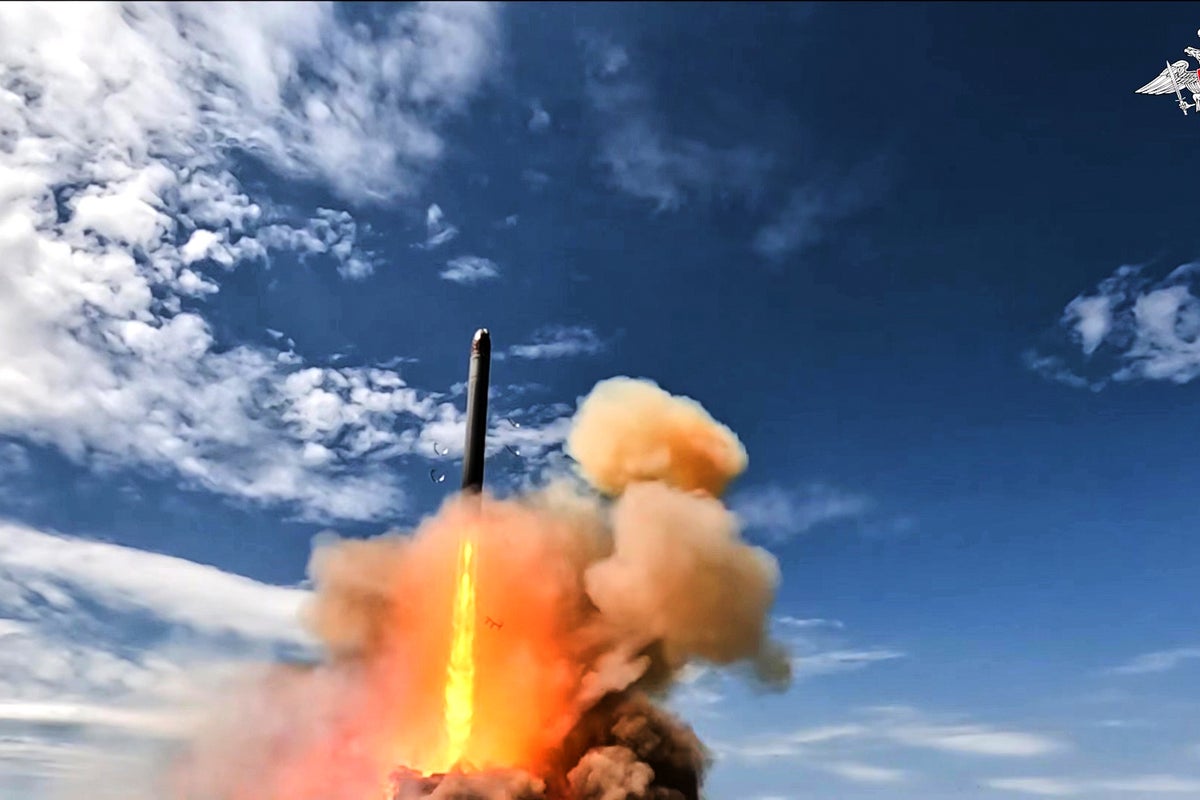
The successful May 12, 2026, test launch of the RS-28 Sarmat from the Plesetsk Cosmodrome signifies more than a routine modernization of Russia’s nuclear triad. It represents a fundamental shift in the geometry of global nuclear deterrence. By achieving a verified suborbital trajectory with a range exceeding 35,000 kilometers, the Sarmat—designated "Satan II" by NATO—effectively renders the traditional Arctic-centric missile defense architecture obsolete. The weapon is not merely a replacement for the aging R-36M2 Voyevoda; it is a specialized tool designed to exploit the geographic and technological gaps in Western interception networks.
The Tri-Axis Threat: Range, Trajectory, and Throw-Weight
The operational utility of the RS-28 is defined by three distinct technical pillars that separate it from standard Intercontinental Ballistic Missiles (ICBMs). Meanwhile, you can find related developments here: The Dragon and the Silicon King.
1. Southern Polar Navigation
The most significant strategic variable is the Sarmat’s ability to execute a Fractional Orbital Bombardment (FOBS) profile. Conventional ICBMs follow a predictable parabolic arc over the North Pole, a path heavily monitored by the U.S. Ground-based Midcourse Defense (GMD) systems in Alaska and California. The Sarmat’s 35,000-kilometer range allows for a southern polar trajectory, approaching the United States or European targets from the South Pole.
This creates a structural blind spot. Existing terrestrial radar and interceptor batteries are oriented toward the northern horizon. Reorienting these defenses to cover 360 degrees of arrival vectors requires a capital-intensive overhaul of the entire global sensor net, a process that lags years behind the Sarmat's 2026 deployment schedule. To understand the complete picture, check out the excellent report by Gizmodo.
2. The Payload Multiplier
The Sarmat is a heavy, liquid-fueled missile with a throw-weight of approximately 10 tons. This massive lifting capacity facilitates a diverse and high-density payload configuration:
- MIRV Saturation: It can carry 10 to 15 Multiple Independently Targetable Re-entry Vehicles (MIRVs).
- Hypersonic Integration: The system is designed to deploy the Avangard hypersonic glide vehicle, which maneuvers at speeds exceeding Mach 20 during the terminal phase to bypass Aegis and THAAD interceptors.
- Countermeasure Density: A significant portion of the 10-ton payload is dedicated to "penetration aids"—decoys and electronic jammers that mimic the signature of real warheads, overwhelming the processing capacity of interceptor fire-control computers.
3. Accelerated Boost Phase
Liquid-fueled engines typically suffer from longer preparation times compared to solid-fueled counterparts. However, the RS-28 utilizes a "cold launch" silo system and advanced propulsion that minimizes the boost phase—the period when a missile is most vulnerable to space-based infrared detection and boost-phase interception. By clearing the atmosphere rapidly, the Sarmat reduces the window of time for satellite-based tracking to establish a firm lock.
Operational Deployment and Tactical Realities
The first regiment of RS-28 missiles is scheduled to enter combat duty at the Uzhur unit in the Krasnoyarsk region by the end of 2026. This location is strategically selected for maximum survivability and reach.
Strategic Deep-Tissue Positioning
Uzhur is situated deep within the Siberian interior, beyond the reach of most conventional standoff weapons and stealth aircraft. This geographic shielding ensures that the Sarmat remains a viable second-strike asset even if the primary command nodes are degraded. The transition from the R-36M2 to the RS-28 at this location ensures continuity in the Strategic Missile Forces (RVSN) while providing a quantum leap in strike flexibility.
The Maintenance of Strategic Parity
The expiration of the final bilateral nuclear arms pact in February 2026 created a regulatory vacuum. The Sarmat is the Russian response to this environment. Its development serves as a hedge against U.S. advancements in Conventional Prompt Global Strike (CPGS) and the expansion of the Aegis Ashore systems in Eastern Europe. The Russian doctrine posits that if a missile defense system can theoretically intercept 90% of incoming warheads, the Sarmat provides the remaining 10% with enough maneuverability and volume to ensure total target destruction.
Technical Constraints and Engineering Risks
While the Sarmat is a high-capability platform, it is not without systemic vulnerabilities. The reliance on liquid fuel (hypergolic propellants) introduces complexity in long-term storage and handling. Unlike solid-fueled missiles like the American Minuteman III or LGM-35A Sentinel, which can remain in a launch-ready state with minimal maintenance, liquid-fueled ICBMs require sophisticated thermal management and corrosion monitoring within the silo.
The program has also faced significant developmental hurdles, including documented silo-based explosions during the 2024 testing cycle. The May 2026 success validates the design but does not erase the high maintenance overhead required to keep a fleet of 40 "heavy" ICBMs operational.
The Economic Attrition Logic
The deployment of the RS-28 forces a shift in the cost-benefit analysis of missile defense. For an adversary to counter a single Sarmat carrying 15 MIRVs and dozens of decoys, they must theoretically fire 30 to 45 interceptors to achieve a high probability of kill (Pk). Since each interceptor often costs as much as or more than the individual warheads they target, the Sarmat acts as an economic attrition weapon. It compels the opponent to spend exponentially more on defense than Russia spends on the offensive platform.
This creates a strategic bottleneck for NATO. Investing in a "Southern Shield" to counter the FOBS capability would require tens of billions of dollars in new radar installations and interceptor silos across the Southern Hemisphere or on mobile sea platforms. By fielding the Sarmat, Russia effectively forces a multi-decade, high-cost reaction from its rivals.
The RS-28 Sarmat is not merely a bigger bomb; it is a specialized geographic and economic bypass. As the first regiment becomes operational in late 2026, the primary challenge for Western strategic planners will not be the yield of the warheads, but the fundamental inability of current infrastructure to track and intercept a suborbital threat originating from the southern horizon. The strategic play is now a required investment in space-based sensor layers, as terrestrial-based defense has reached its logical limit of effectiveness against this specific class of heavy ICBM.