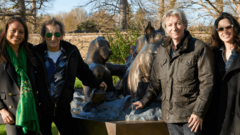
Ronnie Wood just parked a one-tonne reminder of rock history in the middle of the Wiltshire countryside. It isn’t every day you see a massive, shimmering tongue and lips logo sitting on the manicured lawns of an Elizabethan estate, but here we are. The legendary Rolling Stones guitarist has officially lent his "Stones Tongue" sculpture to Longleat, and frankly, it's a move that makes a lot of sense if you know anything about the man's obsession with art.
People often forget that before Ronnie was a Stone, he was a student at Ealing Art College. He isn't just a guy who doodles on setlists. He's a serious artist who happens to play guitar in the biggest rock band on the planet. This specific sculpture is a three-dimensional tribute to the iconic logo designed by John Pasche in 1970. It’s big, it’s bold, and it’s a bit ridiculous. It's perfectly Ronnie.
The story behind the one tonne tongue
If you're heading to Longleat to see the lions, you'll now find this giant piece of pop art standing as a sentinel near the main house. The sculpture itself is a massive version of the "Tongue and Lips" design. While the original logo was famously inspired by the Hindu goddess Kali—and Mick Jagger’s mouth—this physical version is all about the energy of the 1960s and 70s.
Why Longleat? The connection isn't as random as it looks. The Ceawlin Thynn, the 8th Marquess of Bath, has a long-standing friendship with Wood. There's a shared appreciation for the eccentric and the grand. Longleat has always been a bit "rock and roll" for a stately home. It was the first place in the UK to open a safari park outside of Africa. It has a history of doing things differently. Bringing in a piece of Rolling Stones iconography fits that mold of breaking tradition.
Wood’s sculpture arrived at the estate as part of a wider celebration of his artwork. For fans, it's a rare chance to see how the band's visual identity translates into something tangible. You can feel the weight of it. Literally. A tonne of steel and fiberglass isn't easy to move, and seeing it against the backdrop of 16th-century architecture creates a weird, wonderful contrast.
Ronnie Wood is more than a rock star with a paintbrush
I’ve seen plenty of "celebrity art" over the years. Usually, it’s mediocre stuff sold at high prices because of the name on the canvas. Wood is different. He’s been painting as long as he’s been playing. When you look at his work, you see the movement. He captures the chaos of a Stones rehearsal or the quiet intensity of a backstage moment.
This sculpture represents a shift from the canvas to something more architectural. It’s an evolution. He’s taking the most recognizable brand in music history and making it a physical landmark. He’s stated before that painting is a "restorative" process for him, a way to escape the madness of touring. But this sculpture isn't quiet. It’s a statement.
The Pasche connection and the 50 pound logo
Let’s get the history right because people always mess this up. Many people think Andy Warhol designed the Stones logo because he did the Sticky Fingers album cover. He didn't. It was John Pasche, a student at the Royal College of Art. The band paid him £50. It’s arguably the most valuable piece of graphic design in history, and Wood’s sculpture is a direct homage to that specific bit of genius.
By turning it into a three-dimensional form, Wood is reclaiming the image for the band. It’s no longer just a sticker on a flight case or a print on a t-shirt. It’s a monument.
Seeing the sculpture for yourself
If you're planning a trip, don't just snap a selfie and leave. Look at the lines. The sculpture is designed to be viewed from all angles, and the way the light hits the red finish changes throughout the day. It’s positioned to catch the sun, which makes that iconic red pop against the green of the Wiltshire hills.
- Location: Near the main entrance of Longleat House.
- Size: Over six feet tall.
- Material: Mixed media including reinforced fiberglass and steel.
The exhibition at Longleat isn't just about the big tongue, though. It’s a window into Wood’s private world. There are paintings, sketches, and personal notes on display. It’s a bit like getting a backstage pass to his brain. You see how he views his bandmates. He paints Keith Richards with a jagged, rough energy and Charlie Watts with a precise, rhythmic elegance. It’s insightful stuff.
Why this matters for Longleat and the arts
Stately homes in the UK are often seen as dusty museums. They're places where you look at old oil paintings of people in wigs. Longleat is trying to kill that perception. By hosting contemporary, rock-inspired art, they're staying relevant. They’re bringing in a crowd that might not care about 400-year-old tapestries but will drive two hours to see something related to the Rolling Stones.
It’s a smart strategy. It’s also a reminder that art shouldn't be confined to stuffy galleries in London. Putting a massive sculpture in the middle of a safari park is brilliant. It’s accessible. You don't need an art history degree to appreciate a giant red tongue. You just need to have heard Gimme Shelter once in your life.
How to get the most out of your visit
Don't just rush through. The estate is huge, and the art is spread out.
- Check the weather. The sculpture is outdoors, and the colors look best under a clear sky.
- Look for the sketches. While the sculpture is the star, Wood’s charcoal sketches of the band are where the real skill shows.
- Combine the trip. You’re already there for the animals, so make a day of it. The juxtaposition of a tiger and a Rolling Stones logo is a peak British experience.
Wood’s loan to Longleat is a temporary thing, so don't wait too long. It’s a rare moment where rock history and British heritage collide in a way that isn't boring. It’s loud, it’s heavy, and it’s very Ronnie Wood. Go see it before he decides he wants it back in his garden.
Check the Longleat website for the exact dates of the exhibition and ticket availability. If you're a fan of the band, this is a non-negotiable stop on your summer list. Grab a ticket, head to Wiltshire, and stand in the shadow of a rock icon.