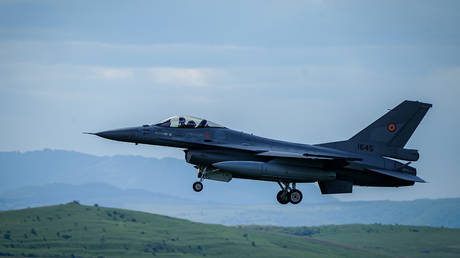
Shooting Down a $20,000 Drone With a $60 Million Jet Is Strategic Defeat
The headlines celebrate a tactical victory: air defense scrambles, a fighter jet locks on, a threat is neutralized. Headlines call it a triumph of readiness and NATO integration.
They are wrong.
Celebrating the kinetic destruction of a cheap reconnaissance or loitering munition by a multi-million-dollar fighter jet reveals a fundamental misunderstanding of modern attrition warfare. When an advanced military deploys a high-end platform like an F-16 or Typhoon to destroy an uncrewed aerial vehicle (UAV) built with off-the-shelf electronics and commercial lawnmower engines, the side firing the missile is losing the economic war.
I have watched defense procurement officers spin these intercepts as proof of concept. It is not a proof of concept. It is a slow-motion depletion of Western air defense stockpiles disguised as vigilance.
The Asymmetric Cost Curve Demolishing Western Air Defense
Let us break down the brutal math that conventional defense commentary routinely ignores.
- The Attack Vector: An Iranian-designed Shahed-136 or similar regional surveillance drone costs anywhere from $20,000 to $50,000 to manufacture and deploy.
- The Intercept Vector: An AIM-9X Sidewinder costs roughly $400,000. An AIM-120 AMRAAM pushes past $1 million. Add the flight-hour cost of a fourth- or fifth-generation fighter jet—ranging from $15,000 to $40,000 per hour—and the math becomes absurd.
You are trading a million-dollar missile and precious flight-hours to destroy a target that costs less than a used sedan. The adversary does not need to hit a strategic asset to win that exchange; they just need you to press the launch button.
This is the asymmetry trap. When a border airspace violation occurs near the Danube or the Black Sea, military command structures face a dilemma: allow uncrewed platforms to violate sovereign airspace and risk intelligence gathering or accidental kinetic impact, or expend non-renewable stockpiles to project force. Choosing the latter every time creates a trajectory toward complete inventory exhaustion before a major war even starts.
Why Land-Based Guns and EW Are Being Sidelined
Why do air forces default to launching jets instead of utilizing localized electronic warfare (EW) or ground-based direct-fire weapons? Because military bureaucracies prioritize high-visibility deterrence over cost-effective defense.
A jet scramble makes a dramatic press release. A localized GPS-jamming grid or a static anti-aircraft gun emplacement like the Gepard does not carry the same political impact, even though the Gepard fires 35mm rounds costing a fraction of a guided missile's price tag.
The Misunderstanding of Air Sovereignty
Pundits argue that scrambled jets send a clear signal of resolve. That logic belongs to the Cold War.
- Deterrence requires an entity that fears loss. An autonomous or remotely piloted drone has no pilot to intimidate. Scrambling a crewed jet against an uncrewed platform does not deter the operator back in the control station; it gives them valuable telemetry on your response times, radar signatures, and interception vectors.
- Every scramble is an intelligence leak. When an interceptor radar paints a cheap surveillance drone, the drone's signal intelligence suite records the exact frequencies, response latencies, and tactical approaches of defender aircraft. You are paying a fortune to train your adversary's electronic warfare systems.
The Strategic Fix Strategy Commanders Refuse to Implement
To break this dynamic, frontline states must stop treating drone incursions as dogfights. The airspace defense protocol near active warzones needs a complete overhaul.
1. Mandate Cost-Proportional Engagement Thresholds
If the target lacks low-observable stealth features and travels under 150 knots, firing a radar-guided or high-end imaging infrared missile should require explicit command authorization. Commanders must be forced to account for asset depletion in real-time tactical decisions.
2. Deploy Layered, Low-Cost Interceptors at Borders
Instead of relying on multi-role fighters to police lower airspace, invest heavily in counter-UAV (C-UAV) ecosystems:
- Hard-kill drone interceptors: Small, fast, kinetic drones designed specifically to ram or net incoming threats at 1/10th the cost of a traditional missile.
- Directed Energy Weapons (DEWs): High-energy laser systems that reduce the marginal cost per shot to the price of the diesel generating the electricity.
- Ammunition-based automated guns: Radar-directed gun systems covering high-risk transit corridors along international borders.
3. Accept Controlled Airspace Sinks
Not every target demands instant kinetic destruction. If an incoming platform is identified as a passive decoy or low-tier reconnaissance unit heading away from critical infrastructure, passive tracking and electronic spoofing are far superior to physical destruction. Forcing the adversary to guess whether their telemetry is real or manipulated yields a higher strategic return than creating a cloud of falling debris.
The Catch to Low-Cost Air Defense
Skeptics will point out the trade-offs, and they are real. Ground-based systems have limited horizon lines and cannot cover hundreds of miles of porous river borders like a patrolling fighter jet can. Electronic warfare can disrupt civilian GPS and aviation corridors if deployed indiscriminately. Furthermore, directed energy systems degrade rapidly in heavy fog, rain, or dense cloud cover—conditions common along eastern European borderlands.
These limitations are real. But relying on multi-million-dollar interceptor suites to clear $20,000 nuisance drones is not a strategy; it is a rapid depletion model masquerading as national defense.
The next time a press release boasts about a tactical jet eliminating a drone on the border, stop applauding. Start asking how many more of those missiles are left in the warehouse.
Stop using scalpel-priced air forces as sledgehammers against plastic drones. Ground the jets, turn on the jammers, and save the advanced munitions for the fight that actually matters.