High-speed robotic locomotion presents a distinct physics problem that standard engineering approaches struggle to resolve. When a mechanical biped accelerates down a track, the system must balance rapid ground force generation with structural survival under high-impact loads. Recent exhibitions at Chinese robotics competitions featuring bipedal sprinters breaking speed records highlight a fundamental tension in modern cybernetics: the trade-off between peak instantaneous velocity and thermal or structural degradation. To understand why these machines can shatter short-distance benchmarks while remaining fragile in extended use, one must deconstruct the mechanical anatomy of high-velocity robotics, the energy transfer systems that drive them, and the hard physical limits governing their acceleration.
The Mechanics of Bipedal Acceleration
Achieving sprint velocities in a bipedal robot requires an extreme optimization of ground reaction forces. Unlike wheeled systems that maintain continuous contact, a running robot alternates between flight phases and high-impact ground strikes. This introduces two distinct engineering constraints.
First, the actuator torque-to-weight ratio must exceed standard industrial thresholds. Every additional gram on a limb increases the rotational inertia, requiring exponentially more power from the hip and knee joints to cycle the leg forward during the recovery phase. The machines setting sprint records rely on specialized high-torque brushless motors paired with custom planetary gearboxes designed to maximize power density at the expense of continuous operational lifespan.
Second, the structural compliance of the leg assembly dictates how efficiently kinetic energy transfers into the ground. Rigid titanium or carbon-fiber frames prevent energy loss through flexure, but they concentrate shock loads directly into the gear teeth and motor shafts. When a robot hits the track with a force equivalent to several times its body weight, that energy must either be absorbed by active control algorithms, dissipated through mechanical springs, or managed by the raw structural integrity of the drivetrain.
The primary variables governing this phase include:
- Peak ground reaction force relative to structural mass
- Joint angular velocity during the swing phase
- Actuator thermal dissipation rates under maximum load
- Closed-loop sensor latency for real-time balance correction
Energy Density Versus Power Delivery
The core constraint limiting robot sprinters is not computational power; it is energy delivery. Traditional battery chemistries like lithium-ion possess high energy density, meaning they can store substantial total power over time. However, sprinting demands extreme power density—the ability to discharge massive amounts of current in fractions of a second.
To achieve record-breaking acceleration, these platforms typically utilize high-discharge lithium-polymer cells or auxiliary supercapacitors. Supercapacitors can release energy instantaneously without suffering the internal resistance heating that degrades chemical batteries during high-draw maneuvers.
[Energy Source: Supercapacitor/LiPo]
        │
        ▼ (High-Current Transient Burst)
[Inverter / Motor Controller]
        │
        ▼ (PWM Signal Optimization)
[High-Torque Actuator]
        │
        ▼ (Mechanical Transmission)
[Ground Reaction Force Spike]
This architecture creates a severe operational bottleneck. While the energy system can sustain a ten-second sprint, it cannot maintain that output for long distances. The thermal energy generated within the motor windings scales quadratically with current. Without active liquid cooling—which adds prohibitive weight—the copper coils approach critical temperature thresholds within seconds. Consequently, these record-breaking runs are engineered purely for explosive, short-duration bursts rather than sustained functional locomotion.
Control Systems and Closed-Loop Latency
Hardware capability remains useless without software capable of stabilizing an inherently unstable dynamic system. Bipedal running is a controlled fall. The robot must calculate its center of mass, predict foot placement errors, and adjust joint torques within milliseconds of every ground strike.
Modern sprint algorithms rely on model predictive control combined with reinforcement learning policies trained in simulation. The system continuously solves optimization problems over a short time horizon to determine the ideal torque commands for each motor.
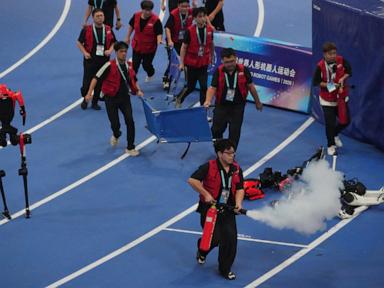
The system efficiency depends directly on sensor feedback loops. Inertial measurement units, joint encoders, and sometimes tactile sensors embedded in the feet feed data back to the onboard microcontrollers. If the processing latency exceeds five milliseconds, the robot cannot correct for micro-slips or uneven track surfaces, resulting in catastrophic structural failure or tumbling. This explains why sparks often fly during these demonstrations. When a control loop misses a single correction cycle, the foot placement drifts, the ankle joint twists under off-axis loads, and friction against the track generates thermal sparks from titanium structural elements scraping the surface.
The Operational Horizon for High-Speed Robotics
The utility of a robot sprinter extends far beyond competitive novelty. The underlying mechanics required to move a biped at high velocities directly inform the development of dynamic systems designed for disaster response, military logistics, and industrial automation on uneven terrain.
However, transitioning from a ten-second sprint on a controlled indoor track to reliable, high-speed outdoor navigation requires solving the durability paradox. The materials that make a robot fast—lightweight alloys, minimal safety factors, aggressive gear ratios—also make it fragile.
Future development will not be defined by higher top speeds, but by efficiency gains in thermal management and power conversion. Until engineers develop actuators that can deliver sprint-level torque without generating destructive internal heat, high-speed robotics will remain an impressive exhibition of transient physics rather than a practical deployment modality. Scale the operational duration, and the current architecture collapses under its own thermal and mechanical stress. The path forward demands a fundamental redesign of actuation technology, shifting away from brute-force electrical discharge toward material-level energy recuperation and structural intelligence.