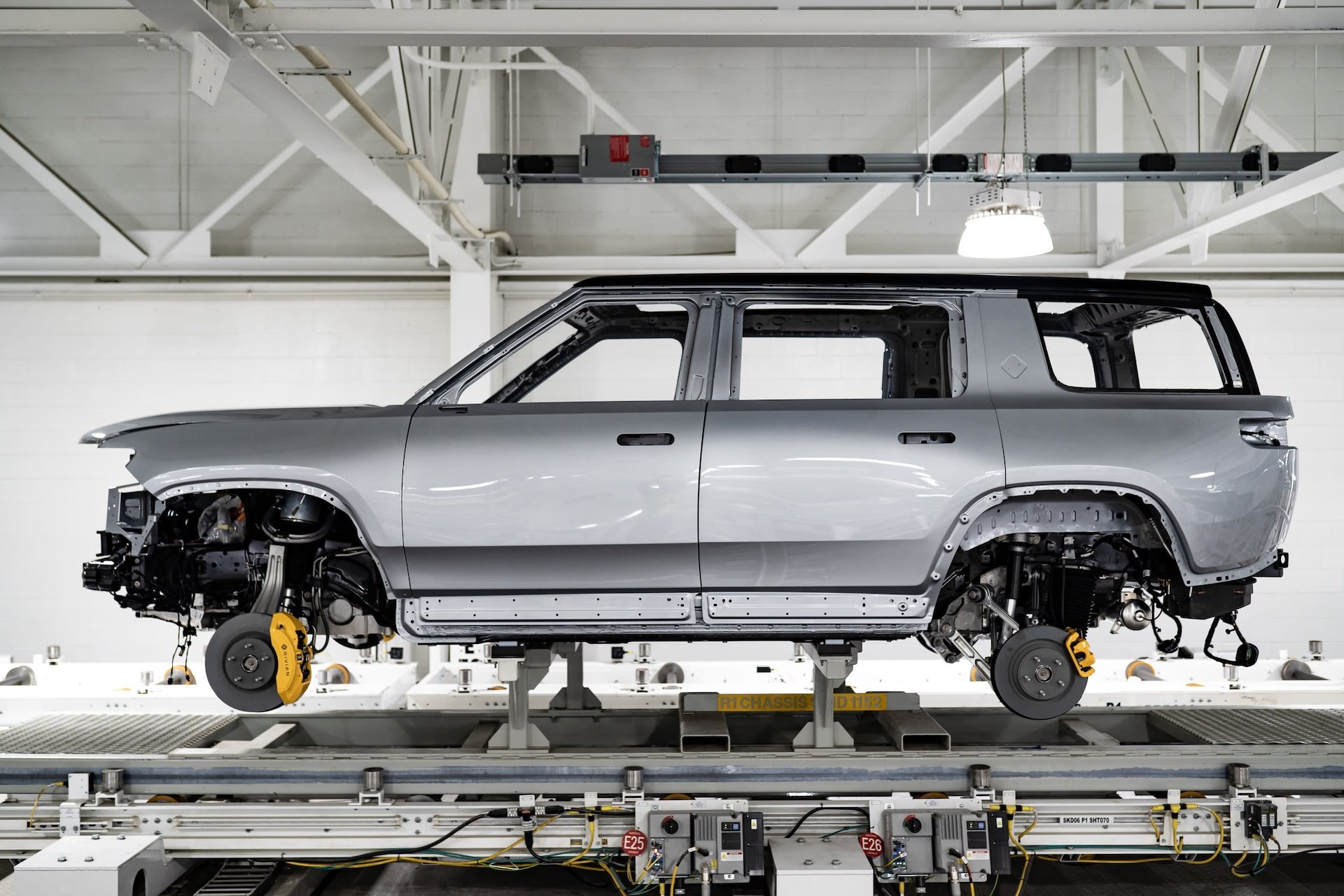
The tech press is mourning a $2.1 billion "loss" that doesn't exist. When Rivian announced it was trimming its Department of Energy (DOE) loan from $6.6 billion down to $4.5 billion, the consensus shifted instantly to a narrative of retreat. Critics smelled blood. Analysts whispered about cooling demand. They are looking at the spreadsheet upside down.
This isn’t a retreat. It’s a surgical strike against the bloated, inefficient capital structures that have turned the American EV sector into a graveyard for "disruptors." Scaling back the Georgia plant's initial capacity isn't a sign of weakness; it’s a sign of survival instinct in an industry that has forgotten how to value cash over vanity metrics.
The Myth of the Infinite Factory
The "lazy consensus" in automotive circles is that massive scale is the only moat. If you aren't building a "Giga-factory" capable of churning out 400,000 units on day one, you’re supposedly dead on arrival.
That logic is a relic of the zero-interest-rate era.
Building a $5 billion factory in Georgia to produce vehicles for a market that is currently undergoing a painful price war is an ego trap. By cutting the loan and the initial scope, Rivian CEO RJ Scaringe is doing something radical for a startup founder: he is practicing discipline.
Most EV startups—and even some legacy giants—treat government loans like free money. They aren't. They come with strings, reporting requirements, and rigid timelines that force companies to build for the sake of building. Rivian is choosing to build for the sake of selling.
Why the $4.5 Billion Figure is the Sweet Spot
Let’s talk about the cost of capital. Even "low-interest" government loans aren't "no-cost."
Every dollar Rivian borrows from the DOE is a dollar that must be serviced through the gross margins of the R2 and R3 platforms. By slashing $2 billion off the debt pile, Rivian effectively lowers its break-even point for the Georgia facility.
- Lower Debt Service: Interest payments don't care about your "vision." They care about your cash flow.
- Operational Agility: Smaller initial capacity means higher utilization rates. A factory running at 90% capacity of 200,000 units is a profit machine. A factory running at 45% capacity of 400,000 units is a bankruptcy waiting to happen.
- The R2 Pivot: By prioritizing the R2 launch at their existing Normal, Illinois plant, Rivian proved they can squeeze blood from a stone. The Georgia facility is now a secondary expansion phase, not a "do-or-die" gamble.
I’ve seen companies blow through hundreds of millions on "future-proofing" facilities for demand that never materialized. Lucid and Fisker (the second iteration) both fell into versions of the "capacity trap." Rivian is the first to publicly admit that the 2021 projections for 2026 demand were hallucinations.
The Fallacy of "EV Cooling"
The media loves the "EV demand is dying" headline. It’s simple. It’s scary. It’s also fundamentally wrong.
EV demand isn't dying; it’s maturing. The early adopters who would pay $90,000 for a R1S "Launch Edition" are all accounted for. The next 10 million buyers are looking at the $45,000 to $55,000 price bracket. That is where the R2 sits.
The competitor article suggests that renegotiating the loan is a reaction to a "tougher environment." No. It’s a reaction to a smarter environment.
The DOE’s Advanced Technology Vehicles Manufacturing (ATVM) program is designed to bridge the gap between "cool prototype" and "mass-market reality." By accepting $4.5 billion instead of $6.6 billion, Rivian is telling the market they can get to the R2 finish line with less help. In any other industry, a company saying "we need less debt to succeed" would be met with a standing ovation. In the distorted lens of EV tech, it’s treated as a red flag.
The Hidden Risk of Government Dependency
There is a dark side to these loans that no one wants to talk about: political volatility.
We are entering a cycle where federal support for green energy is a political football. Tying your company’s entire future to a $6.6 billion federal lifeline makes you a target. By reducing that exposure, Rivian de-risks its balance sheet from the whims of Washington.
If the political climate shifts and the ATVM program is scrutinized or clawed back, Rivian’s $2 billion reduction makes them more resilient than a competitor who is 100% leveraged against federal goodwill.
Precision Over Power
Legacy automakers like Ford and GM are currently hitting the brakes on their EV investments. They are "pivoting" back to hybrids because their massive internal combustion engine (ICE) infrastructures are too heavy to turn.
Rivian doesn't have an ICE anchor. Their only weight is their debt and their burn rate.
By shrinking the Georgia plan, they are increasing their "thrust-to-weight" ratio. They are focusing on the R2—a vehicle that actually addresses the mass market—rather than trying to build a monument to their own ambition in the Georgia clay.
The R2 platform represents a shift from "luxury outdoor brand" to "global volume player." You don't need a $6.6 billion debt facility to prove you can build a mid-sized SUV. You need a streamlined production line and a supply chain that doesn't leak cash.
The New Math of Manufacturing
Let's look at the mechanics of the Georgia plant. The original plan was a sprawling complex designed for a world where interest rates were 0% and every suburban dad was ready to trade his Tahoe for a quad-motor truck.
That world is gone.
The new math requires:
- Modular Expansion: Building in blocks. Don't build the second 200,000-unit line until the first one is printing money.
- Vertical Integration: Doing more in-house to capture the margin that usually goes to Tier 1 suppliers.
- Platform Commonality: Ensuring the R2 and R3 share enough DNA that the factory doesn't require a total overhaul to switch between them.
The $4.5 billion loan allows for exactly this kind of disciplined, phased rollout. It covers the essential infrastructure without over-committing to a future that hasn't arrived yet.
Stop Asking if Rivian Can Build 400,000 Cars
The industry keeps asking the wrong question. They ask, "When will Rivian hit full capacity in Georgia?"
The real question is: "When will Rivian make $1,000 of profit on every car they sell?"
Chasing volume before you've mastered unit economics is how you end up like the legacy players—selling EVs at a $30,000 loss per unit just to meet regulatory credits. Rivian’s recent "re-tooling" of the Normal, Illinois plant showed they are obsessed with the "per-unit" cost. They stripped out hundreds of parts, simplified the wiring, and improved the drive units.
If they take that same "lean" philosophy to a $4.5 billion Georgia plant instead of a $6.6 billion behemoth, they might actually become the first post-Tesla EV company to show a consistent profit.
The Actionable Truth
If you are an investor or a market observer, ignore the "loan reduction" as a headline of failure. Look at it as a "burn rate reduction."
Every billion dollars not borrowed is a billion dollars that doesn't need to be repaid with interest during the most volatile period in automotive history. Rivian is choosing to be a lean, mean, manufacturing machine rather than a bloated, debt-heavy ward of the state.
The market hates uncertainty, so it punished the stock. The market also used to hate Tesla's "production hell" and Apple's "lack of a headphone jack." The market is often wrong about the long game because it is obsessed with the next quarter's optics.
Rivian just bought themselves a longer runway and a more efficient plane. If you can't see the value in that, you're the one who’s lost.
Don't wait for the Georgia plant to be the biggest in the world. Wait for it to be the most profitable.
Build smaller. Build better. Win.