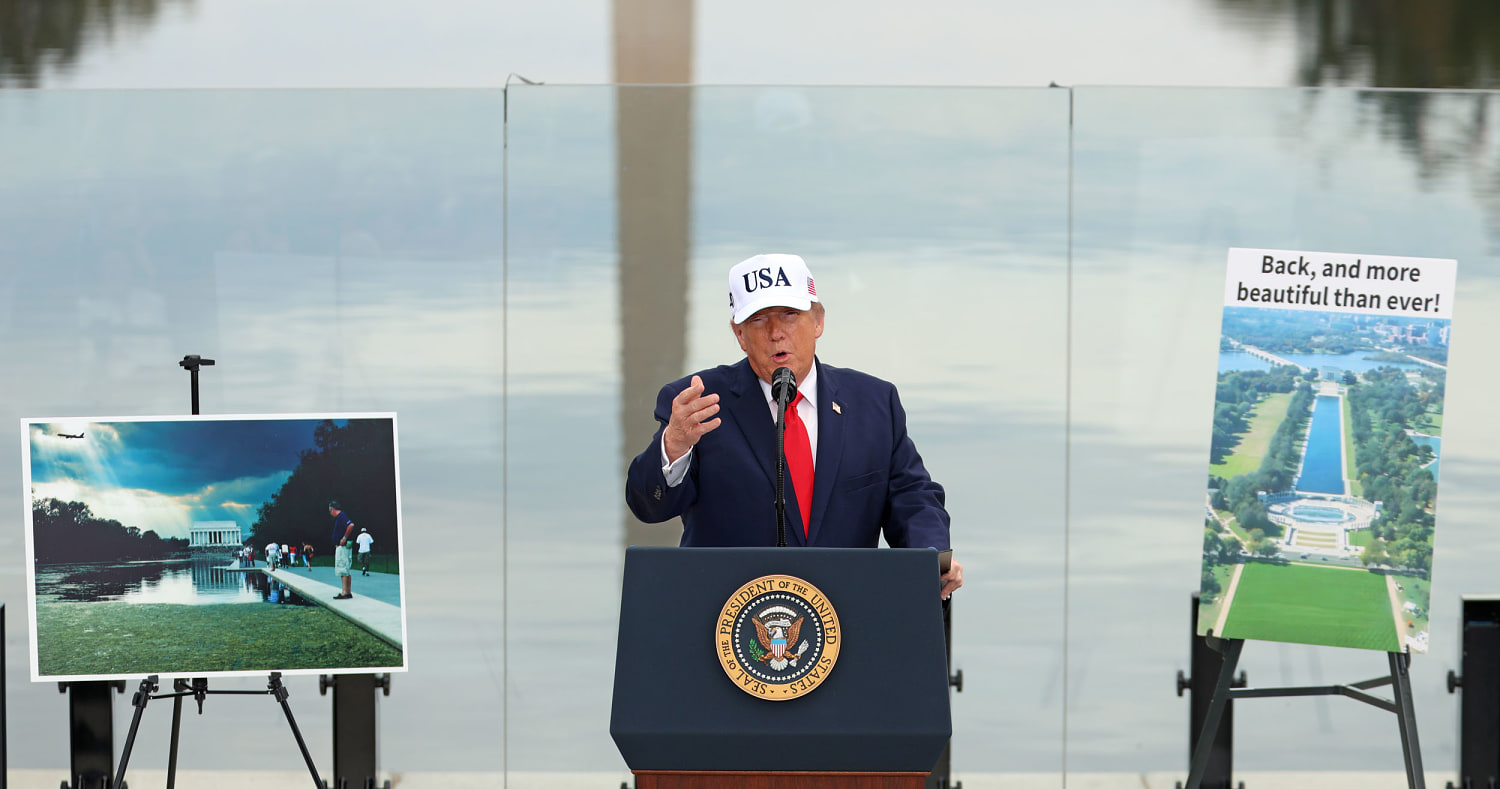
Political communication in the final seventy-two hours before a midterm election operates on a strict scarcity model: attention is saturated, persuasion windows have closed, and the sole remaining objective is base mobilization through symbolic framing. When Donald Trump dedicated significant airtime in his final pre-midterm public address to the condition, aesthetics, and maintenance of the Lincoln Memorial Reflecting Pool, conventional political reporting treated the detour as an erratic digression from core economic or legislative messaging. That interpretation misreads the mechanics of populist rhetoric. Focusing on a decaying or mismanaged national monument is not an off-script tangent; it is a deliberate application of tangible proxy theory, converting abstract governance failures into a concrete, visually verifiable symbol of institutional decline.
The Architecture of Symbolic Grievance
Standard political analysis assumes voters evaluate incumbents through macroeconomic indicators—inflation rates, employment figures, and legislative output. Yet behavioral political science demonstrates that late-cycle voters suffer from statistical fatigue. Abstract metrics require cognitive processing and are easily contested by partisan media ecosystems. Physical infrastructure, conversely, bypasses analytical friction.
By centering a final campaign speech on the Reflecting Pool—a centerpiece of the National Mall designed to mirror the Lincoln Memorial and the Washington Monument—the speaker executes a specific rhetorical substitution. The pool ceases to be a municipal maintenance issue managed by the National Park Service and becomes a physical diagnostic of national competence.
This mechanism relies on three operational components:
- Visual Verifiability: A claim about federal regulatory overreach cannot be photographed. Algae buildup, cracked masonry, or stagnant water in a prominent civic basin can be instantly visualized by any voter who has visited Washington, D.C., or seen broadcast footage of the National Mall.
- Custodial Accountability: In populist framing, the federal government is judged not as a complex policy apparatus, but as a property manager. If the incumbent administration cannot maintain the literal front yard of the American republic, the voter is invited to infer that it cannot manage border security, foreign alliances, or fiscal policy.
- Nostalgic Contrast: Monumental architecture is built to project permanence and order. Highlighting physical degradation introduces an immediate temporal contrast between a perceived golden era of national strength and a present state of administrative neglect.
Deconstructing the Broken Windows Theory of Governance
The strategic logic behind this rhetorical choice mirrors the criminological "broken windows" theory formulated by James Q. Wilson and George Kelling, adapted for federal politics. In urban policing, visible signs of disorder—unrepaired windows, graffiti, public neglect—signal a breakdown of social control, accelerating further decay. In campaign rhetoric, pointing to visible disrepair at the seat of federal power signals a breakdown of executive competence.
When a candidate bypasses standard talking points on tax policy or healthcare to critique the upkeep of the Reflecting Pool, the speech targets a specific psychological vulnerability in the electorate: status anxiety. Voters concerned about national decline look for confirming evidence in their immediate environment. Because most voters do not interact directly with federal trade negotiators or defense planners, they rely on heuristics. Civic monuments serve as the primary heuristic for state capacity.
The causal chain constructed in the speech follows a linear path:
- Premise: The National Mall represents the physical manifestation of American exceptionalism and historical continuity.
- Observation: Specific features within that space, such as the Reflecting Pool, exhibit visible signs of neglect, mismanagement, or aesthetic degradation.
- Attribution: Responsibility for this decay rests entirely with the current administrative apparatus and entrenched bureaucracy.
- Conclusion: Restoring national vitality requires replacing the current managers with an executive focused on visible, physical order.
Competitor media coverage frequently misses this causal chain because journalists evaluate speeches based on policy novelty. From a newsroom perspective, a critique of park maintenance offers zero policy substance. From a campaign strategy perspective, policy substance is counterproductive in the final days of a midterm cycle, as specific legislative proposals alienate marginal coalition members. Grievance over shared civic property carries zero policy risk while maximizing emotional resonance.
Narrative Disruption and Earned Media Economics
The timing of the speech—immediately preceding midterm voting—reveals an acute understanding of earned media economics. In the final week of an election cycle, campaign advertising reaches diminishing marginal returns. Television markets are saturated, voter ad-blindness peaks, and cost-per-thousand impressions (CPM) escalates sharply. To penetrate this noise without exhausting liquid capital, a campaign must generate high-velocity earned media.
Delivering a predictable stump speech on inflation or crime guarantees localized, routine coverage. Introducing an unexpected, hyper-specific fixation—such as the state of the Reflecting Pool—triggers a predictable journalistic reflex. Political reporters, trained to spot deviations from prepared remarks, amplify the anomaly. Cable news panels dissect the commentary to question the speaker's discipline, inadvertently broadcasting the core populist message to millions of viewers outside the rally's immediate geographic footprint.
This dynamic illustrates a fundamental asymmetry in modern political communication:
- Institutional Media Objective: Frame the candidate as unfocused, erratic, or detached from pressing voter concerns by highlighting non-traditional rhetoric.
- Campaign Objective: Hijack the news cycle to project an image of a leader uniquely attuned to the tangible, everyday details that Washington insiders ignore.
Both sides achieve their immediate content goals, but the campaign captures the strategic advantage. Even critical coverage reinforces the underlying visual contrast between a decaying capital and a candidate demanding physical restoration. The framing forces opponents into a defensive posture, compelling fact-checkers and administration defenders to debate the maintenance schedules of the National Park Service rather than their own legislative achievements.
Historical Precedents in Civic Aesthetics
Using architecture and public spaces as political weapons is neither novel nor accidental. Throughout modern political history, populist and nationalist movements have consistently weaponized civic aesthetics to critique ruling establishments.
During the late nineteenth and early twentieth centuries, American municipal reformers frequently used the physical squalor of public parks, waterworks, and civic plazas to dismantle entrenched political machines. The argument was identical: corruption and incompetence in high office inevitably manifest as physical rot in public spaces. Similarly, executive leaders seeking to project strength have historically prioritized rapid, visible infrastructure renovations over complex structural reforms because physical improvements yield immediate, undeniable political dividends.
Donald Trump’s professional background in commercial real estate development amplifies this tendency. In real estate, asset valuation is dictated by curb appeal, structural integrity, and visible maintenance. A developer evaluates management competence by inspecting the lobby, the landscaping, and the facade. Applied to the presidency, this operational lens treats the United States as a distressed property requiring immediate exterior renovation.
When Trump critiques the Reflecting Pool, he is speaking in his native professional idiom. To an electorate skeptical of career politicians, this idiom registers as authentic. Traditional politicians speak the language of legislation, appropriations, and committee oversight—terms that obscure individual accountability. A builder speaks the language of concrete, water quality, and physical upkeep—terms that establish clear, binary standards of success and failure.
Limitations of the Symbolic Proxy Strategy
While effective for base mobilization and media disruption, relying on symbolic proxies like the Reflecting Pool carries distinct operational limitations, particularly in a midterm election environment.
First, the attribution gap weakens the impact when the primary target is not on the ballot. Midterm elections are inherently fragmented, driven by local candidates, state-level economic conditions, and district-specific demographics. A sweeping critique of federal monument maintenance in Washington, D.C., holds high resonance in a presidential general election where the incumbent executive is directly accountable. In a midterm race, voters in swing suburban districts may struggle to connect the state of the National Mall to their local congressional representative.
Second, persuasion ceiling constraints limit the reach of grievance-based rhetoric. Base voters already primed to view the federal government as broken will immediately accept the Reflecting Pool as proof of systemic failure. However, undecided or independent voters—who typically decide tight midterm races—often prioritize immediate household balance-sheet issues over symbolic cultural grievances. For a voter calculating the monthly cost of groceries or mortgage rates, an extended critique of a Washington landmark can register as disconnected from their immediate material reality.
Third, verification vulnerability exposes the rhetoric to rapid counter-framing. Unlike broad ideological claims, assertions about physical infrastructure can be immediately audited. If the National Park Service has recently completed a multi-million-dollar filtration upgrade or basin restoration, rapid visual fact-checking can neutralize the rhetorical premise, shifting the narrative from administrative incompetence to factual inaccuracy on the part of the speaker.
The Structural Evolution of Late-Cycle Campaigning
The deployment of the Reflecting Pool motif signals a broader structural shift in how late-cycle political campaigns allocate rhetorical capital. Traditional campaign doctrine dictates a funnel approach: broad ideological themes in the spring, detailed policy contrasts in the summer, and strict get-out-the-vote (GOTV) logistics paired with core economic closing arguments in the autumn.
Modern attention fragmentation has inverted this model. Because media consumption is hyper-polarized, campaigns no longer need to construct logical, linear closing arguments designed to win over a mythical, unified public square. Instead, late-cycle speeches function as content generation engines designed to produce discrete, high-emotion video clips optimized for algorithmic distribution.
In this ecosystem, a three-minute tangent about stagnant water in front of the Lincoln Memorial outperforms a ten-minute exposition on supply-chain logistics. The tangent contains a clear villain (negligent bureaucrats), a sympathetic victim (the American taxpayer and national heritage), and a vivid mental image. Algorithmic feeds reward emotional clarity and visual specificity, ensuring that the symbolic critique travels further and faster than any policy white paper.
Strategic Execution for Political Communicators
Political strategists and institutional communicators analyzing this rhetorical maneuver must adjust their response frameworks. Treating symbolic tangents as mere distractions guarantees strategic failure.
To counter or replicate this approach effectively, campaigns must execute three specific protocols:
- Pre-Emptive Aesthetic Auditing: Incumbent administrations and municipal leaders must treat high-visibility civic assets not as line items in a maintenance budget, but as front-line political vulnerabilities. Deferred maintenance on symbolic landmarks creates asymmetric political risk; the cost of routine upkeep is negligible compared to the earned media damage of visible neglect during an election cycle.
- Immediate Visual Rebuttal: When an opponent weaponizes a physical proxy, text-based fact-checks are ineffective. Counters must deploy immediate, high-resolution visual evidence—live feeds, recent restoration footage, or side-by-side historical comparisons—to collapse the opponent's premise before the narrative solidifies in the news cycle.
- Material Anchoring for Swing Audiences: Challengers utilizing symbolic proxies must explicitly bridge the gap between the symbol and the voter's personal balance sheet within thirty seconds of introducing the metaphor. Failing to tether civic decay to household economic anxiety caps the message's utility at base turnout, forfeiting the marginal swing voters required to flip contested legislative districts.