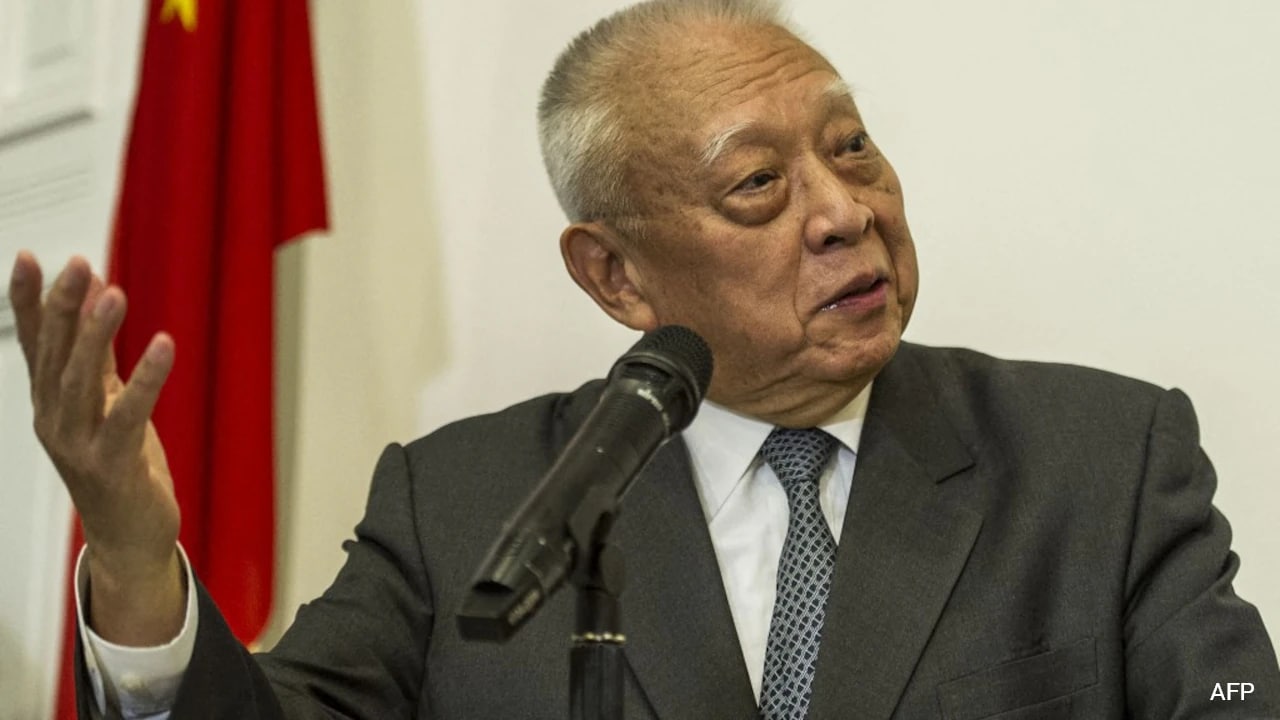
The rain in the summer of 1997 did not wash away the ghosts; it only made them slicker.
Imagine standing on the deck of a vessel caught between an empire sunset and a rising dragon. The air smells of wet asphalt, old tea, and salt from a harbor that has launched a thousand fortunes. For most of us watching from the crowded pavements of Causeway Bay, the transfer of sovereignty felt less like a celebration and more like holding our collective breath. We wondered who would dare to hold the wheel when the British colors finally came down and the red flag went up.
Enter Tung Chee-Hwa.
He was not a politician. He was a shipping magnate, a quiet man who wore tailored suits like armor and preferred the orderly ledgers of cargo containers to the messy theater of democratic debate. When Beijing tapped him to become Hong Kong's first Chief Executive, it felt like asking the captain of an oil tanker to navigate a category five hurricane in a canoe. He inherited a metropolis built on frantic energy, sudden wealth, and an uneasy, brilliant hustle.
History often chooses the wrong men for the sharpest turns.
To understand Tung is to understand the strange, bifurcated soul of Hong Kong itself. He was born in Shanghai, fled to Taiwan, studied in Britain, and built an empire that spanned oceans. He understood trade. He understood shipping lanes. But governing a city of six million fiercely independent souls who viewed authority with a mixture of cynicism and fierce pride is entirely different from moving dry goods across the Pacific.
The transition was never going to be gentle. Almost the moment he took office, the Asian Financial Crisis struck like a physical blow. Property values, the gravitational pull of local life, plummeted. Negative equity became a household phrase. People who had felt invincible suddenly found themselves owing more than their homes were worth. I remember walking past bakeries where the daily chatter shifted from stock tips to quiet, desperate whispers about job security.
Tung tried to fix it. His administration launched ambitious housing initiatives to build eighty-five thousand flats a year, aiming to break the stranglehold of astronomical property prices. It was a noble, necessary ambition. But the timing was catastrophic. The market crashed before the foundations could dry, and homeowners watched their life savings evaporate. The public anger was swift, unforgiving, and deeply personal.
He absorbed the blows with a stoic silence that many mistook for coldness. In Chinese culture, dignity often looks like impassivity. But in the modern media age, silence is a vacuum waiting to be filled by rage. Protests grew. The famous march of July 1, 2003, when half a million people flooded the streets under a blistering sun, was a watershed moment. They were not just marching against a proposed national security bill; they were marching against the growing disconnect between a boardroom style of leadership and a populace that demanded to be heard.
Through it all, Tung remained utterly consistent. Whether that consistency was a virtue or a fatal flaw depends entirely on who you ask. His supporters saw a dedicated patriot trying to stabilize a traumatized territory under an unprecedented "One Country, Two Systems" framework. His detractors saw a well-meaning executive out of his depth, clinging to colonial-era bureaucratic habits while the ground shifted beneath his feet.
When he stepped down in 2005, citing health reasons, the city exhaled. Yet, looking back from the vantage point of later decades, the narrative of his tenure looks far more complicated than the simple headlines of the early noughties suggested. He laid the groundwork for deeper integration with the mainland, for better or worse, and he steered the city through the terrifying valley of the SARS epidemic, standing shoulder-to-shoulder with medical workers when fear was the only currency that mattered.
Tung Chee-Hwa passed away at the age of eighty-nine, closing a chapter that feels increasingly distant in the neon-lit turbulence of modern Asia. He leaves behind a legacy written in sea salt, concrete, and compromise.
The harbor remains. The ferries still cross from Victoria Peak to Tsim Sha Tsui, cutting through the gray water with their steady, mechanical pulse. The ships still come and go, carrying steel, textiles, and the ambitions of millions. The man who first brought the city across that perilous bridge is gone, but the turbulent waters he navigated still shape the shores we walk today.



