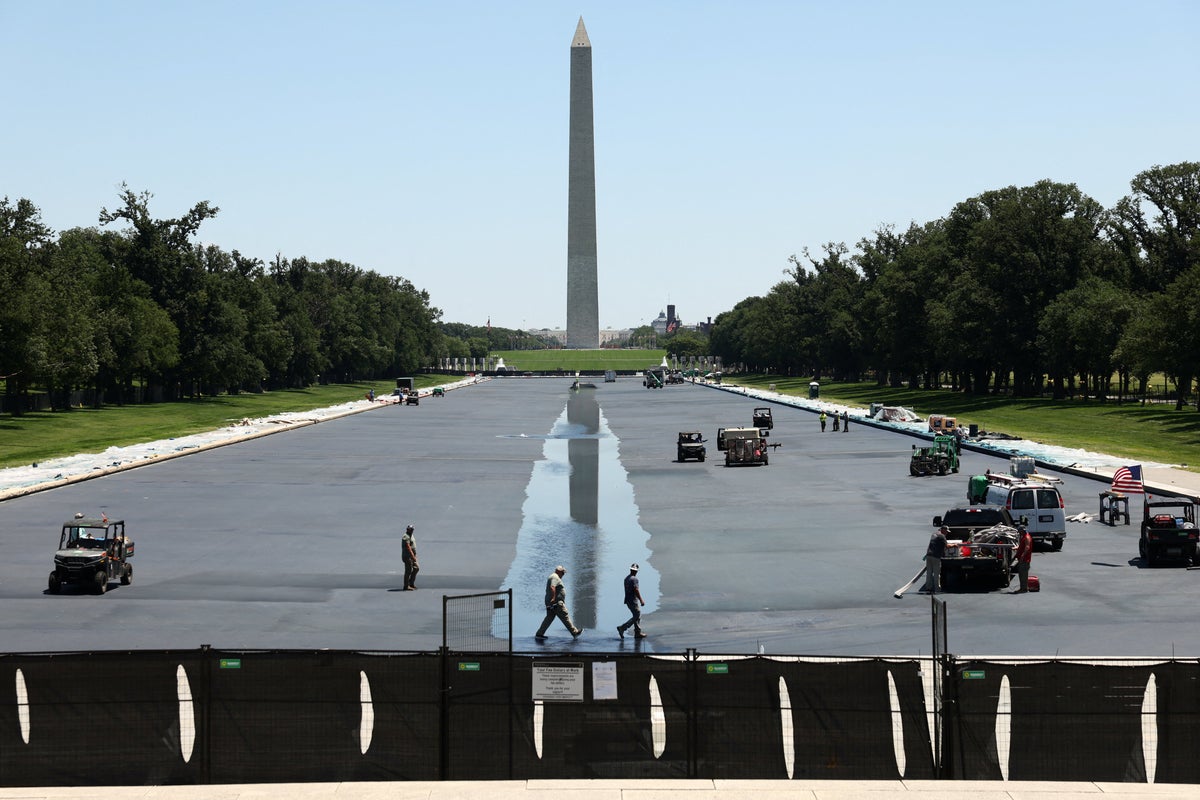
The media is collectively losing its mind because Donald Trump declared the National Mall Reflecting Pool restoration project complete while the basin sat bone dry. Outraged pundits are pointing at a concrete slab, screaming that a pool without water is a failure. They are fundamentally misinterpreting how modern civil engineering works.
They see an empty pool. I see a successful multi-million-dollar structural overhaul delivered on a massive scale.
The lazy consensus loves a superficial optics trap. To the untrained eye, a pool is only "done" when it splashes. In reality, the most critical, expensive, and complex phases of heavy civil engineering happen entirely beneath the surface. Demanding that a massive water feature be filled the exact second the structural crew packs up their tools is a fundamental misunderstanding of asset management, concrete curing, and municipal supply chains.
Stop judging infrastructure by its surface shine. Let us look at what actually matters.
The Engineering Realities the Critics are Ignoring
For decades, the Lincoln Memorial Reflecting Pool was an engineering disaster. It leaked hundreds of thousands of gallons of potable water directly into the swampy Washington D.C. subsoil every single week. It stagnant, bred mosquitoes, and relied on a broken system fed directly by the city's domestic water supply. Fixing it was never a matter of turning a giant faucet; it required a total systemic overhaul.
When a project manager declares a massive basin restoration "complete," they are talking about substantial completion of the structural, mechanical, and filtration infrastructure. They are certifying that the post-tensioned concrete slabs are poured, the waterproofing membranes are sealed, the supply lines are pressurized, and the ozone filtration plants are operational.
Throwing 7 million gallons of water into a newly treated basin immediately is the worst thing a contractor could do.
The Chemistry of Concrete and Sealants
New concrete and specialized elastomeric joint sealants require precise timelines to cure and reach full hydrostatic resistance. Pumping millions of gallons of water onto fresh compounds alters the chemical curing process, compromises the structural integrity of the joints, and risks triggering catastrophic subsurface leaks.
Furthermore, a dry basin allows for comprehensive dry-testing of the integrated electronic monitoring systems and structural load-bearing capacity before introducing the massive weight of the water.
- Total Capacity: Approximately 6.75 million gallons.
- Total Weight: Over 56 million pounds of water pressing down on the structural bed.
- The Risk: Filling the basin prematurely can cause uneven settling in the subgrade, cracking the newly laid concrete.
Why the Fill Phase is a Separate Operational Log
The media coverage frames the empty pool as a political lie or a logistical failure. It is neither. It is standard operational sequencing.
The National Park Service does not just hook up a garden hose to fill a 2,000-foot-long monument. Drawing millions of gallons from the municipal grid requires strict coordination with local water authorities to avoid dropping water pressure for surrounding neighborhoods, hospitals, and government facilities. It is a slow, metered, multi-day operational phase that occurs after the construction crews hand over the keys.
I have managed large-scale commercial builds where stakeholders demanded visual compliance before structural readiness. Every single time a executive forces a premature opening for the sake of a photo-op, the asset suffers. Cracks develop. Systems fail. The budget doubles. Waiting for the proper operational window to introduce water is the only fiscally responsible move.
Dismantling the Panic
Why would a leader say a project is finished if there is no water?
Because the contract with the construction firm is fulfilled. In heavy industry, a project is deemed complete when the engineering specifications are met and signed off by inspectors. The physical construction of the pool—the excavation, plumbing, filtration infrastructure, and masonry—is finished. The act of filling it is a routine maintenance task, not a construction milestone.
Is an empty pool a waste of taxpayer money?
The waste of taxpayer money was the old system, which leaked millions of gallons of treated city water every year. The dry basin represents the final stage of an eco-friendly upgrade that utilizes sustainable water sources and high-efficiency filtration. Rushing the fill process and ruining the seals would be the actual waste of public funds.
The Cost of Prioritizing Optics Over Substance
The obsession with immediate visual satisfaction is destroying how we evaluate public works. We routinely reward contractors who deliver flashy, rushed results that fail three years later, while penalizing rigorous, phased engineering that lasts for a century.
The empty Reflecting Pool is not a failure of execution. It is a failure of public literacy regarding heavy construction. The basin is dry because the engineering demands it, the curing schedules require it, and municipal logistics dictate it.
Stop demanding superficial compliance from complex structural engineering. The bones of the project are done. The water will come when the concrete is ready to hold it, and not a second before.