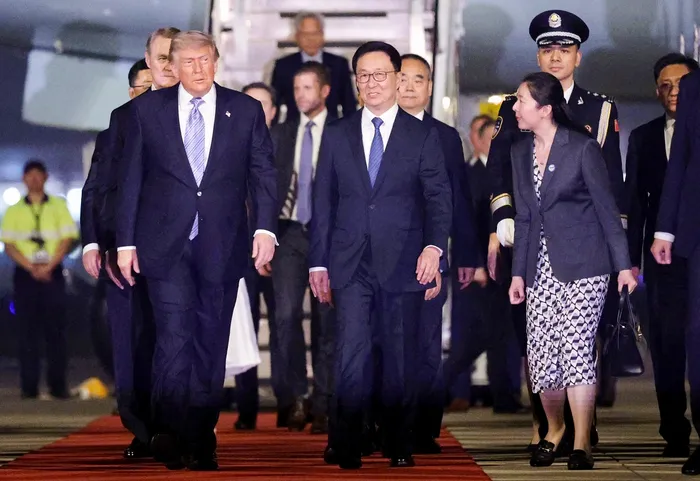
The air in Beijing during a state visit doesn't feel like normal air. It is heavy, scrubbed clean of its usual grit by decree, and unnervingly still. When the wheels of Air Force One touched down on the tarmac this week, the sound wasn't just the screech of rubber meeting concrete. It was the sound of two tectonic plates grinding together.
Donald Trump stepped out into a city that had been curated to a high gloss. He wasn't just meeting a counterpart; he was stepping into a theater where every handshake, every slight nod, and every missed glance carries the weight of billions of dollars and millions of lives. We often talk about "high-stakes summits" as if they are poker games played in mahogany rooms. They aren't. They are more like heart surgery performed during an earthquake. For another look, see: this related article.
The Ghost in the Room
While the cameras captured the practiced smiles and the orchestrated grandeur of the Great Hall of the People, the real story wasn’t on the red carpet. It was 110 miles across the water from the Chinese coast.
Taiwan is the invisible guest at every table in Beijing. For the American delegation, it is a democratic outpost and a vital link in the global supply chain—the place where the "brains" of our phones and fighter jets are born. For the Chinese leadership, it is a piece of a broken mirror they are desperate to glue back together. Further analysis on this trend has been provided by Reuters.
Imagine a family dinner where a long-lost sibling is the only thing anyone wants to talk about, but no one is allowed to say their name. That is the tension underlying the pleasantries. Trump arrives with the baggage of recent arms sales and diplomatic phone calls that have made Beijing’s skin crawl. Xi Jinping meets him with the quiet, immovable patience of a man playing a game that lasts centuries, not election cycles.
The friction isn't just about territory. It’s about the fundamental way the world works. If the silicon flow from Taiwan is interrupted, the "business as usual" of the West doesn't just slow down. It stops. Cold.
The Persian Shadow
But the world is too small for one crisis at a time. As the two leaders sat down to discuss trade imbalances and intellectual property, the scent of oil and woodsmoke drifted in from the Middle East.
Iran is the complication neither side can afford to ignore, yet neither side sees in the same light. To Washington, Tehran is a puzzle box of nuclear ambitions and regional defiance that must be sealed shut. To Beijing, Iran is a gas station and a strategic anchor on the far end of the Silk Road.
Consider the hypothetical merchant in a coastal Chinese province. His factory runs on energy that might come from the Persian Gulf. If the United States tightens the noose on Iranian exports, that merchant’s costs go up. His workers lose hours. His children’s tuition becomes a question mark. For Trump, the pressure on Iran is a moral and security imperative. For Xi, it is an unpredictable variable in a delicate economic machine.
They are haggling over the price of global stability, and the currency they are using is influence.
The Human Toll of Macroeconomics
It is easy to get lost in the jargon of "tariffs," "trade deficits," and "strategic ambiguity." These words are designed to be boring. They hide the reality that these decisions filter down to the most mundane parts of our lives.
When these two men disagree on a percentage point in a trade deal, it manifests as a farmer in Iowa staring at a row of silos filled with soybeans that have nowhere to go. It shows up as a tech worker in Shenzhen wondering if their company will be the next one placed on a restricted list.
The summit isn't a victory or a defeat. It is a temporary truce in a permanent struggle. The "high stakes" aren't just about who leads the world in 2030. They are about whether the person reading this can afford a mortgage in 2027.
History is rarely made by grand proclamations. It is made in the silences between sentences in a translation headset. It is made when two leaders realize that they are locked in a room together and neither has the key.
As the motorcade wound its way back through the emptied streets of Beijing, the lights of the city flickered with a frantic, artificial energy. The world watched the planes take off, looking for a sign of a breakthrough or a breakdown. But the truth is more complicated. The plates are still grinding. The tension hasn't vanished; it has just been repackaged and filed away for the next meeting.
The red carpet has been rolled up. The razor edge remains.