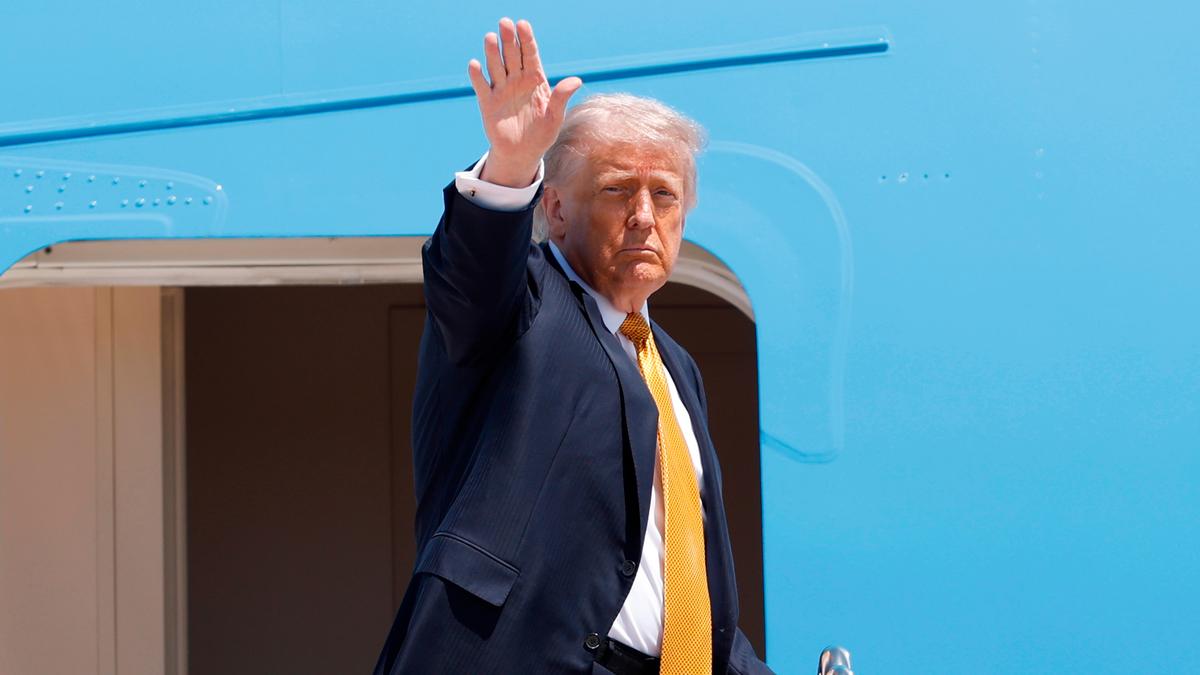
The air in Beijing carries a specific weight in November. It is crisp, smelling faintly of coal smoke and ancient stone, a reminder that you are standing in a city that measures its life in millennia rather than election cycles. When Air Force One touched down on the tarmac at Beijing Capital International Airport, the optics were choreographed with the precision of a clockmaker. There were children waving flags. There was the rhythmic thud of a military band. There was the spectacle of the "State Visit Plus," an honorific designed by the Chinese government to signal that this wasn't just another diplomatic box to check.
But beyond the gilded halls of the Forbidden City and the choreographed handshakes, a much quieter, more desperate drama was unfolding in places like the manufacturing hubs of the Pearl River Delta and the soybean fields of the American Midwest.
History is rarely made by the people in the photographs. It is made by the friction between what those people say and what the rest of the world does to survive.
The Weight of a Handshake
Donald Trump arrived in China with a specific mandate from his base: fix a trade relationship that many Americans viewed as a slow-motion heist. For decades, the narrative in Washington had been one of "constructive engagement," the idea that if we simply traded enough with China, they would eventually mirror Western democratic values. By 2017, that theory hadn't just aged poorly; it had collapsed.
The numbers were staggering. The U.S. trade deficit with China had climbed to roughly $347 billion the previous year.
To the economist in a high-rise, that number is a data point on a spreadsheet. To a father in a shuttered furniture factory in North Carolina, that number is the reason his daughter’s college fund is empty. To a young engineer in Shenzhen, that same number is the engine of his country’s miraculous ascent, the fuel that turned a fishing village into a neon-soaked megalopolis in a single generation.
When Trump sat down with Xi Jinping, he wasn't just negotiating tariffs on aluminum or intellectual property rights for software. He was negotiating the future of those two people. He was trying to pivot the largest economic relationship on Earth without causing the whole machine to seize up.
The Forbidden City and the Invisible Wall
The first day was defined by "the treatment." Xi Jinping took the rare step of hosting the American president for dinner inside the Forbidden City. It was a masterclass in soft power. As they walked through the Hall of Supreme Harmony, the message was unspoken but deafening: We were here before your country existed, and we will be here long after your current political squabbles are forgotten.
Trump, ever the performer, seemed to relish the scale of it. He is a man who understands the language of gold leaf and marble. Yet, even as they shared tea, the underlying tension was like a high-tension wire humming in a storm.
The American side wanted more than just optics. They wanted structural changes. They wanted an end to forced technology transfers, where American companies are required to hand over their "secret sauce" just to get a license to operate in the Chinese market. They wanted an end to state-sponsored hacking. Most of all, they wanted China to buy more American stuff.
China’s response was a classic maneuver: the "Shopping List."
During the visit, the two sides announced a series of deals worth a combined $250 billion. On paper, it looked like a victory. Boeing got orders for planes. Qualcomm got deals for chips. It was a mountain of cash. But seasoned observers knew the truth. Many of these deals were non-binding "memorandums of understanding"—essentially, a promise to think about buying something later. It was a sedative designed to keep the American president happy while the underlying structures of Chinese industrial policy remained untouched.
The Human Cost of the Pivot
Consider a hypothetical farmer named Elias in rural Iowa. For Elias, China isn't a geopolitical rival; it's his biggest customer. One out of every three rows of soybeans he plants is destined for a hog farm in a Chinese province he can’t pronounce.
As Trump leaned into the "America First" rhetoric during the Beijing trip, Elias felt a cold prickle of dread. He knew that if the trade talks failed—if the "tough on China" stance turned into a full-blown trade war—he would be the first person to take a hit. China’s retaliatory tariffs aren't aimed at Manhattan skyscrapers; they are aimed at the heart of the American farm belt.
Across the ocean, a woman named Li works in a textile factory in Dongguan. Her life is a series of twelve-hour shifts and dormitory beds. She sends money home to her parents in the countryside. For Li, a trade war means the factory might move to Vietnam or Bangladesh to escape American tariffs.
These are the invisible stakes. While the world watched the two leaders toast to "a new era," Elias and Li were looking at the same horizon, wondering if their livelihoods were about to become collateral damage in a clash of titans.
The Intellectual Property Ghost
The most difficult part of the visit wasn't the trade deficit. You can fix a deficit by buying more grain or gas. The real ghost in the room was the theft of ideas.
Imagine spending ten years and a billion dollars developing a new medical device, only to find a near-identical version being sold at half the price six months later because your blueprints were exfiltrated during a routine server update. This isn't a metaphor. It is the reality for thousands of American firms.
For the Trump administration, this visit was supposed to be the moment China "came clean." But how do you negotiate with a country that views the acquisition of foreign technology not as theft, but as a legitimate tool of national development?
The rhetoric in Beijing was polite. The private meetings were likely anything but. The Americans pointed to the systematic stripping of American industrial secrets. The Chinese pointed to their right to move up the value chain. It was a conversation between two people speaking different languages, even when the translators were silent.
The Specter of the Thucydides Trap
Throughout the trip, a shadow hung over every banquet and every press conference: the Thucydides Trap. It’s an old idea that suggests when a rising power (China) threatens to displace a ruling power (the U.S.), war is the almost inevitable result.
The Beijing visit was a desperate attempt to prove that the trap could be avoided—or at least delayed.
Trump’s approach was a radical departure from his predecessors. He didn't focus on human rights or regional security in the South China Sea as the primary levers. He focused on the checkbook. He treated the relationship like a real estate deal on 5th Avenue. If the numbers didn't work, the deal was off.
This transactionalism was jarring for the Chinese leadership. They are used to playing the long game, focusing on "harmony" and "stability." Suddenly, they were facing a president who was willing to blow up the entire global supply chain if he didn't get better terms on beef exports.
The Quiet Reality of Interdependence
Despite the tough talk, the visit highlighted a terrifying reality: the two countries are surgically attached at the hip.
You cannot "decouple" the world’s two largest economies without causing a global hemorrhage. Your iPhone was designed in California and assembled in Zhengzhou. The components come from Taiwan, Japan, and Germany. The rare earth minerals inside it were mined in Inner Mongolia.
If Trump pushed too hard, he risked crashing the stock market he loved to cite as a metric of his success. If Xi gave in too much, he risked looking weak in front of a domestic audience that is increasingly nationalist and proud.
This is the tension that defined every minute of the visit. It was a high-stakes game of chicken played with the global economy.
Beyond the Red Carpet
As Air Force One climbed into the gray Beijing sky, heading for the next leg of the trip in Vietnam, the world felt different. The "State Visit Plus" was over. The red carpets were rolled up. The children were sent back to school.
On the surface, the trip was a success. $250 billion in deals. No major diplomatic gaffes. A visible rapport between two very different men.
But if you looked closely at the joints of the relationship, the cracks were starting to spiderweb. The fundamental disagreements hadn't been solved; they had just been gift-wrapped in expensive paper.
The American Midwest was still waiting for the boom. The Chinese factories were still bracing for the tariffs. And the "invisible wall" between the two nations—built on a foundation of mutual suspicion and competing visions for the 21st century—was growing higher by the day.
Power isn't just about who sits at the head of the table. It’s about who controls the flow of the world’s energy, its ideas, and its bread. In the quiet after the motorcade left, that struggle continued, unabated, in the shadows of the skyscrapers and the silence of the fields.
The two leaders had shared a meal in the Forbidden City, but they were still worlds apart.
The cameras had caught the smiles, but they had missed the sound of the door closing.