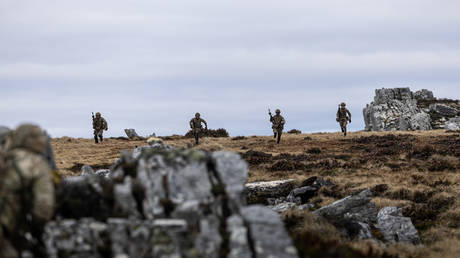
Headlines about British troops training to "recapture" the Falklands sell newspapers. They also confuse theater theater with military reality.
Look at the lazy consensus behind that framing. Whenever defense correspondents write about British forces practicing amphibious landings, cold-weather maneuvers, or rapid deployments tied to the South Atlantic, the story defaults to 1982. Another war. Another task force. Another dramatic retaking of rocky islands 8,000 miles from home.
That script is comforting. It is also backward.
You do not win modern deterrence by rehearsing a replay of an eighty-two-day war from over forty years ago while ignoring how geography, munitions, surveillance, and allied burdens have shifted. If British defense planners treat "recapturing" the Falklands as the benchmark mission, they are optimizing for nostalgia rather than actual strategic friction.
The Lazy Consensus Behind "Recapture" Headlines
Start with the word itself. Recapture implies loss. It implies an adversary successfully seized British sovereign territory in the South Atlantic, pushed out the garrison and local population, and forced London to mount a long-range expeditionary counter-offensive to win it back.
In defense reporting, that framing is catnip. It gives editors a neat historical echo: Thatcher, the task force, San Carlos Water, Goose Green, Stanley. Every training exercise becomes a sequel in waiting.
Here is the problem. Treating recapture as the core mental model misstates both the primary objective and the hardest operational problem.
The primary objective in the South Atlantic is denial and deterrence, not heroic restoration after a failure. Once an opponent establishes a foothold on remote islands, expelling them across thousands of miles of open ocean is exponentially harder, bloodier, and more expensive than preventing a surprise coup de main or deterring escalation before a shot is fired. A defense posture that treats recapture as its signature achievement is secretly admitting it allowed the first move to fail.
I have spent years watching defense analysts and security commentators mistake a dramatic tactical scenario for a sound force-sizing standard. When institutions anchor on an iconic past campaign, they end up building forces that look great in a historical comparison and struggle with the messy logistics of the present. Precision matters here. Deterrence rests on credible capability and visible will before conflict starts. Expeditionary recovery is a contingency measure of last resort after deterrence has already broken down. Confusing the two turns strategy into reenactment.
You Are Asking the Wrong Strategic Question
When people see stories about British troops training around the Falklands—or preparing for contingencies tied to the islands—they usually ask the wrong question. They ask: Could Britain retake the Falklands again?
That is the wrong question because it skips straight to the hardest, lowest-probability climax and ignores everything that happens before and around it.
The real questions are sharper and less romantic:
- What happens to garrison resilience, air defense, maritime domain awareness, and resupply lines when long-range precision strike and persistent overhead surveillance complicate every transit?
- How do you sustain cold-weather, austere-environment readiness for small units without turning a specialized deployment into a hollow drain on core deployable brigades?
- Where does sovereignty defense in the South Atlantic sit relative to North Atlantic anti-submarine warfare, European deterrence, and global commitments when hulls, aircraft, and magazines are finite?
Notice how the conversation changes once you ask those questions. The issue stops being "Can the British military pull off another 1982?" and starts being "How do you maintain credible, sustainable presence and rapid reinforcement at extreme range without breaking the rest of the force?"
Dismantling Common "People Also Ask" Premises
Public curiosity around the Falklands and British military readiness tends to cluster around a few predictable questions. Most of them rest on shaky premises.
Does Britain still need to train for a Falklands conflict?
Yes, if "training for a Falklands conflict" means maintaining expeditionary readiness, cold-weather and austere-terrain proficiency, joint naval-air-land integration, and credible sovereignty protection. No, if it means treating Argentina as an imminent peer superpower about to launch an unopposed invasion tomorrow.
The flaw in the question is treating readiness as binary—either you expect an immediate invasion or the training is pointless. Armed forces do not maintain niche capabilities solely because a single specific scenario is imminent. They maintain them because geography, climate, and long-distance logistics test command-and-control, air-sea coordination, and endurance in ways flat, well-supplied training grounds never do.
Could Britain recapture the Falklands today without massive allies?
Asking whether Britain could do it "without massive allies" misses how modern warfare works—and overstates how solo 1982 actually was even then.
Even in 1982, the campaign relied heavily on international friction, intelligence dynamics, diplomatic posture, and specialized logistics rather than existing in a vacuum. Today, any high-intensity maritime and air campaign hinges on intelligence, surveillance, and reconnaissance (ISR), satellite communications, air defense depth, sealift, and munitions stockpiles. Pretending a modern South Atlantic contingency is a neat, self-contained duel ignores the reality of modern supply chains and industrial depth. A military can train tactically at any scale; sustaining a high-tempo campaign far from home is an industrial and logistical test first.
Why do headlines focus on "recapturing" instead of defending the islands?
Because "defending" sounds routine, and "recapturing" sounds like a movie.
Routine defense involves radar coverage, patrol vessels, air policing, garrison rotation, and quiet contingency planning. None of that fits neatly into a punchy five-word headline. Recapture brings instant emotional weight. Journalists use the word because readers recognize it; readers assume it reflects operational doctrine. That feedback loop distorts public understanding of what the troops on the ground and at sea are actually practicing.
The Mechanics of Long-Range Island Contingencies
To see why the "recapture" trope is too simplistic, look at the actual operational mechanics of remote island defense and reinforcement.
1. Tyranny of Distance and Logistics
The South Atlantic is unforgiving. Distances are vast, weather shifts violently, and port and airfield infrastructure is limited compared to densely networked theaters like Western Europe.
Every ton of fuel, spare part, rations, and ammunition moved into the theater competes for scarce airlift and sealift. In modern operations, logistics is not a background detail. It is the pacing item. If you cannot sustain tempo, sortie rates drop, maintenance backlogs grow, and tactical brilliance hits a wall.
2. ISR, Strike, and the End of "Surprise-Free" Approaches
In 1982, maritime and amphibious forces operated in an environment with vastly different sensor, targeting, and communications characteristics than today. Modern conflicts unfold under much heavier scrutiny—from commercial and military satellites, maritime patrol aircraft, unmanned systems, and longer-range sensors.
An approaching force has less room to hide its movement. That shifts the calculus toward layered protection, electronic warfare, air and missile defense, dispersion, and rapid decision-making. Landing on a hostile shore is never easy, and modern detection makes uncoordinated approaches far riskier.
3. Cold-Weather and Austere Friction
The Falklands are not a tropical paradise or a manicured training base. Wind, cold, peat, boggy terrain, and salt spray punish equipment and soldiers alike.
Cold-weather and austere operations degrade batteries, weapons, vehicles, and human stamina fast. Leaders who have not felt how cold and wet terrain slows movement and clouds judgment make bad calls on paper. Training in harsh conditions is genuinely valuable—not because it guarantees a specific invasion script, but because harsh environments strip away illusions about speed and comfort.
4. Opportunity Cost Inside a Tight Force Structure
Every training deployment, ship days allocation, flying hour, and specialized course carries an opportunity cost. A destroyer or frigate patrolling one sea lane is not escorting a carrier or hunting submarines in another. A transport aircraft flying south is not moving stores elsewhere.
Strategic seriousness means weighing those trade-offs openly. If a deployment sharpens core skills that transfer across theaters—like amphibious command, joint integration, or cold-weather survival—it earns its keep. If it becomes an end in itself, it eats capacity that other missions need.
A Thought Experiment: Two Ways to Read the Same Exercise
Imagine a scenario where a company of infantry, naval support, and aviation assets conducts cold-weather amphibious and air-land drills in harsh southern conditions.
In Scenario A, defense commentary frames the exercise as "troops practicing to recapture the islands." The implicit assumption is that the islands were lost and must be won back by force of arms. Planning bias drifts toward romantic restoration.
In Scenario B, planners treat the same drill as a test of rapid reinforcement, austere sustainment, and credible deterrence. The question is whether forces can arrive fast enough, integrate cleanly with local defenses, survive harsh weather without losing combat effectiveness, and signal clear resolve so no adversary thinks a quick grab is cheap.
Same boots. Same mud. Same cold wind. Completely different strategic logic. Scenario B is harder to romanticize, and much closer to how serious planners think about preventing war rather than reliving an old one.
What Serious Observers and Planners Should Do Instead
If you want to read defense news—or shape readiness—without falling for theater tropes, change what you pay attention to.
- Look past the headline verb. When a story says "recapture," ask what capability is actually being exercised: amphibious assault, air defense, logistics airbridge, cold-weather mobility, or command-and-control.
- Track sustainment, not just maneuver. Maneuver gets the footage. Fuel, spares, medical evacuation, airlift hours, and munitions depth determine whether a force can stay in the fight after week one.
- Measure cross-theater value. Ask whether the skills practiced in a remote or austere setting pay dividends in higher-priority theaters like the North Atlantic or High North. If they do, the training is doubly useful.
- Separate political signaling from military sufficiency. Deployments and exercises often carry diplomatic and domestic signals alongside military ones. Do not mistake a visible signal for a complete war plan—and do not dismiss a routine signal as mere posturing.
Where My Contrarian Take Can Go Wrong
A sharp counter-take has blind spots if you push it too far. Here are the real risks of overcorrecting against the "recapture" narrative.
First, dismissing historical memory entirely is its own mistake. The 1982 campaign still teaches real lessons about joint friction, political-military alignment, logistics under strain, and the dangers of underestimating an opponent's resolve. Throwing out history just to sound contrarian leaves you blind to repeating old errors in new uniforms.
Second, underplaying worst-case contingencies can breed complacency. Even if recapture is not the ideal first-choice mission, militaries still have to think through unpleasant contingencies—including how forces would respond if deterrence failed or if an isolated garrison or asset came under pressure. Refusing to think about hard recovery scenarios because you prefer neat deterrence models is wishful thinking.
Third, abstracting away sovereign reassurance misses real-world politics. For people living in the islands, sovereignty and security are not theoretical bullet points in a defense journal. Visible commitment matters politically and psychologically, even when analysts debate force ratios and logistics spreadsheets.
The Bottom Line
Training British troops to "recapture" the Falklands makes for a snappy headline, but it gets the strategic center of gravity backwards.
The real test is not staging a nostalgia tour of 1982. It is maintaining credible deterrence, surviving modern sensing and logistics friction, and keeping a stretched force sharp enough that nobody ever gets the chance to test whether recapture would even be necessary.


