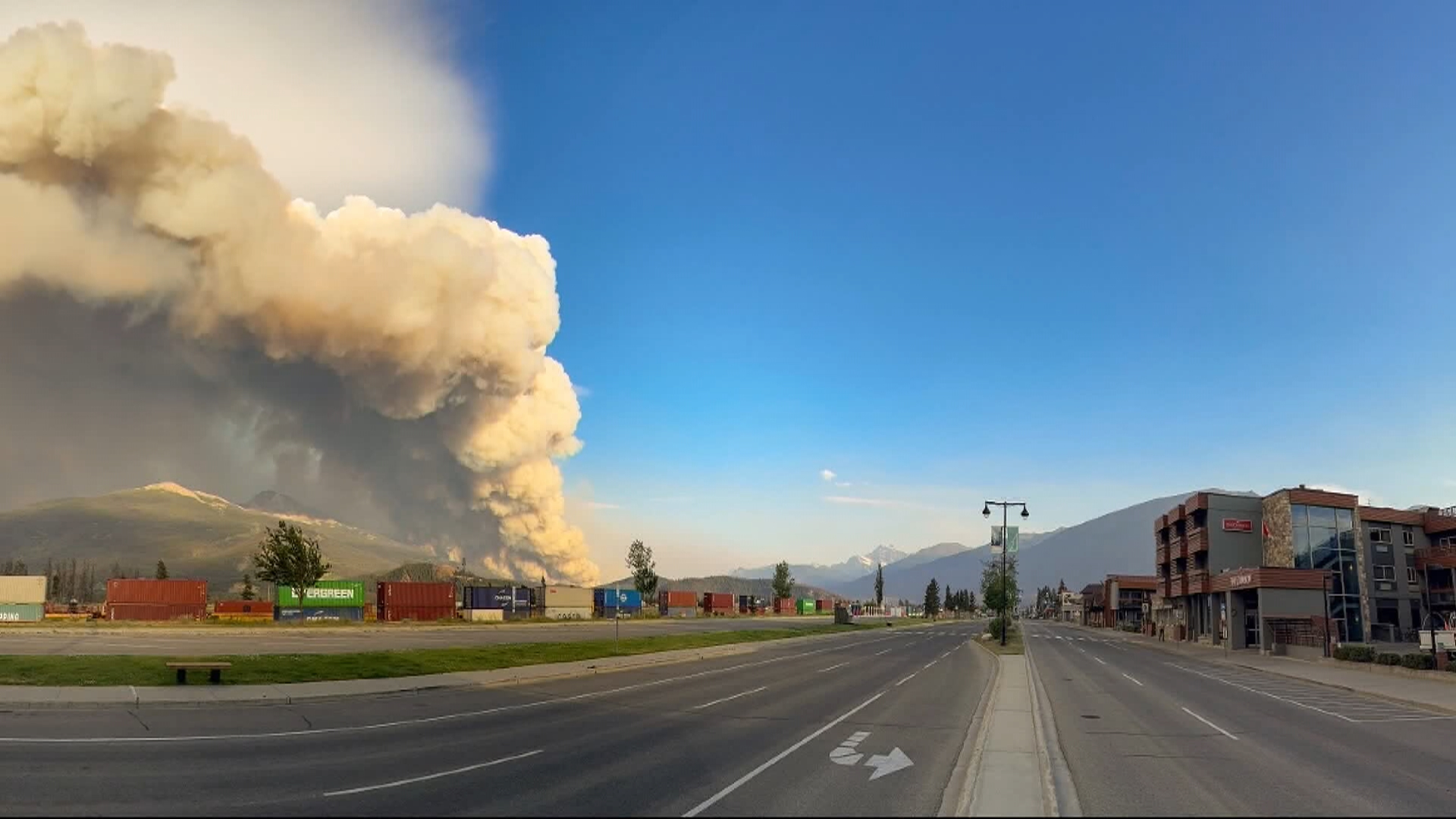
Governments love writing big checks after a disaster. It makes for a perfect photo op. The politician stands against a backdrop of charred timber, puts on a somber face, and promises hundreds of millions of dollars to "rebuild and recover." The crowd applauds. The media runs the headline. Everyone goes home feeling like something has been solved.
It hasn't.
Ottawa’s decision to dump an additional $520 million into Jasper’s wildfire recovery is not a triumph of public policy. It is a textbook example of throwing good money after bad. It is a refusal to accept ecological reality. Writing a massive check to reconstruct a high-density tourist town sitting right in the middle of a fire-dependent ecosystem is an exercise in futility. We are quite literally subsidizing the next catastrophe.
The narrative surrounding the Jasper rebuild is built on a foundation of lazy assumptions. The prevailing consensus says that we must restore the townsite exactly as it was, that the federal government is obligated to underwrite the entire recovery, and that more money equals more safety. Every single one of these points is fundamentally wrong.
The Eco-System Does Not Care About Taxpayer Subsidies
The boreal forest is born to burn. For decades, wildfire ecologists like David Andison and others have pointed out that fire suppression in national parks has created an unnatural accumulation of fuel. Lodgepole pines grow, mature, get attacked by the mountain pine beetle, die, and turn into standing tinderbox matches.
When you build a town inside a national park, you are building inside a fireplace.
Imagine a scenario where a private developer proposes building a brand-new, luxury resort town wrapped entirely in dead pine trees, with limited evacuation routes, right in a zone known for extreme lightning strikes and high winds. The project would be laughed out of every zoning office in the country. Yet, because Jasper already exists, we suspend all logic. We treat the 2024 fire as an unpredictable, once-in-a-lifetime anomaly rather than what it actually was: an inevitable biological event.
By pouring $520 million into rebuilding the exact same structures in the exact same footprint, Ottawa is trying to fight natural selection with fiat currency. Nature wins this fight every single time. If we do not fundamentally alter where and how we live in these regions, we are just buying a very expensive intermission before the next evacuation order.
The Perverse Incentives of Municipal Bailouts
When the federal government steps in to cover the costs of rebuilding a municipality, it destroys the concept of risk management.
Local governments should face the financial consequences of their zoning and asset management decisions. For years, Jasper and Parks Canada struggled to balance aesthetic desires with hard-nosed wildfire mitigation. People like their view of the trees. Property owners resist aggressive fire-smart initiatives when it means cutting down the beautiful canopy surrounding their multi-million-dollar cabins.
When the bill for that aesthetic preference arrives in the form of a devastating wildfire, who pays? Not the local tax base. Not the developers who profited off the tourism boom. The Canadian taxpayer pays.
This dynamic creates a severe moral hazard:
- Insulating Risk: Property owners are insulated from the true economic cost of living in a high-risk zone.
- Stifling Innovation: Municipalities have zero financial incentive to implement radical fire-proofing measures—like mandatory concrete construction, completely clearing a one-kilometer buffer zone around the entire town perimeter, or banning wood shingles entirely—because they know a federal bailout is always waiting.
- Distorting the Insurance Market: Private insurance companies look at these regions and see unmanageable risk. When the government steps in to bridge the gap, it artificially suppresses insurance premiums that should otherwise be skyrocketing to reflect the actual danger.
I have spent years analyzing capital allocation in high-risk zones. When you decouple risk from financial responsibility, you get catastrophic decision-making. If a private corporation operated its physical assets with this level of disregard for environmental hazards, shareholders would liquidate the management team within an hour.
The Myth of Rebuilding It Better
The official press releases are always filled with buzzwords about rebuilding "green," "resilient," and "smart." Let us look at the math.
A significant portion of that $520 million will vanish into bureaucratic overhead, consultant fees, and temporary housing infrastructure. What remains will be spent on escalating labor and material costs driven up by the sudden influx of government cash in a remote region.
Even if every single house is rebuilt to the highest modern FireSmart standards, the fundamental vulnerability remains unchanged. A house made of fire-resistant drywall and fiber-cement siding cannot withstand a crown fire throwing embers two kilometers ahead of the main front when the surrounding park remains an unmanaged fuel load.
Unless Parks Canada intends to clear-cut a massive swathe of Jasper National Park—a move that would trigger endless lawsuits and public outrage from environmental groups—the town will remain surrounded by fuel. No amount of triple-pane glass or metal roofing changes the physics of a thermal column generated by thousands of hectares of burning forest.
What True Adaptation Looks Like
If we were serious about adaptation, the conversation would not be about rebuilding. It would be about managed retreat or radical restructuring.
Instead of treating Jasper as a traditional permanent town, we should treat it like an offshore oil rig or an Arctic research station. Minimize the permanent residential footprint. Transition the economy toward seasonal, temporary infrastructure that can be evacuated with minimal asset loss. Stop building sprawling wood-frame single-family homes.
If people want to build luxury residential properties inside a national park, they should be required to secure 100% private insurance without government backstops. If private insurers refuse to write the policy, that is the market telling you that the structure should not exist.
Instead, Ottawa has chosen the path of political convenience. They are spending half a billion dollars to recreate the exact conditions that led to the 2024 disaster, hoping that luck will be on their side for the next few decades.
It won't be. The climate is shifting, the forests are drying, and the fuel loads are still there. The federal government didn’t save Jasper with this funding package. They just financed the sequel. Stop celebrating the bailout and start preparing for the next evacuation.