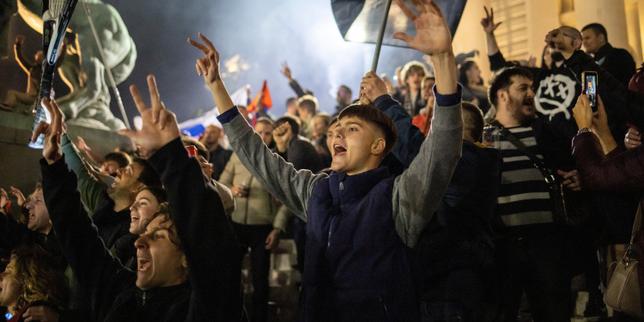
When you look at recent European politics, few moments match the shock of Serbia's student movement winning legislative elections against Aleksandar Vucic. For years, political observers treated Vucic's grip on Belgrade as practically unbreakable. Then university students stepped out of lecture halls, organized blockades, and reshaped the country's electoral map.
The competitor's headline frames this strictly as a triumph over a populist leader. That's true on the surface, yet it misses the real mechanics of how an initially leaderless campus protest turned into a viable legislative force. If you want to understand why this happened—and what it actually means for Balkan politics—you need to look past the surface-level celebration and examine the structural shifts on the ground.
Why Conventional Opposition Failed Where Students Succeeded
For over a decade, established opposition parties in Serbia struggled to mount a unified challenge against Aleksandar Vucic and his Serbian Progressive Party (SNS). Voters often viewed traditional opposition figures with skepticism, citing internal fragmentation, ideological confusion, and past governance records.
Students didn't carry that baggage. When demonstrations erupted across Belgrade, Novi Sad, and Nis—sparked originally by demands for institutional accountability, transparency, and the rule of law following major public infrastructure failures—young people refused to hand the microphone to career politicians.
They kept things simple. Their demands focused on basic institutional function rather than partisan ideology. That distinction mattered enormously to everyday Serbian voters who felt alienated by standard political bickering. By framing their movement around civic responsibility and anti-corruption rather than left-versus-right culture wars, students built a coalition that reached far beyond university campuses.
The Power of Decentralized Organization
Traditional political campaigns rely on top-down hierarchies, expensive media buys, and charismatic frontrunners. In Serbia, where mainstream television networks largely favored the ruling establishment, competing on traditional media terrain was a losing game from day one.
Students bypassed that bottleneck entirely. Using direct campus assemblies—known locally as plenums—they made decisions collectively and rotated spokespeople constantly. There was no single leader for state-aligned tabloids to smear or co-opt. When you can't target one head of a movement, standard political attack playbooks fall apart.
How Campus Blockades Turned Into Legislative Votes
Protesting in the streets is one thing. Winning seats in the National Assembly is something else entirely. Historically, youth-led protest waves across Europe—from anti-austerity marches to climate strikes—have struggled to translate street energy into ballot-box discipline.
Serbia's student movement avoided that trap through relentless grassroots logistics. Instead of staying confined to city centers in Belgrade, student groups organized marches and outreach into smaller towns and rural municipalities—areas long considered safe strongholds for Vucic's SNS.
They knocked on doors. They spoke directly with pensioners, farmers, and industrial workers who rarely heard anything outside state-friendly broadcasts. When a twenty-year-old walks dozens of kilometers through rural Serbia just to talk about public accountability, people listen. That face-to-face contact broke through information bubbles in ways digital campaigns never could.
Bridging the Generational Divide
One of the biggest misconceptions about Serbian politics was that older voters would automatically back the status quo out of fear of instability. During this election cycle, family dynamics shifted visibly. Parents and grandparents saw their own children risking academic years and personal safety to demand functioning institutions.
Support from teachers, professors, farmers, and legal professionals gradually turned a youth protest into a cross-generational civic front. By the time voters entered polling stations, backing the student-aligned legislative slate wasn't seen as a radical gamble—it felt like an investment in keeping Serbia's younger generation from emigrating abroad.
What Vucic's Establishment Misjudged
Aleksandar Vucic built his political career on reading public sentiment with surgical precision. Yet his administration repeatedly miscalculated how to respond to the student mobilization.
Early attempts to dismiss the protests as foreign-funded or politically motivated backfired. Calling domestic university students traitors or paid agitators alienated moderate voters who knew those students personally. Subsequent efforts to offer piecemeal concessions—such as selective document releases or minor cabinet reshuffles—came across as reactive rather than sincere.
Every misstep reinforced the students' core argument that state institutions were operating without genuine accountability. Instead of exhausting the protesters through delay tactics, the government's stalling gave the movement more time to organize, refine its platform, and register observers for election day.
The Real Challenges Facing a Student-Backed Parliament
Winning a legislative majority is an extraordinary milestone, though governing Serbia presents an entirely different set of problems. Skeptics and seasoned political analysts rightly point out that consensus-based student assemblies work well for protest coordination, yet parliamentary lawmaking requires rapid executive compromises.
The incoming legislative bloc faces immediate tests:
- Institutional Reform: Rebuilding trust in the judiciary, public prosecutors' offices, and electoral commissions without triggering administrative paralysis.
- Economic Continuity: Managing major infrastructure projects, foreign direct investment, and inflation pressures while auditing state contracts for corruption.
- Geopolitical Balancing: Navigating Serbia's delicate position between European Union accession talks, regional Balkan stability, and traditional ties with Russia and China.
Vucic's political network also retains deep roots across local administrations, state-owned enterprises, and media outlets. A legislative victory shifts the balance of power in parliament, yet dismantling entrenched patronage networks takes years of sustained legal and administrative work.
What You Should Watch Next in Serbian Politics
If you're following European democracy or Balkan affairs closely, don't treat this election as the end of the story. Watch how the student-backed lawmakers handle their first hundred days in the National Assembly. Pay close attention to whether they maintain internal unity once concrete policy votes—on budgets, judicial appointments, and EU alignment—replace broad anti-corruption slogans.
Track independent election monitoring reports from organizations like CRTA (Center for Research, Transparency and Accountability) and OSCE observers to see how institutional reforms progress on the ground. Keep an eye on local municipal governance too, since real democratic change in Serbia depends just as much on city halls in Novi Sad, Nis, and Kragujevac as it does on parliament in Belgrade.