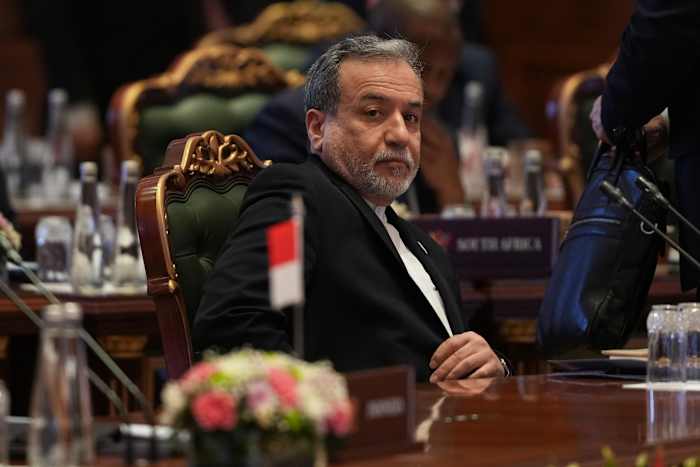
Diplomacy between Washington and Tehran has reached a familiar, bitter impasse. Speaking from a BRICS ministerial gathering in New Delhi, Iranian Foreign Minister Abbas Araghchi laid bare the friction paralyzing current negotiations, stating bluntly that a fundamental lack of trust remains the primary barrier to ending the undeclared war between the United States and Iran. While a fragile, exceedingly shaky ceasefire currently holds following the devastating joint US-Israeli military strikes that commenced on February 28, the backchannel dialogue intended to formalize a permanent peace has ground to a halt. The immediate consequence of this deadlock is a grinding maritime and economic stalemate, with the United States maintaining a strict naval blockade on Iranian petroleum exports while Tehran maintains a retaliatory, suffocating grip on the strategic Strait of Hormuz, keeping global energy markets in a state of volatile disruption.
The public narrative offered by both sides suggests a simple tactical disagreement over nuclear stockpiles and maritime access. The reality is far more complex, rooted in a structural cycle of kinetic leverage and diplomatic whiplash. By examining the mechanics of this standoff, it becomes clear that the current peace process is failing not because of a simple "trust deficit," but because both administrations are operating on fundamentally incompatible definitions of diplomatic engagement.
The Mirage of Parallel Diplomacy
The core of the current friction lies in what Tehran views as a pattern of bad-faith maneuvering by Washington. According to Araghchi, the United States routinely shifts toward the negotiating table only when its immediate military objectives stall. The Iranian delegation points to a specific timeline of betrayal, alleging that the massive joint military intervention on February 28 caught them entirely by surprise because it occurred precisely while delicate, indirect diplomatic channels were actively open.
This creates a severe operational dilemma for Iranian decision-makers. From their perspective, Washington uses diplomacy not to find a mutually acceptable compromise, but as a smoke screen to achieve tactical positioning before launching kinetic strikes.
The White House views the situation through an entirely different lens. For the Trump administration, military pressure and diplomatic overtures are not mutually exclusive; they are complementary components of a restored maximum pressure campaign. The administration believes that Iran only offers meaningful concessions when facing an existential military or economic threat. Consequently, what Tehran views as duplicity, Washington views as effective, coercive statecraft. This fundamental misalignment means that every diplomatic olive branch extended by either side is instantly interpreted by the other as a trap.
The Garbage Flap and Backchannel Reality
The fragility of the current peace process was put on stark display earlier this week when US President Donald Trump publicly dismissed Iran’s latest 14-point formal peace proposal, labeling it a piece of garbage. The proposal reportedly contained notable concessions regarding Iran's nuclear activities, but fell short of Washington’s absolute demands. The public insults from the Oval Office suggested a complete collapse of communication, sending shockwaves through international energy markets and raising fears of an immediate return to open warfare.
Yet, behind the theatrical hostility, the mechanical gears of diplomacy continue to turn. Araghchi revealed that within days of Trump’s public dismissal, Tehran received fresh, quiet messages from American intermediaries expressing an explicit willingness to persist with negotiations and maintain engagement.
This duality reveals the distinct style of the current American administration, which relies heavily on performative public dominance paired with pragmatic backchannel deal-making. For a country like Iran, where diplomatic protocol and national honor are deeply intertwined with state survival, these contradictory signals generate profound reluctance. Tehran is left trying to decipher which American voice is real: the bellicose rhetoric designed for domestic television, or the sober proposals delivered via Pakistani and Omani intermediaries.
The Nuclear Sticking Point
Beyond the psychological friction, the negotiations are trapped in a zero-sum dispute over highly enriched uranium. The position of the United States, backed firmly by Israel, is non-negotiable. Washington demands the complete removal of all highly enriched uranium from Iranian territory and a verified, permanent dismantling of the infrastructure required to develop nuclear weapons.
Iran refuses to accept what it views as a total capitulation. Araghchi reiterated that Tehran maintains an inherent right to enrich uranium for peaceful energy purposes, a stance that has been a cornerstone of Iranian foreign policy for decades.
The Russian Alternative
- The Proposal: Moscow has previously offered to take custody of Iran's enriched uranium stockpile, acting as a third-party guarantor to satisfy Western security concerns without forcing Iran to destroy its material assets.
- Current Status: Araghchi confirmed that while the Russian option is not currently under active discussion, it remains on the table as a potential mechanism if talks progress.
- The Complication: Relying on Russia as a neutral supervisor is highly problematic for Washington given the broader, fractured geopolitical alignment between the West and Moscow.
The Maritime Stranglehold
While diplomats argue in foreign capitals, the immediate crisis remains anchored in the shipping lanes of West Asia. The dual blockade has effectively closed the Strait of Hormuz, a vital artery that handled approximately one-fifth of the world’s oil and gas supply prior to the outbreak of hostilities.
[Global Energy Markets]
       │
       ▼
[Strait of Hormuz] ◄───► [US Naval Blockade] (Choking Iranian Exports)
       ▲
       │
[Iranian Restrictions] (Seizing/Inspecting Foreign Vessels)
In a bid to ease international pressure and project an image of maritime responsibility, Iran has indicated a willingness to assist the transit of commercial vessels through the strait. However, this offer comes with a strict caveat: assistance is extended only to countries that are not actively at war with Iran.
The limits of this policy were demonstrated on Thursday when the merchant vessel Hui Chuan, operated by a Chinese private security firm, was diverted into Iranian waters for what Tehran termed a documentation and compliance inspection. Even as Araghchi actively courts Beijing to play a greater diplomatic role in the peace process—frequently citing China’s successful mediation of the Iran-Saudi Arabia detente—Tehran's naval forces continue to assert absolute tactical control over regional waters, demonstrating that no international commerce is entirely safe from the ongoing conflict.
A Framework for Broken Trust
The fundamental flaw of the current peace process is the belief that a breakthrough requires mutual trust. In the modern history of US-Iran relations, trust has never existed. The landmark 2015 nuclear agreement was not built on trust; it was built on a highly structured, intrusive verification regime that accounted for deep-seated mutual suspicion.
The current administration's decision to walk away from previous frameworks shattered the baseline of predictability that makes international treaties work. Iran learned that an agreement signed by one American president can be summarily torn up by the next. Conversely, Washington learned that regional proxy networks could easily bypass the spirit of formal diplomatic agreements.
To break the current deadlock, negotiators must abandon the abstract pursuit of trust and focus entirely on verifiable, transactional reciprocity. A temporary lowering of uranium enrichment must be tied directly and immediately to the mechanical lifting of specific port blockades. The current, vague framework of a shaky ceasefire paired with public insults guarantees a return to open kinetic conflict the moment one side feels its temporary leverage slipping. Diplomacy cannot function when it is treated merely as the pause button on an ongoing war.