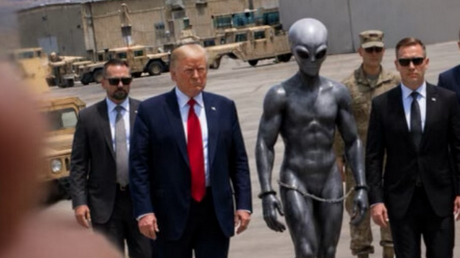
Donald Trump recently flooded Truth Social with a surreal blitz of AI-generated imagery that would have been career-ending for a politician a decade ago. Among the twenty-five images shared in a single weekend were depictions of the former president walking alongside a grey alien flanked by Secret Service agents, and another featuring a shackled extraterrestrial. While critics quickly dismissed the posts as "slop"—a term for low-effort, high-volume synthetic content—the strategy behind the absurdity is far more calculated than a simple eccentric hobby. By leaning into the bizarre, the Trump campaign is effectively desensitizing the electorate to visual truth, preparing the ground for a world where no recording or photograph can be used as definitive evidence.
This digital spree comes at a specific friction point in American policy. Earlier this month, the administration initiated the Presidential Unsealing and Reporting System for UAP Encounters (PURSUE), a project dedicated to declassifying government files on unidentified aerial phenomena. By mixing legitimate, highly anticipated government disclosures with hyper-stylized AI "shitposting," the line between official transparency and meme culture evaporates. The goal is not to convince the public that Trump has an alien bodyguard. The goal is to ensure that when the public sees any digital image, their first instinct is to doubt its reality. For a different look, check out: this related article.
The Weaponization of Low Fidelity
Most analysts look at AI "slop" and see a failure of quality. They point to the blurred fingers, the inconsistent lighting, and the "uncanny valley" faces as evidence that the technology isn't ready for prime time. This misses the point of the political operative. In the context of a 24-hour grievance cycle, high fidelity is actually a liability.
Hyper-realistic deepfakes are subject to intense forensic scrutiny and platform bans. However, "slop"—content that is obviously synthetic and often garish—occupies a protected space of "artistic expression" or "satire." It bypasses the automated filters designed to catch misinformation because it doesn't pretend to be a real photograph. Yet, it still communicates a vibe. When Trump shares an image of himself overseeing orbital strikes from a "Space Force" command center, he isn't making a policy statement. He is reinforcing a brand of strength and cosmic destiny that resonates with his base's emotional state, regardless of the image's physical impossibility. Related reporting on the subject has been published by NPR.
The shackled alien image is particularly instructive. It taps into a specific subculture of "disclosure" activists who believe the deep state has been hiding extraterrestrial secrets for decades. By positioning himself as the man who literalized the metaphor—bringing the "alien" to heel—Trump signals to these fringe groups that he is their champion. It is dog-whistling via prompt engineering.
Breaking the Feedback Loop of Fact Checking
Standard journalism thrives on the "gotcha" moment. A politician says something false, the journalist presents the tape, and the contradiction creates a scandal. AI slop breaks this loop. When the information environment is saturated with intentional nonsense, the "truth" becomes just another aesthetic choice.
Consider the psychological impact of the "Truth Social spree" on May 18, 2026. By posting images of himself as a space general alongside maps of the Middle East with "BYE BYE" captions directed at Iran, Trump creates a chaotic noise floor. If a real, damaging photo of a backroom deal or a military misstep were to leak tomorrow, his supporters are already trained to view it through the same lens as the alien photo. They will see it as just more "slop" generated by his enemies.
This is the "Liar's Dividend." It is a concept where the mere existence of deepfake technology allows bad actors to claim that real evidence is fake. By being the primary generator of his own fake imagery, Trump isn't just a victim of the trend; he is the architect of the fog.
The PURSUE Files and the Disclosure Pivot
The timing of these posts coincided with the release of pixelated imagery from military pilots through the PURSUE project. This was a historic moment—the first time an administration openly admitted to shielding UAP files from the public. However, the release was criticized by the research community for lacking metadata and context.
By flooding the zone with AI aliens at the exact moment real UAP data was being discussed, the administration successfully "meme-ified" a serious national security conversation. It turned a potential moment of accountability—questions about why this data was hidden for seventy years—into a circus. The serious researchers are left fighting for oxygen while the "shackled alien" becomes the face of the news cycle.
This isn't just about aliens. It is a blueprint for handling any sensitive data drop. If you don't like the facts, drown them in a sea of synthetic hallucinations.
The Future of the Synthetic Campaign
We are entering an era where political campaigns will be run by prompt engineers rather than speechwriters. The cost of generating a thousand images that cater to every specific grievance of every specific demographic is nearly zero.
Traditional media outlets are currently ill-equipped for this. Fact-checking an image of a man walking with an alien feels beneath the dignity of a major newspaper, yet ignoring it allows the narrative of "Trump as the Great Discloser" to harden in niche communities. The "slop" is winning because it plays by a set of rules that the traditional press hasn't learned yet. It isn't trying to be true; it’s trying to be felt.
The ultimate end-game of the shackled alien isn't a secret base in Nevada. It’s the total surrender of the shared reality that once made democratic debate possible. If everything is a hallucination, then the person with the loudest megaphone and the fastest GPU wins. The alien isn't the one in chains. The public's ability to discern reality is the real captive here.