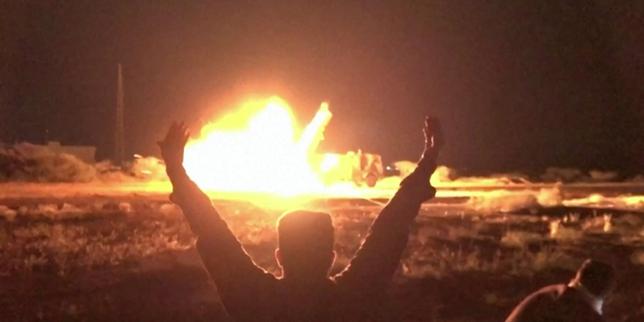
Tehran just raised the stakes in its shadow war with the West by claiming a direct strike on American military assets stationed in Jordan. While the Pentagon moves quickly to downplay the extent of the damage, the geopolitical reality is clear. Jordan is no longer just a safe buffer zone. It has become the primary friction point where Iranian drone technology meets American regional defense. Simultaneously, the sudden departure of Lebanese Armed Forces Commander Joseph Aoun to Washington signals an aggressive, behind-the-scenes scramble to prevent a total collapse along the Mediterranean coast.
These two events are not separate news items. They are interconnected gears in a rapidly accelerating regional conflict. If you enjoyed this piece, you should check out: this related article.
The Escalation in the Jordanian Desert
For years, Jordan remained a quiet sanctuary for Western military operations. It served as a stable launching pad for anti-ISIS campaigns and a critical logistics hub. That stability shattered when Tehran-backed militias began using advanced unmanned aerial vehicles to test the perimeter of American installations like Tower 22 and various remote airstrips near the Syrian border.
The Iranian state apparatus claims its forces successfully destroyed multiple American assets on Jordanian soil. Pentagon officials routinely label these claims as propaganda designed for domestic consumption in Iran. The truth lies somewhere in the murky middle. Tehran does not need to obliterate an entire airbase to achieve its strategic objectives. By proving it can penetrate sophisticated air defense networks with low-cost, loitering munitions, Iran forces Washington to reallocate expensive air defense systems from other global theaters. For another angle on this development, check out the latest coverage from The New York Times.
This is an economic war fought with kinetic weapons. A single Iranian-engineered drone costs a fraction of the price of an interceptor missile. Tehran understands this asymmetry perfectly. By keeping American forces pinned down in the Jordanian desert, Iran keeps the United States on the defensive while its proxy networks expand their footprint across Iraq and Syria.
The Secret Logistics of the Drone Pipelines
To understand how these attacks happen, one must trace the smuggling routes that cut across the Syrian desert. The weapons do not arrive fully formed. They travel in pieces.
- Component smuggling: Electronic components, precision guidance microchips, and small engines are smuggled through established civilian trade corridors flowing from Iraq into eastern Syria.
- Local assembly: Militias operating under the umbrella of the Islamic Resistance in Iraq assemble the airframes in underground facilities near Palmyra and Albukamal.
- Deployment: The completed platforms are moved to mobile launch sites along the porous Jordanian border, hidden inside standard commercial transport trucks.
Jordanian intelligence has been working overtime to intercept these shipments. The kingdom's border guards frequently engage in deadly firefights with drug smugglers who double as weapons traffickers for regional militias. It is a grueling war of attrition. The border is too vast to seal completely, and the financial incentives for the smugglers are too high to ignore.
Why Washington is Risking Everything on Joseph Aoun
While the desert borders burn, Lebanon hangs by a thread. The institutional vacuum in Beirut has left the country without a functioning president, making General Joseph Aoun, the commander of the Lebanese Armed Forces, the de facto representative of what remains of the Lebanese state. His sudden journey to Washington reflects deep desperation on both sides of the Atlantic.
The Lebanese Armed Forces are the only institution holding the country together. If the army fractures, the entire state falls directly into the hands of armed factions aligned with Iran. Washington knows this. The Pentagon has been directly subsidizing the salaries of Lebanese soldiers to prevent mass desertions caused by the historic collapse of the Lebanese pound.
Joseph Aoun is not visiting Washington to discuss abstract diplomatic strategies. He is there to ask for basic survival tools. The army needs fuel, spare parts for its aging transport fleets, and direct financial assistance to keep its personnel fed. For the United States, keeping the Lebanese military funded is a cheap alternative to dealing with the chaotic aftermath of a failed state on the Mediterranean.
The Friction Between Conventional Armies and Asymmetric Networks
The United States military excels at fighting conventional wars against defined state adversaries. It struggles against decentralized networks that do not respect international borders. The current crisis highlights the limits of traditional American deterrence in the region.
When an Iranian-backed militia launches a strike from Syrian territory into Jordan, Washington faces a difficult choice. Striking back inside Syria risks escalating a delicate conflict involving Russian forces. Striking inside Iraq alienates a fragile partner government in Baghdad. Doing nothing invites further attacks. Iran exploits these diplomatic constraints with cold calculation. They use proxies to maintain plausible deniability while reaping the strategic benefits of showing they can strike American forces at will.
This asymmetric approach has fundamentally altered the security calculations of regional allies. Jordan, traditionally silent about its security arrangements, has been forced to seek explicit defense guarantees from Washington. The kingdom cannot afford to become a battleground, yet its geography makes it unavoidable.
The Fractured Arab Front
The response from neighboring Arab capitals has been fractured and cautious. While Gulf states watch the escalation with growing alarm, they are hesitant to form an open military alliance against Iran. Past diplomatic thaws between Riyadh and Tehran remain fragile, and no one wants to invite a drone strike on their own oil infrastructure.
This leaves Jordan isolated. Amman must balance its dependence on American security assistance with the domestic pressures of a population deeply sympathetic to regional grievances. The presence of American bases on Jordanian soil has become a sensitive political issue, one that Tehran-backed media outlets exploit daily through coordinated disinformation campaigns.
The Limits of Financial Containment
Sanctions have failed to stop the flow of weaponry. The black market networks that supply the Iranian drone program have proven remarkably adaptive, utilizing shell companies across East Asia and Europe to source dual-use technologies.
The financial pressure applied by Washington has undeniably crippled the domestic Iranian economy, but it has not forced the regime to defund its regional proxy strategy. The Islamic Revolutionary Guard Corps prioritizes its external operations above all else. As long as these groups can manufacture effective weapons using off-the-shelf components, economic blockades will remain a secondary concern for military commanders on the ground.
The Fragile Balance in Beirut
Back in Lebanon, Joseph Aoun’s trip to Washington will be viewed with intense suspicion by local political factions aligned with Tehran. They see any direct American support for the Lebanese military as an attempt to build a counterweight to their own armed wings.
The general must walk an impossible tightrope. If he returns from Washington empty-handed, the army risks fragmentation, which would trigger immediate instability inside the country. If he returns with too many American conditions attached to the aid, he risks provoking a domestic political backlash that could paralyze the military command structure.
The United States is betting heavily that Aoun can maintain this balance. The alternative is a security vacuum stretching from the borders of Israel to the shores of Syria, a scenario that would permanently alter the balance of power in the eastern Mediterranean.
The Long War for Regional Influence
The current escalation is not a temporary spike in violence. It represents a permanent shift in how regional influence is contested. The era of localized proxy skirmishes has evolved into a coordinated, multi-front campaign designed to wear down the American military presence through constant pressure.
Jordan will continue to face cross-border incursions and airspace violations. The air defense batteries stationed around Western facilities will remain on high alert, firing expensive interceptors at cheap plastic drones. This is the new normal for American forces in the region, a slow-burning conflict where tactical victories mean very little without a comprehensive diplomatic solution that addresses the root causes of the regional power struggle.
Washington's immediate task is to secure the Jordanian border while keeping the Lebanese state from sliding into chaos. It is a dual-front crisis that requires constant operational readiness and brutal diplomatic realism. The margins for error are shrinking by the day, and the next drone that gets through could trigger the very war everyone claims they want to avoid.