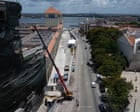
A rare, powerful 6.1-magnitude earthquake striking off the coast of western Cuba on Monday afternoon sent shockwaves across the Gulf of Mexico, triggering building evacuations in downtown Miami and shaking office desks as far north as Orlando and Jacksonville. While mainstream reports treat the event as a freak geological anomaly, the tremor exposes a significant, systemic vulnerability: Florida's modern high-rise architecture and unique regional geology are highly susceptible to distant Caribbean seismic activity.
The quake occurred at approximately 2:00 p.m. Eastern, centered in the southern Gulf of Mexico just west of Mantua, Cuba. According to the U.S. Geological Survey (USGS), the event marks one of the strongest earthquakes ever recorded in the Gulf region since modern instrumentation began in the 1950s. While local emergency management agencies quickly confirmed there was no tsunami threat to the U.S. mainland, the psychological and structural reality of the tremor has forced a reassessment of Florida's perceived seismic immunity. For another look, check out: this related article.
The Physics of Long-Distance Shaking
To understand why a desk in a Fort Lauderdale law firm or a government high-rise in Miami-Dade County shook from a fault line hundreds of miles away, one must understand how seismic energy travels. Earthquakes release different types of waves.
The short, sharp, high-frequency waves that cause immediate destruction near the epicenter tend to dissipate quickly over distance. However, low-frequency surface waves can travel vast distances through solid bedrock without losing their energy. Similar reporting regarding this has been published by USA Today.
Florida sits on a massive platform of carbonate rocks, mostly limestone. This solid, deep-seated basement acts as a highly efficient conductor for low-frequency seismic waves coming from the Caribbean plate boundary. When these slow, rolling waves reach Florida, they pass through the deep bedrock but change behavior when they hit the surface layers of loose sand, clay, and shallow water tables.
This brings us to a phenomenon known as seismic amplification.
When a low-frequency wave transfers from hard bedrock into softer, unconsolidated surface soil, the wave slows down and its amplitude increases. The ground shakes more violently at the surface than it does deep underground. This is exactly what happened along Florida's coastline, transforming a distant Caribbean tremor into a palpable local event.
Why High-Rises Are Vulnerable to Distant Quakes
The widespread reports of swaying buildings in Miami, Fort Lauderdale, and even Lake County—which closed its offices out of an abundance of caution—were not a fluke. They are the result of engineering physics, specifically a concept known as resonance.
Every building has a natural frequency, a preferred rate at which it wants to vibrate back and forth.
- Low, single-story ranch homes have a high natural frequency; they vibrate rapidly with short waves.
- Tall structures, like the 28-story Miami-Dade county government high-rise that was evacuated, have a very low natural frequency. They sway slowly.
When the low-frequency waves from the Cuban earthquake reached South Florida, their frequency matched the natural frequency of the tallest skyscrapers.
[Distant 6.1 Quake] ──> Travels through Bedrock ──> Hits Soft Florida Soil ──> Low-Frequency Waves Match High-Rise Resonance ──> High-Rise Sways
When these frequencies sync up, the building acts as an amplifier. The higher up you are in a skyscraper, the more dramatic the swaying becomes. A person standing on a sidewalk in Miami might feel absolutely nothing, while an office worker on the 20th floor of a nearby tower sees water sloshing out of a glass and hanging pendants swinging wildly.
The Myth of Florida Seismic Safety
Florida building codes are universally recognized as some of the strictest in the world. However, these codes were forged in the aftermath of devastating hurricanes, not seismic activity. The Florida Building Code is designed to withstand immense lateral wind pressures from Category 5 hurricanes.
While wind engineering and earthquake engineering both deal with lateral forces, they handle them differently.
Wind forces apply dynamic, aerodynamic pressure to the exterior envelope of a building. Earthquake forces, conversely, are inertial; the ground moves rapidly beneath the structure, and the building's own mass tries to stay in place, causing internal structural stress.
Because Florida is historically classified as a very low seismic hazard zone by the USGS, structural engineers are not legally required to implement the rigorous ductile detailing—flexible joints and reinforcing steel configurations—mandated in states like California or countries like Japan. The structures are rigid enough to resist wind, but rigidity can lead to cracking when subjected to unexpected seismic ground motion.
Monday's event was the second notable reminder of this structural blind spot in recent history, echoing a similar 6.8-magnitude event in November 2024 that struck southeastern Cuba and similarly vibrated the Florida peninsula.
The Historical Precedent
Seismologists from the USGS noted that Monday's earthquake is incredibly rare for the northern and western Caribbean regions. Most Cuban seismic history is dominated by the Septentrional-Oriente fault zone off the southeastern coast, which produced a massive 7.7-magnitude quake in 2020.
The Western Cuba region, where this 6.1-magnitude quake originated, involves intraplate tectonics that are far more complex and less understood.
| Date | Location / Epicenter | Magnitude | Florida Impact |
|---|---|---|---|
| August 26, 1959 | Northern Gulf of Mexico | 6.4 | Widely felt, minor structural cracks |
| September 10, 2006 | Gulf of Mexico (250 mi off Florida) | 5.9 | Felt across FL, triggered minor panic |
| November 10, 2024 | Bartolomé Masó, SE Cuba | 6.8 | Tremors reported in South Florida |
| June 8, 2026 | Mantua, Western Cuba | 6.1 | Widespread swaying, high-rise evacuations |
Historically, earthquakes within the Gulf of Mexico basin itself are few and far between. Yet, as the historical data reveals, when a significant event occurs in the northern Caribbean, the physical pipeline straight to Florida is active and highly efficient.
Emergency management plans in metropolitan Florida areas rarely include comprehensive earthquake response protocols. The immediate reaction of local officials on Monday—suspending commuter rail lines and ordering mass evacuations—was handled out of caution rather than a codified seismic response playbook.
As urban density increases along the coast and more high-rises alter the skyline, the intersection of distant intraplate earthquakes and local building resonance will continue to turn distant Caribbean faults into direct Florida disruptions. The ground beneath the Sunshine State is stable, but the structures built upon it remain tethered to the volatile tectonic boundaries of its southern neighbors.


