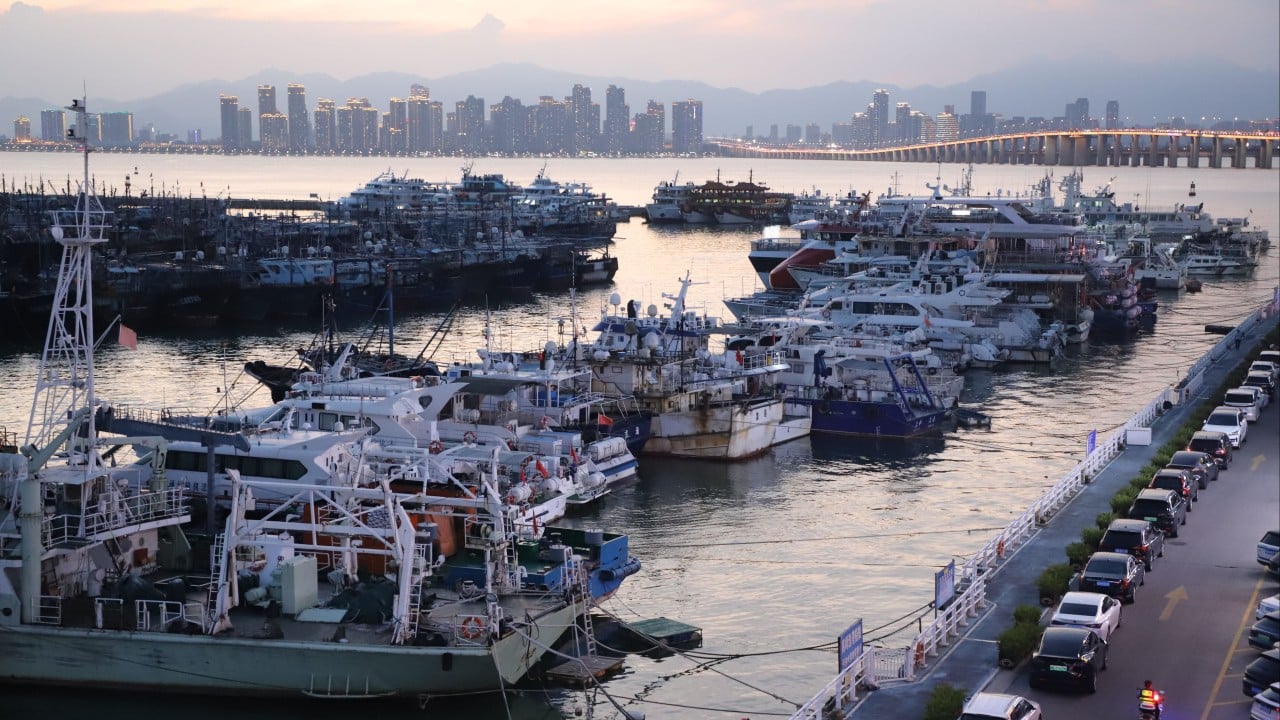
When the state meteorological apparatus in Beijing issues its first red rainstorm alert of the year, a predictable and massive administrative machinery roars to life. High-speed rail lines lock down, hundreds of commercial flights clear the tarmac, and thousands of maritime vessels are ordered back to port. The sweeping shutdown ahead of Typhoon Bavi looks like a display of total administrative control over nature. Yet, this top-down defensive strategy masks a systemic vulnerability that evacuations and transit cancellations cannot solve. China's industrial coastlines remain fundamentally unprotected against the sheer volume of water modern storms carry.
The official response to Typhoon Bavi follows a long-rehearsed script. Central authorities upgraded emergency response protocols with mechanical precision as the storm gathered force over the Pacific. Millions of people across Zhejiang and Fujian provinces are being told to stay indoors, while industrial operations pause to minimize casualties. This heavy-handed disruption is effective at keeping the immediate death toll low. However, it does nothing to protect the critical industrial infrastructure, supply chains, and urban drainage networks that are consistently overwhelmed by sub-tropical deluges.
The Limits of Command and Control
Shutting down a multi-billion-dollar provincial economy is a blunt instrument. While state media champions the swift mobilization of emergency personnel and the distribution of mobile pumping units, these measures only treat the symptoms of an escalating environmental reality. The core issue is structural. Decades of aggressive coastal development have replaced natural floodplains with concrete factories, high-rise residential complexes, and paved transport corridors.
When a storm like Bavi threatens to dump up to 800 millimeters of rainfall within a 24-hour window, the water has nowhere to go. Standard engineering metrics used across eastern China's urban centers were designed for the weather patterns of the late twentieth century. They are inadequate for an era where a single tropical system can dump a quarter of a city's annual rainfall in a single afternoon. Municipal drainage networks choke almost immediately, turning major arterial roads into canals and ground-level warehouses into salvage yards.
The financial cost of these disruptions ripples far beyond the immediate impact zone. When the ports of Ningbo-Zhoushan or Xiamen freeze, global logistics networks stagger. Components destined for factories across the globe sit stranded in flooded logistics hubs. The narrative of absolute preparedness overlooks the reality that an economy cannot simply pause every time the western Pacific produces a severe storm without incurring compounding structural damage.
The Illusion of Total Safety
The political mandate to ensure zero casualties frequently leads to extreme local implementation. Local officials face severe penalties or immediate dismissal if a storm causes preventable deaths on their watch. Consequently, their incentives tilt toward maximum disruption rather than targeted resilience. Whole districts are locked down, power grids are preemptively cut to avoid electrocutions, and public transit ceases entirely.
This defensive posture creates an illusion of safety. For instance, consider a hypothetical city where the local government boasts a successful evacuation of 100,000 citizens from low-lying areas. While those citizens are temporarily safe in shelters, the small manufacturing businesses that form the backbone of the local economy are left to drown. When the water recedes, these enterprises face bankruptcy due to ruined equipment and lost contracts. The state counts the evacuation as a triumph of disaster management, but the economic fabric of the community is permanently frayed.
Furthermore, the heavy reliance on massive concrete seawalls and engineered river channels has created a false sense of security among coastal populations. These hard engineering defenses are vulnerable to failure when confronted with the dual threat of intense storm surges and concurrent inland flooding. When river systems swollen by torrential mountain runoff meet a rising ocean tide pushed by Force 14 winds, the engineered barriers can cause water to back up directly into urban centers.
The Regional Reality
The path of Bavi highlights a broader regional vulnerability that transcends political borders. Before taking aim at the Chinese mainland, the storm caused extensive infrastructure failures across the Pacific territories, knocking out power, communications, and water supplies on islands like Rota. The storm also battered Taiwan, where over 14,000 people were forced out of vulnerable mountain and coastal zones.
This trail of disruption emphasizes that modern sub-tropical storms are outgrowing the defensive capabilities of East Asian infrastructure. The oceans are warmer than ever recorded, providing a continuous supply of thermal energy that transforms standard tropical storms into severe systems much faster than in previous decades.
Chasing total safety through administrative decrees and emergency mobilizations is a losing strategy. As long as coastal planning prioritizes real estate and industrial expansion over hydrological reality, the annual cycle of mass cancellations and economic paralysis will continue. True resilience requires a fundamental overhaul of urban design, abandoning the belief that nature can be commanded into submission by an official order.



