Beijing has no intention of dismantling Pyongyang's nuclear shield, because a nuclear-armed rogue state serves as China's ultimate buffer against Western containment.
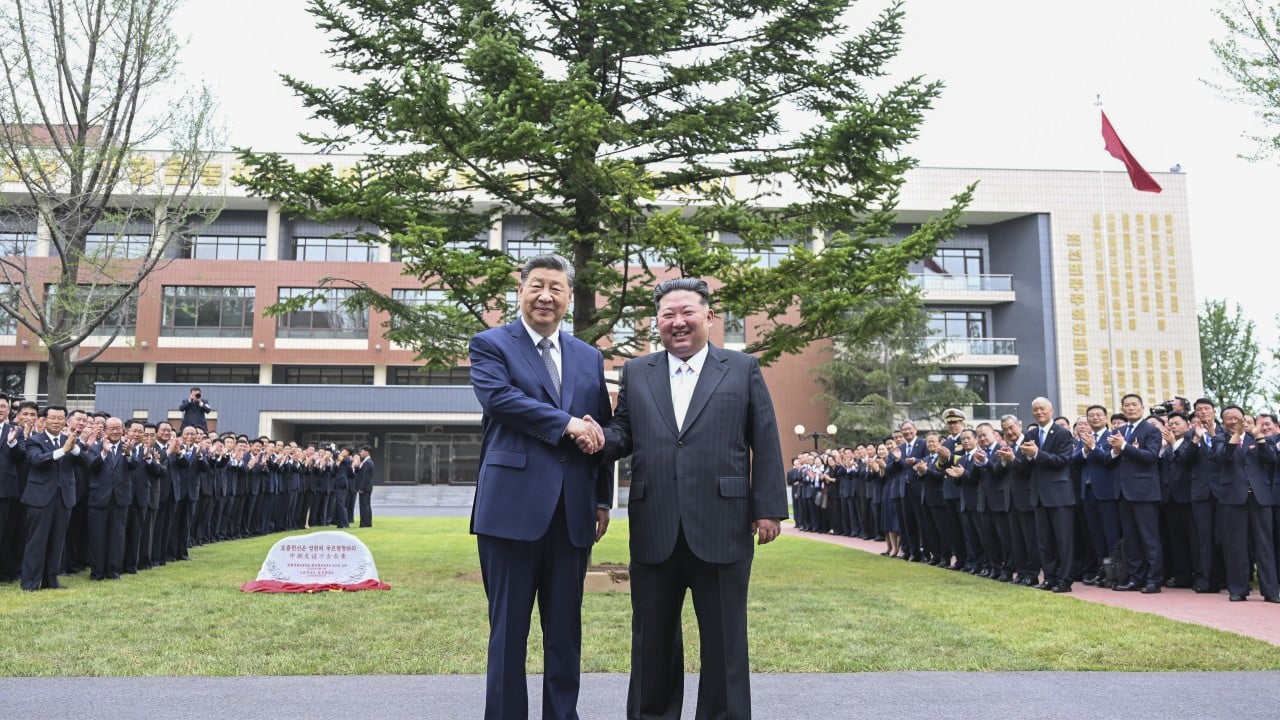
When Chinese President Xi Jinping stepped off his Air China flight onto the tarmac at Pyongyang’s Sunan International Airport for his first visit in seven years, the optics were predictably symphonic. Red carpets, a 21-gun salute, and carefully choreographed crowds waving plastic flowers offered a textbook display of socialist solidarity. Yet behind the staged warmth between Xi and North Korean leader Kim Jong Un lies a cold, transactional realignment that permanently rewrites the security dynamics of Northeast Asia.
For years, Western diplomatic strategies relied on a comfortable fiction. The consensus held that China, weary of an unpredictable nuclear neighbor, would eventually use its massive economic leverage to force North Korea toward denuclearization. Xi’s high-profile summit effectively shatters that illusion. By elevating bilateral relations to a formal strategic partnership and completely omitting any reference to denuclearization from official joint statements, Beijing has signaled that it now views Kim’s nuclear arsenal not as a regional liability, but as a structural asset.
This pivot is driven by necessity. Over the past few years, Beijing has watched with growing alarm as the United States systematically fortified its security architecture along China’s eastern flank. Washington’s aggressive push to build a trilateral military alliance with Tokyo and Seoul, paired with Japan's historic defense buildup and relaxed restrictions on exporting lethal weapons, has triggered deep containment anxieties in Beijing.
To break this encirclement, China is securing its backyard.
The Death of Denuclearization
The absolute silence on disarmament during the Pyongyang summit tells the real story. In 2019, during Xi’s last trip to the North Korean capital, Chinese state media openly declared Beijing’s commitment to playing a "constructive role in the denuclearization of the Korean Peninsula." That language is now dead. It has been replaced by boilerplate language about mutual development and structural alignment.
This rhetorical erasure is a deliberate concession to Kim Jong Un. The North Korean dictator has spent the last several years expanding his nuclear-capable arsenal, unveiling a new uranium enrichment facility, and testing diverse delivery systems designed to reach both Seoul and the American mainland. Kim’s ultimate diplomatic goal has always been simple. He wants international recognition as a de facto nuclear weapons state, forcing the West to negotiate on his terms. By refusing to bring up disarmament, Xi gave Kim exactly what he wanted: a tacit, superpower endorsement of his nuclear status.
Beijing’s calculation is brutally pragmatic. A disarmed, vulnerable North Korea risks collapse, an eventuality that could bring a unified, US-aligned Korean nation right to the Chinese border. Conversely, a nuclear-armed North Korea acts as a highly effective lightning rod. It absorbs Western diplomatic fury, forces the Pentagon to split its strategic attention, and serves as an unruly, heavily armed guard dog on China's northeastern perimeter.
Rescuing Pyongyang from Moscow
The timing of Xi’s voyage points to another, overlooked friction point. Beijing is moves to curb Vladimir Putin's growing influence over Kim Jong Un.
Following the pandemic-era isolation that devastated North Korea’s economy, Kim found an aggressive, free-spending patron in Moscow. Desperate for artillery shells and manpower for its grinding war in Ukraine, Russia traded advanced military technology, food, and diplomatic immunity at the UN Security Council for North Korean troops and munitions. This sudden intimacy between Moscow and Pyongyang caught Beijing off guard.
While China benefits from an anti-Western axis, it views Northeast Asia as its exclusive sphere of influence. A North Korea completely dependent on Moscow risks dragging China into unpredictable European security entanglements, or worse, empowering Kim to initiate a localized military provocation that Beijing cannot control.
The economic packages rolled out during the summit show China reasserting its dominance as Pyongyang's primary patron. Xi offered significant investments in North Korean agriculture, healthcare, and infrastructure, alongside the resumption of lucrative Chinese group tourism and transport links. Monthly trade between the two nations has already surged past historical benchmarks, largely driven by North Korean imports from Chinese factories.
China is proving that while Russia can buy ammunition with military hardware, Beijing controls the daily economic survival of the Kim regime.
The Taiwan Variable
The diplomatic ledger was not entirely one-sided. In exchange for economic lifelines and nuclear cover, Kim delivered a critical geopolitical chip to Xi. The North Korean leader explicitly affirmed his absolute support for the "One China principle," declaring that regardless of shifting global dynamics, Pyongyang recognizes Beijing's total sovereignty over the Taiwan Strait.
This is a critical endorsement as cross-strait tensions continue to simmer. In the event of a military conflict over Taiwan, North Korea’s role changes from an isolated autocracy into a dangerous wild card. A heavily armed Pyongyang tied to a mutual defense pact with Beijing forces the United States and Japan to keep substantial naval and air assets stationed in the East Sea, preventing them from fully reinforcing Taiwan.
The strategic partnership established in Pyongyang binds the security of the Korean Peninsula directly to the fate of Taiwan.
Washington’s traditional playbook of relying on Beijing to police Kim Jong Un is officially obsolete. China is no longer a partner in containing North Korea. It is the architect of its preservation. By integrating Kim's rogue state into its broader strategy to counter American power in the Pacific, Beijing has guaranteed that the nuclear crisis on the peninsula will not be solved, but sustained.


:max_bytes(150000):strip_icc():focal(665x0:667x2)/gettyimages-50733149-2000-8b129a2475974982a915418ce92a73d8.jpg)