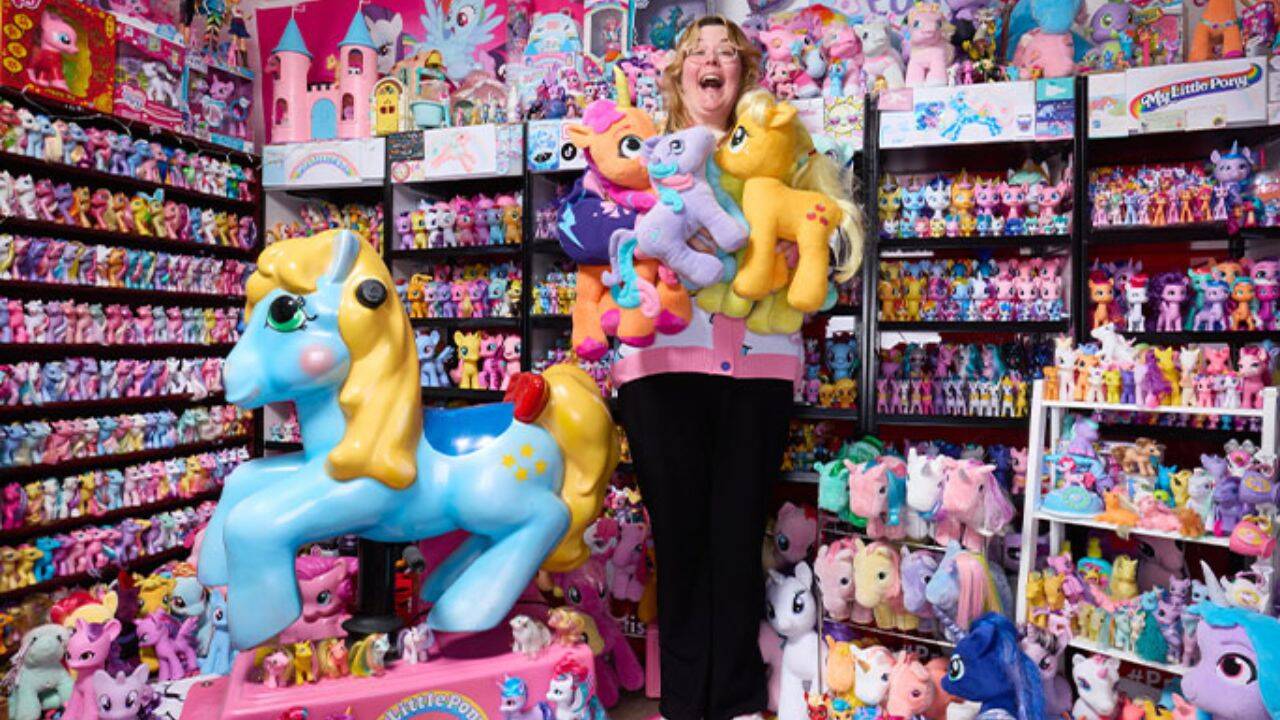
When a British collector amassed 4,550 My Little Pony items after her childhood request for a real horse was denied, tabloid headlines framed it as an eccentric human-interest quirk. That framing misses the real story. Behind the pastel plastic shelves lies a cold, quantifiable reality involving the exorbitant cost of equine ownership in the United Kingdom, the deliberate psychological hooks of 1980s toy manufacturing, and a modern secondary market where vintage vinyl commands serious capital.
To understand how a childhood compromise turns into an archive of more than four thousand artifacts, you have to look at the math first. Parents do not say no to ponies out of spite. They say no because the financial barrier to entry is brutal.
The Brutal Math of British Horse Ownership
In the United Kingdom, owning a horse is rarely a casual middle-class hobby. It is an ongoing
The Real Psychology Behind a 4,550-Piece My Little Pony Collection
lifestyle
When a British woman amassed 4,550 My Little Pony items after being denied a real horse in childhood, tabloid headlines framed it as a charming, slightly eccentric human-interest story. That framing misses the actual story entirely. The accumulation of thousands of plastic equines is rarely about the toys themselves; it is a textbook case of compensatory consumption, where an unmet childhood desire transforms into an adult archival obsession. While standard news coverage treats extreme collecting as a quirky hobby, behavioral economics and consumer psychology reveal a much sharper reality about how adults process early deprivation, navigate nostalgia markets, and assign emotional value to mass-produced plastic.
The Anatomy of Compensatory Consumption
Children ask for ponies. Parents say no. Usually, the story ends there, filed away alongside requests for backyard swimming pools and pet monkeys. Horses are expensive, demanding animals requiring stables, veterinary budgets, and acres of pasture—luxuries firmly out of reach for the average working-class or middle-class family in the United Kingdom. When a child experiences a hard boundary around a deeply desired object or experience, that unmet need does not simply evaporate upon reaching adulthood.
In consumer behavior research, compensatory consumption occurs when an individual purchases goods to offset a psychological deficit or an unfulfilled aspiration. Instead of acquiring the inaccessible primary object—a living, breathing horse—the buyer substitutes an accessible, controllable proxy. A vintage 1980s Hasbro pony costs a few pounds at a car boot sale or an online auction. One pony provides a brief dopamine hit. Four thousand five hundred and fifty ponies represent an ongoing, decades-long effort to satisfy a hunger that plastic was never designed to feed.
Consider a hypothetical example to see how this escalation works in practice. Imagine an adult who grew up in a household where musical instruments were strictly forbidden due to noise and cost. At thirty-five, with disposable income and no parental oversight, they buy one vintage guitar. Then another. Within ten years, their spare bedroom holds sixty guitars they barely play. The instruments are not tools for making music; they are physical proof that the adult now holds the power the child lacked.
For the British collector, every G1 (Generation One) pony, brushable mane, and playset acts as a tiny monument to personal agency. You cannot easily keep a thoroughbred in a suburban semi-detached house, nor can you pause a real horse's aging process or prevent its medical emergencies. Plastic, however, is permanent. It stays on the shelf exactly where you put it.
Why Nostalgia Markets Thrive on Unfinished Business
The secondary market for 1980s and 1990s toys has exploded into a multi-billion-dollar global sector, driven almost entirely by adults buying back their childhoods. Toy manufacturers like Hasbro understood this dynamic long before internet auction houses made hunting down rare variants effortless. When My Little Pony launched in 1982—evolving from the earlier 1981 "My Pretty Pony" concept—it was engineered specifically for collectibility.
Unlike a single doll or a generic stuffed animal, the line relied on distinct color palettes, unique "cutie marks" on the flanks, and subtle variations across international releases. This design architecture exploits a well-documented cognitive quirk known as the Zeigarnik effect, which states that people remember uncompleted or interrupted tasks far better than completed ones. A partial set feels psychologically itchy. A missing variant from a 1984 UK-exclusive release becomes a nagging void that demands resolution.
Tabloid journalism loves a clean, heartwarming narrative arc: girl wants horse, girl gets toys, woman is happy. Industry analysts look at the same facts and see a sophisticated retail trap meeting a vulnerable emotional trigger. The shift from casual enthusiast to mega-collector happens quietly, usually accelerating when internet marketplaces remove geographical friction. Thirty years ago, building a 4,550-piece archive required exhausting physical legwork across flea markets, charity shops, and pen-pal trading networks. Today, algorithmic recommendation engines feed the habit 24 hours a day, serving up rare prototypes, mint-in-box releases, and foreign factory errors directly to a collector's smartphone.
The Economics of Mass-Produced Scarcity
To outsiders, dedicating entire rooms of a residential property to molded polyvinyl chloride (PVC) looks financially reckless. Yet inside the collecting ecosystem, participants frequently justify the expenditure through the lens of alternative asset preservation.
Mint-condition Generation One ponies, particularly mail-order exclusives or variants produced in smaller runs for European and South American markets, regularly fetch hundreds of pounds each. A collector sitting on 4,550 items is not just managing clutter; they are curating an inventory that, if liquidated piecemeal, could rival the value of a modest pension pot—or at least easily eclipse the purchase price of several actual horses.
That financial rationalization carries a massive catch. Valuation is strictly theoretical until a sale occurs. Liquidating a massive, hyper-specialized collection requires hundreds of hours of photography, grading, packaging, and customer service. Selling it in bulk to a dealer typically yields thirty to forty cents on the dollar. The monetary value serves primarily as a psychological shield, protecting the collector from accusations of frivolous spending while keeping the emotional attachment firmly intact.
The Blurred Line Between Archiving and Hoarding
Media coverage of extreme collections walks a delicate tightrope, often celebrating behaviors that, under slightly different lighting, would trigger clinical concern. Psychologists and professional organizers draw sharp distinctions between structured collecting and compulsive hoarding, though the physical footprint of both can look remarkably similar to an uninvited guest.
A true collector curates. Items are categorized by generation, year, or condition, cleaned, displayed deliberately, and integrated into a coherent visual system. The person knows what they own and derives genuine aesthetic or historical satisfaction from the arrangement. Hoarding, conversely, is marked by disorganized accumulation, severe distress at the thought of discarding anything, and the gradual loss of functional living space—beds covered in boxes, kitchens rendered unusable, hallways narrowed to goat paths.
When a collection hits 4,550 items, spatial reality becomes an unavoidable adversary. Standard British homes are not built with commercial warehouse square footage. Housing thousands of individual pieces demands dedicated shelving, climate control to prevent "pony cancer" (a notorious fungal or chemical degradation that causes brown spots on vintage vinyl), and rigorous dust management.
At this scale, the collection stops being something the owner possesses and quietly flips into something that possesses the owner. Maintenance dictates the household schedule. Vacations get weighed against auction end-times. Spare bedrooms become off-limits to overnight guests because the beds are occupied by tiered acrylic risers holding pastel-colored figurines.
The Cultural Double Standard of Adult Play
Look closely at the public reaction to the British woman's pony archive, and an uncomfortable cultural bias snaps into focus. Society routinely grants adult men a free pass for obsessive, high-volume collecting—provided the objects carry masculine-coded prestige.
A man who converts his basement into a shrine of 4,000 vinyl records, vintage comic books, Star Wars action figures, or rare sneakers is widely viewed as a connoisseur, a pop-culture historian, or a savvy investor. Even when the financial outlay is identical and the spatial takeover is just as total, masculine collecting is framed around mastery and curation.
When an adult woman amasses 4,550 items from a toy line marketed to young girls, the cultural framing shifts immediately toward infantilization and eccentricity. Reporters emphasize the childhood denial of a pony, casting her as someone perpetually stuck in an eight-year-old's bedroom rather than recognizing her as a serious toy archivist preserving four decades of industrial design and pop-culture history.
This double standard ignores the fact that My Little Pony is one of the most commercially significant toy franchises of the last half-century. Documenting its evolution—from the chunky, realistic equine proportions of the 1980s to the stylized, anime-influenced designs of the 2010s Friendship is Magic era—is no less legitimate than cataloging vintage Hot Wheels or G.I. Joe figures. The discomfort observers feel stems less from the volume of plastic and more from an adult woman unapologetically occupying domestic space with hyper-feminine nostalgia.
What Happens When the Shelves Are Full
Every mega-collection eventually collides with hard physical and psychological limits. Houses run out of wall space. Credit cards hit ceilings. Rare variants become so scarce that years pass between legitimate acquisitions, starving the collector of the hunt that fueled the habit in the first place.
For people whose collecting began as a response to a specific childhood denial, reaching the peak of accumulation often triggers an unexpected emotional reckoning. You can line every wall from floor to ceiling with painted vinyl, organize every comb and ribbon by Pantone shade, and still find yourself standing in a quiet room without the living, breathing animal you actually wanted at age seven.
The tragedy of compensatory consumption is not that it fails to bring joy—it clearly delivers structure, community, and daily delight to millions of collectors worldwide. The catch is that substitutes only ever solve the problem of the substitute. A shelf full of 4,550 plastic ponies proves beyond a shadow of a doubt that nobody can tell you "no" anymore, even if the horse never shows up.