Inside a secured basement laboratory in upstate New York, a cylindrical stainless-steel vat hums with a low, rhythmic vibration. It sounds like a mechanical heartbeat. To a passerby, it looks like an oversized industrial refrigerator. But inside, the temperature is hovering just a fraction of a degree above absolute zero—colder than the deepest, most remote void of interstellar space.
Deep within that manufactured freeze, a tiny silicon chip is trying to do something that defies the very physics of our daily lives. It is trying to exist in two places at once.
For decades, computing has been a predictable game of light switches. Flick a switch on, you get a one. Flick it off, you get a zero. Every photo you have ever taken, every email you have ever sent, and every financial transaction that keeps your world turning is just billions of those tiny switches flipping on and off with blinding speed. It is a system built on absolute certainty.
Quantum computing throws a brick through that window of certainty. It operates on probabilities. Instead of a switch that is either up or down, think of a spinning coin. While the coin is spinning on the table, it is neither just heads nor just tails. It is a blur of both. That blur is called superposition. It allows a machine to calculate millions of possibilities simultaneously.
If regular computers navigate a maze by trying every single path one after the other, a quantum machine explores every path at the exact same moment.
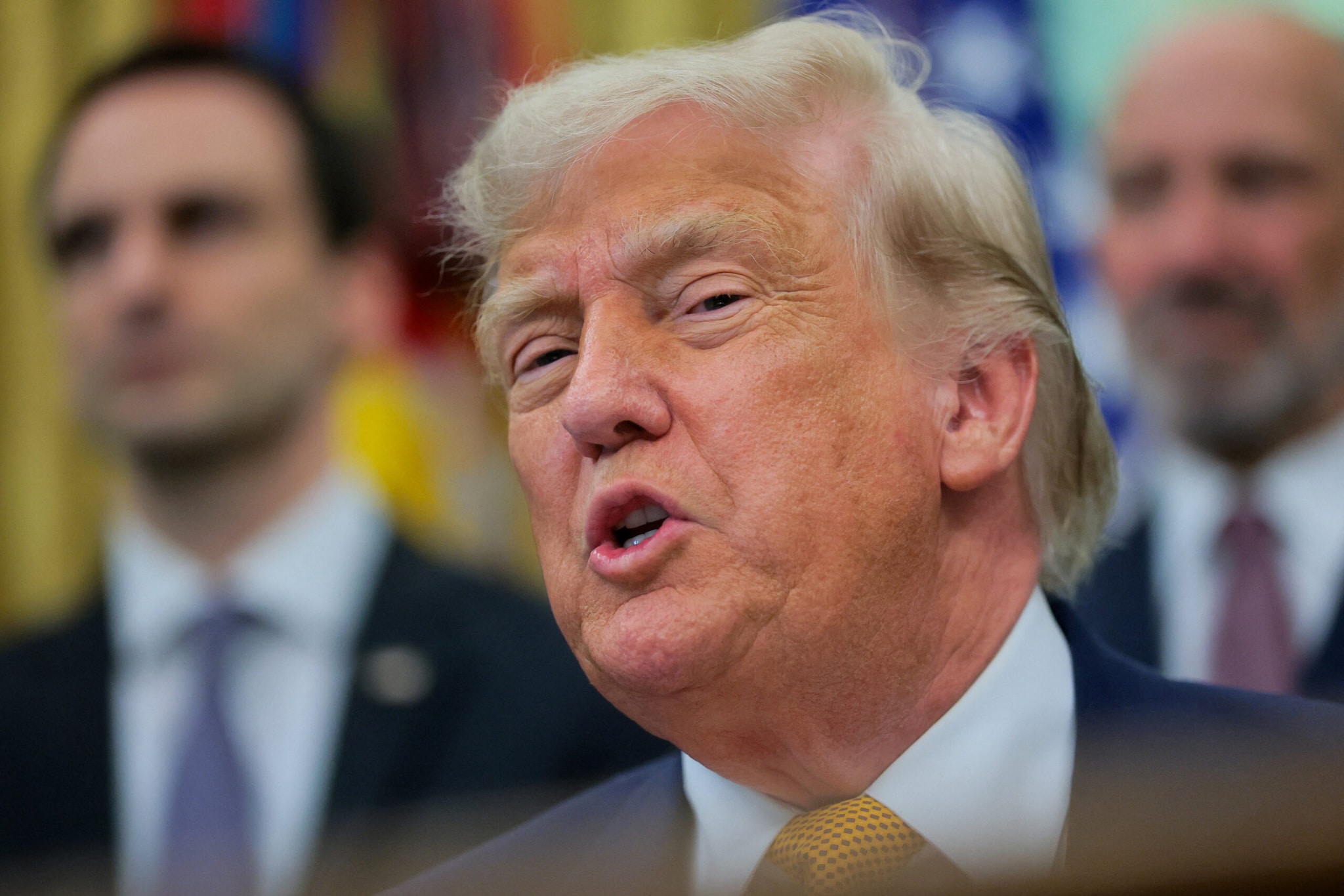
This is not a story about abstract physics. It is a story about a quiet, frantic global race that recently landed on the desk of the Oval Office, culminating in a sweeping executive order from President Trump targeting a five-year breakthrough in national quantum capability. The signing pen hit the paper because the stakes of this technology are entirely human. They involve the security of your bank account, the structural integrity of the electrical grid feeding your home, and the global balance of military power.
The problem with a spinning coin is that eventually, it stops.
If a truck rumbles past the laboratory outside, or if a nearby cell phone tower pulses a signal, the delicate quantum state inside that freezing box collapses. Physicists call this decoherence. The blur vanishes. The coin slaps down on the table. The calculation is ruined.
To understand why a government would commit billions of dollars to keeping a few chips cold, consider a hypothetical encryption specialist named Sarah. She works for a major financial institution, safeguarding the cryptographic keys that protect millions of personal savings accounts. Right now, those keys rely on mathematical problems so complex that a standard supercomputer would need thousands of years to crack just one of them. Sarah sleeps well at night because the math is an unbreakable wall.
A fully realized quantum computer would walk through that wall like a ghost.
Because it can calculate every variable at once, a quantum machine could theoretically dismantle modern encryption codes in a matter of seconds. The day that happens is known in intelligence circles as "Y2Q"—the quantum equivalent of the millennium bug, but with teeth. If an adversarial nation achieves that capability first, the digital locks on every vault, power plant, and military communication channel in the Western world instantly become useless.
The executive order signed by President Trump is an aggressive attempt to ensure that the American flag is planted on that summit first. By setting a strict five-year horizon for tangible breakthroughs, the directive funnels massive federal funding into a coordinated network of national laboratories, private tech firms, and university research teams. It attempts to bridge the gap between academic theory and industrial scaling.
But throwing money at a freezer does not automatically make it work.
The real struggle takes place at the atomic level, where researchers are fighting a war against noise. To scale a quantum computer up to the point where it can outperform a classical supercomputer—a milestone known as quantum supremacy—scientists need to string together thousands of these delicate, spinning-coin variables, known as qubits. The more qubits you add, the noisier the environment becomes. It is like trying to build a house of cards during a gale.
Walk into any university lab working on this problem, and you will see the physical toll of this race. You will find graduate students sleeping on cots next to liquid-helium pumps, their eyes bloodshot from staring at lines of telemetry data. They are chasing errors. They are hunting for single photons of stray heat that can ruin months of work.
The pressure is immense because they know they are not working in an academic vacuum. Similar teams in Beijing, Munich, and Moscow are working under identical pressures, backed by their own state resources.
The timeline dictated by the administration is intentionally uncomfortable. Five years is an eternity in politics, but it is a blink of an eye in fundamental physics. Critics argue that forcing a hard deadline on a technology that still lacks a standardized architecture—some companies use superconducting wires, others use trapped ions suspended in lasers—is like ordering a blueprint for a supersonic jet before the internal combustion engine has even been perfected.
Yet, the history of monumental engineering suggests that discomfort is often the point. The Apollo program did not wait for a perfect consensus on rocket telemetry before committing to the moon; the deadline forced the consensus.
If the five-year push succeeds, the rewards extend far beyond the dark world of espionage and codebreaking.
Consider the way we create medicine. Right now, discovering a new drug is largely a process of sophisticated trial and error. Pharmaceutical companies simulate molecular interactions on classical computers, but those computers can only handle simple structures. For complex proteins, they have to synthesize the drug and test it in a physical lab, a process that takes a decade and costs billions. A quantum computer could simulate the exact behavior of molecules down to the individual electron, designing a targeted cancer therapy or an antiviral drug on a screen in an afternoon.
The implications for agriculture are just as profound. Right now, the world consumes roughly two percent of its total energy output just making synthetic fertilizer through the Haber-Bosch process, a century-old industrial method that requires massive heat and pressure. Yet, humble bacteria living on the roots of clover plants do the exact same thing at room temperature every day. They use a natural catalyst that our current computers are too weak to simulate or understand. Unlocking that single chemical secret could radically reduce global carbon emissions.
We are living in the brief, tense interlude before the spin stops.
The executive orders are signed, the budgets are allocated, and the machinery is humming in the basements. The coming years will determine whether these freezing boxes remain expensive laboratory curiosities or become the engines of a new century.
Back in the upstate laboratory, a technician checks a digital display. The temperature is steady. The qubits are holding their breath, suspended in their fragile, impossible blur. For a few minutes more, the noise of the outside world is kept at bay, and the light inside the coldest box on Earth keeps burning.