Silence.
That is the first thing you notice when a field loses its wild bees, though almost nobody thinks to listen for a sound that was never quite loud enough to name. On a cool May morning in southern Germany, the air over a clover strip smelled of damp earth, crushed thyme, and the sweet, heavy resin of early hawthorn blossoms. Ten years ago, standing beside that strip meant hearing a low, continuous hum vibrating through the soles of your boots—hundreds of small engines lifting off and touching down, dusting anthers with gold and carrying life across a few square yards of soil. Today, you can stand there for five full minutes with a net in your hand and watch a single solitary bee drift past like a stray ash flake.
For years, when people talked about bees in trouble, most of us pictured a white wooden hive sitting near an orchard. We thought of honey. We thought of jars on a breakfast table, golden and thick, maybe a little expensive at the farmers market. That image is comforting. It is also incomplete. Europe is home to roughly two thousand species of wild bees—miner bees, mason bees, cuckoo bees, bumblebees, carder bees, sweat bees—and recent European Red List assessments have shown that most of them are in decline, with hundreds of species threatened with extinction across the continent. Not just honeybees in managed hives. Wild bees, born in hollow stems, sandy banks, old stone walls, and forgotten corners of pasture, are slipping out of the picture at a pace that alarms even seasoned entomologists.
I have spent enough springs walking hedgerows, digging shallow soil cores, and peering through a hand lens at tiny, velvet-coated insects smaller than a grain of rice to know how easily they go unnoticed. If you do not know what you are looking for, a furrow bee looks like a speck of dust with wings. A nomad bee might be mistaken for a slender wasp. You walk right past them on your way to the train station or the supermarket, worried about rent, school schedules, headlines from capitals far away, completely unaware that an invisible workforce is thinning out right beside your shoes.
To see what is actually happening beneath those European skies, let us trace two hypothetical figures grounded in real ecological patterns across the continent. (This is a composite scenario built from field realities rather than a single individual's biography.) Call the first character Tomas, a small-scale pear and cherry grower outside Ghent. Call the second character Clara, an urban planner in a mid-sized city in northern Spain. Neither of them set out to become a bee advocate. Both of them woke up to a quiet crisis when something ordinary stopped working the way it always had.
Tomas walked his orchard rows every April with a clipboard and a knot in his stomach. His grandfather had planted those trees in rows wide enough for a horse cart, leaving thick borders of bramble, dandelion, and wild vetch along the ditches. Over three decades, those borders shrank. Fields consolidated. Sprays became more frequent to keep fungal spots and pests off fruit that buyers demanded should look spotless under grocery store lighting. Tomas noticed first that his early blossoms stayed open longer without setting fruit the way they used to. Honeybee hives rented from a commercial beekeeper helped a bit on warm, calm afternoons, yet honeybees are fair-weather specialists that often stay put when spring winds whip cold across an orchard or light rain beads on petals. Wild mason bees and mining bees, by contrast, work in cooler temperatures, fly shorter distances in tighter bursts, and buzz-pollinate or wedge themselves into flowers with a precision that honeybees simply do not match. When those wild bees vanished from the field edges, Tomas's harvest grew more unpredictable—fewer plump pears, more misshapen fruit, tighter margins at the end of autumn.
image_agent_tag_7888187202436739837
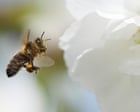
Look closely at what that photograph captures: a bee buried in the purple florets of a wildflower, legs dusted with pollen, body bridging the gap between one blossom and the next. That tiny transaction is not a side note in nature. It is the hinge on which flowering plants—and much of the food chain tied to them—turn. Think of pollination as a relay race run by thousands of specialized runners, each carrying a baton tailored to a specific flower's shape, depth, and timing. If half the runners drop out of the race, the baton does not always reach the next hand, even if one fast sprinter stays on the track.
Why are so many of those runners disappearing across Europe?
No single villain pulls the lever. It is death by a thousand small erasures.
First comes habitat loss—not always dramatic bulldozing, though that happens too, but the quiet tidying up of the landscape. A lawn mowed down to bare green turf every week is a desert to a ground-nesting bee. A field edge sprayed right up to the ditch strips away the wild clovers, knapweeds, and vetches that feed bees in late summer long after crop blossoms have faded. Many wild bees have flight ranges measured in tens or hundreds of meters rather than miles. If a female mining bee cannot find bare, sun-warmed earth to dig her nest shaft and enough flowers within a short hop to provision her larvae, her lineage ends right there.
Then come pesticides, habitat fragmentation, and climate shifts arriving out of sync. A flower opens two weeks early after a mild winter spell, while the wild bee species adapted to pollinate it emerges on its old internal clock—or vice versa. Add fragmented patches of green space separated by highways and monoculture fields, and isolated populations lose genetic resilience. When a wet spring or a heatwave hits, small, disconnected colonies cannot bounce back.
Here is where I have to admit something uncomfortable, both as someone who cares deeply about these insects and as a writer trying to make sense of the numbers. Even experts sometimes feel a heavy knot in their chests when looking at Red List totals. When you read that well over half of Europe's assessed wild bee species are declining, with scores threatened with extinction, it is easy to swing between two unhelpful extremes. One is numbness: Another environmental warning, another sad statistic, pass the coffee. The other is doom: If most of them are in decline, maybe it is already too late.
Neither extreme is true. And neither helps.
Let us return to Clara, our hypothetical city planner in northern Spain, to see why despair is premature—and why business-as-usual is dangerous. (Again, a composite figure representing real municipal shifts across European towns and cities.) Clara spent her first years in planning drawing parking lots, widening arterial roads, and signing off on manicured municipal roundabouts planted with neat rows of non-native shrubs that looked tidy in brochures and offered zero nectar to native insects. Then a summer heatwave baked the city center, stormwater runoff flooded a low-lying neighborhood after a cloudburst, and a local ecology group presented data showing how fragmented urban green corridors were.
Clara started small. Instead of mowing every public verge every two weeks from March to October, her department left strips unmown through spring and early summer so clover, hawkweed, and wild chicory could bloom. They planted native perennials along a pedestrian greenway—borage, scabious, thyme, willow—creating stepping stones so bees could move from a river bank to community gardens without hitting a wall of asphalt. They asked contractors to leave deadwood piles and sandy patches in parks rather than sweeping every leaf and twig into a bin.
Nothing magical happened overnight. A single unmown strip does not rescue an endangered bee species on its own. Yet within two seasons, Clara watched hoverflies, bumblebees, and tiny solitary bees return to corners of the city that had been silent for years. Residents noticed, too. Neighbors began arguing over which patch of wildflowers looked messy versus alive, and slowly the city's definition of beauty shifted from sterile neatness to living abundance.
What does all of this mean for people who never set foot on a farm or work in city planning?
Consider what happens next if wild bees continue to slide downward: food becomes less diverse and more expensive, ecosystems lose their shock absorbers against weather swings, and landscapes grow thinner in both life and color. You do not need wild bees to grow wheat or rice, which rely on wind or self-pollination. You do need pollinators for apples, almonds, berries, courgettes, tomatoes, coffee, and a vast share of the vitamins, minerals, and antioxidants that keep human diets varied rather than bleakly starchy. Wild bees make crops more reliable even when managed honeybees struggle, boosting fruit set and quality in ways that no spray bottle or drone has come close to matching at scale.
More than that, there is a human stake that resists being turned into a spreadsheet. Every species of wild bee is an evolutionary masterpiece—a tiny living solution to a problem of wind, cold, heat, or flower geometry refined over millions of years. A wool carder bee scraping plant fuzz to line a nest cavity in a hollow reed; a long-horned bee sleeping curled inside a flower petal at dusk; a bumblebee vibrating its wing muscles at just the right pitch to shake pollen loose from a blossom like a tuning fork. When a species vanishes, we do not just lose a name in a database. We lose a specific way of being alive on this earth.
That is why researchers and conservationists keep calling this moment a crucial opportunity to act rather than a post-mortem. Decline is real, severe, and documented across Europe. Yet steep decline is not the same as total extinction—not yet. Many wild bees respond remarkably fast when given space, food, and shelter, because insects reproduce quickly and can recolonize restored patches when corridors exist. The window to bend the curve is open right now, through agricultural policy that rewards flower-rich field margins and gentler pest management, through cities that treat green space as living habitat rather than green carpet, and through everyday choices in backyards, balconies, and shopping baskets.
I still think about that quiet morning by the clover strip in southern Germany. The hum was faint, almost easy to miss if your mind was racing ahead to the next task on your list.
Stop for ten seconds the next time you walk past a patch of weeds in full bloom—listen closely before you reach for the mower, and ask what kind of world you want to hear humming outside your window ten summers from now.