The wind across the South Saskatchewan River does not care about silicon. In the dead of winter, it bites with a dry, sub-zero precision that forces your chin into your collar and makes you wonder why anyone ever chose to build a city here. In the heat of July, it sweeps across the plains, carrying the scent of dry grass and heavy loam.
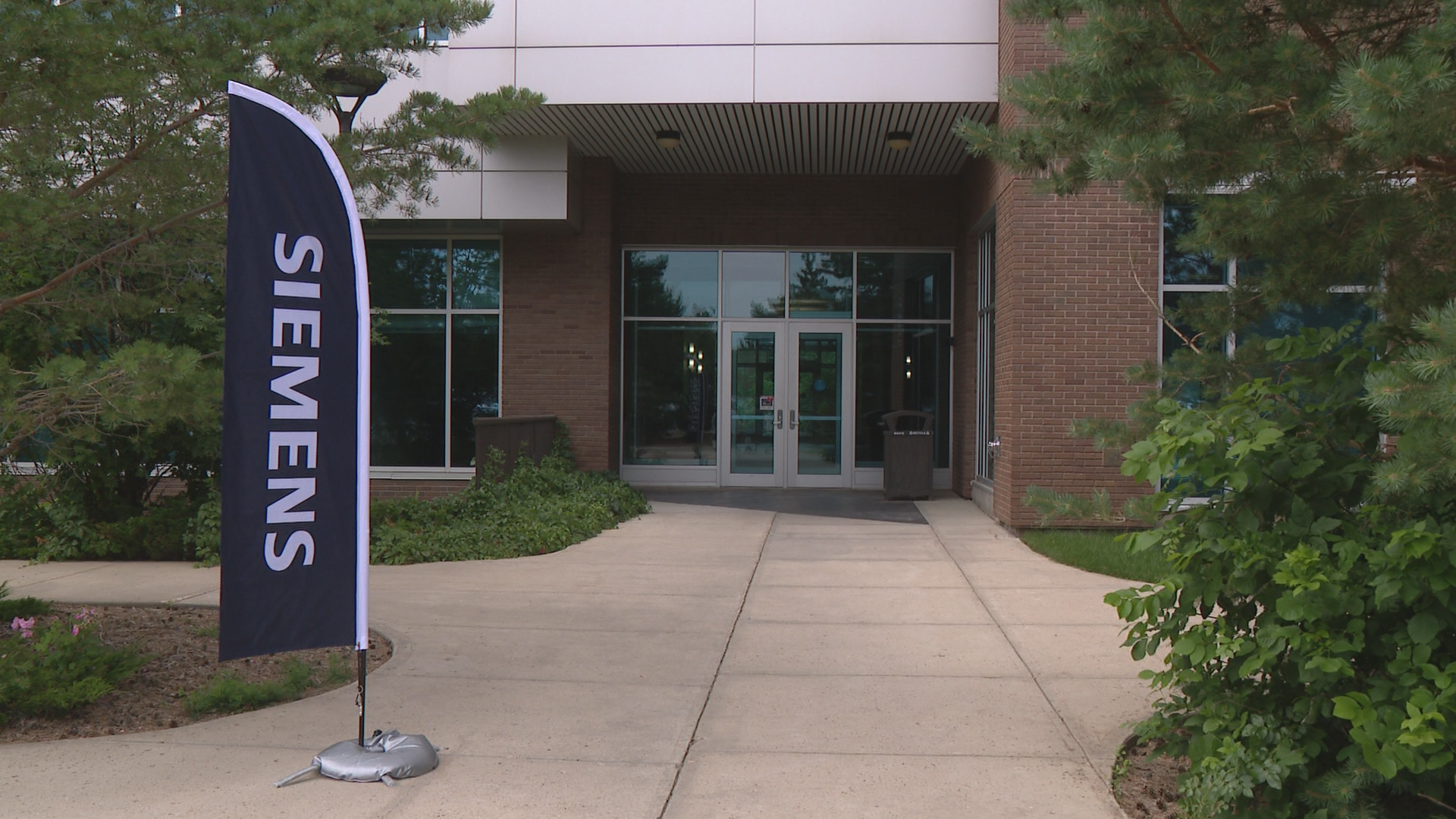
If you walked into the Innovation Saskatchewan Research and Technology Park on a quiet morning, you would see a modest brick building. It looks like an insurance office or a regional library. But inside, on the fourth and fifth floors, people are quiet. They stare at monitors displaying intricate, multi-layered architectures that look like city maps designed by an ancient, hyper-rational civilization.
They are designing the invisible nervous system of our world.
Every time you unlock your smartphone, every time an electric vehicle adjusts its braking system on an icy highway, and every time a massive server farm processes a complex machine-learning query, a microscopic piece of hardware has to work perfectly. Those physical chips are manufactured in massive, multi-billion-dollar fabrication plants in Taiwan, Arizona, or South Korea. But before they can be etched onto silicon, they must be designed.
And a shocking amount of that design happens right here, in Saskatoon.
The Sandbox in the Snow
To understand how a quiet prairie city became a linchpin in the global semiconductor supply chain, you have to look back to 2005. Imagine a tiny, drafty 300-square-foot office just across the street from the University of Saskatchewan. Inside, a handful of local engineers are trying to solve a problem that most people do not even know exists.
The physical limits of silicon are stubborn. As transistors shrink to the size of a few atoms, they stop behaving like predictable switches and start behaving like chaotic quantum entities. Designing a chip with billions of these volatile components is like trying to plan a metropolis where every brick has a small chance of spontaneously vanishing or turning into liquid.
The traditional way to test these designs was slow, agonizing, and expensive. You simulated a few scenarios, crossed your fingers, and spent millions of dollars to print a prototype. If there was a flaw, you started over.
The founders of a local startup called Solido Design Automation had a different idea. What if you used machine learning to simulate billions of variations instantly, predicting where a chip would fail before a single grain of silicon was ever cut?
It was a wild, contrarian bet. In 2005, "artificial intelligence" was still the stuff of niche academic journals and science fiction novels. But the bet paid off. By 2017, the global engineering giant Siemens took notice. They did not just buy the company; they realized that the brain trust built in Saskatoon was irreplaceable.
The Battle for the Brains
There is a common assumption in the technology world that if you want to build something that changes the human experience, you have to do it in Silicon Valley. You have to endure the crushing rent of San Francisco, the frantic networking events, and the relentless, exhausting churn of talent.
But there is a quiet tragedy to that model.
Consider a hypothetical graduate named Sarah. She grew up in a small town outside Prince Albert. She has a brilliant mind for mathematical physics. Under the old rules of the tech industry, Sarah’s path was predetermined: graduate from the University of Saskatchewan, pack her life into two suitcases, and board a one-way flight to California or Seattle. She would leave behind her family, the wide-open prairie skies, and the community that raised her. Her hometown would lose another mind, another future, another taxpayer.
It is a slow, steady drain that quietly hollows out regional economies.
But the expansion of Siemens’ Saskatoon research and development hub—a fresh 10,000-square-foot physical footprint that brings their total space to 45,000 square feet—rewrites that script. By adding 100 highly skilled roles over the next two years, the office is growing from 300 to 400 people.
These are not administrative or support roles. These are software engineers, artificial intelligence researchers, and physical simulation experts.
About 80 percent of the team here earned their degrees just down the road at the University of Saskatchewan. Because of this expansion, Sarah does not have to buy that plane ticket. She can buy a house five minutes from her childhood friends. She can build a life, raise a family, and still spend her afternoons writing the core algorithms that companies like NVIDIA use to design the next generation of artificial intelligence hardware.
The Global Stakes of Local Talent
We live in an era of acute vulnerability. The global semiconductor shortage of the early 2020s revealed just how fragile our highly centralized technology pipelines really are. A single disruption in a shipping lane or a geopolitical standoff can halt car factories on the other side of the planet.
This is why national sovereignty is no longer just about borders and energy reserves. It is about data sovereignty. It is about intellectual property.
When a global titan like Siemens invests in Saskatoon, it is not an act of corporate charity. It is a cold, calculated bet on the stability and quality of prairie talent. The innovation cycles are shrinking. The race to make chips smaller, colder, and faster is accelerating.
"It's always a race," Faisal Kazi, the president and CEO of Siemens Canada, observed during the announcement. "The innovation cycles are getting shorter and shorter, so we cannot stop."
The 100 new desks being moved into the fourth and fifth floors of the technology park represent 100 human minds focused on keeping that race alive. They are working on "digital twins"—virtual replicas of incredibly complex physical systems that allow engineers to test how a chip will age over ten years in a fraction of a second.
It is tedious, incredibly difficult work that requires a specific kind of stubbornness. Perhaps that patience is something cultivated by Saskatchewan winters, where survival requires planning, resilience, and a deep appreciation for things that are built to last.
The crowd that gathered for the ribbon-cutting on Wednesday morning has gone home. The politicians have packed up their microphones, and the local news crews have edited their thirty-second segments for the evening broadcast.
Upstairs, the lights stay on.
Outside the window, the prairie horizon stretches out forever, flat and unassuming. But inside, on glowing screens, a handful of local engineers are quietly mapping out the architecture of the future, one transistor at a time.