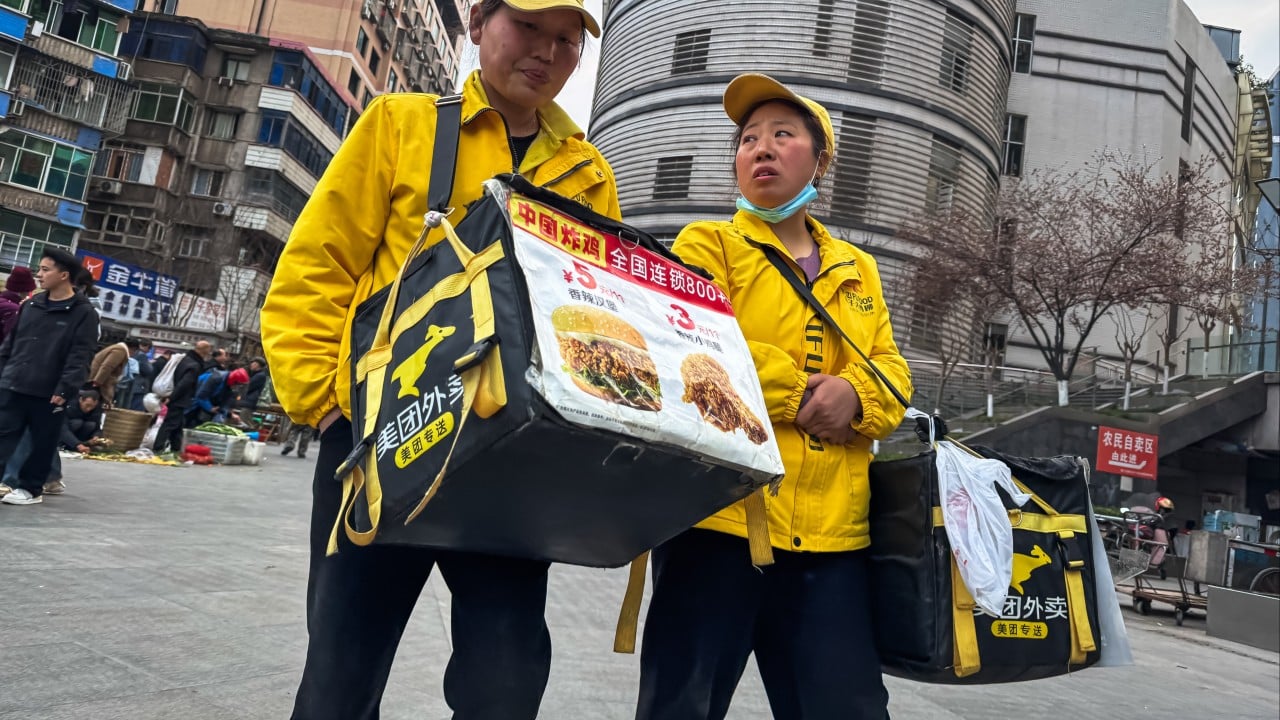
Rain slicks the asphalt in Shenzhen, turning the brake lights of a thousand electric scooters into bleeding streaks of crimson. To understand what is happening inside the highest levels of Chinese governance right now, you do not start in the cavernous, crimson-carpeted halls of Beijing. You start here, at 11:45 PM, watching a twenty-six-year-old man check his phone while steam rises from a Styrofoam box of spicy noodles strapped to his back.
Let us call him Wei. Wei is a composite, a hypothetical character built from the data of millions of real lives, yet if you stand on any street corner in Shanghai, Chengdu, or Guangzhou tonight, you will see him pass by in a blur of yellow or blue polyester. For the past six years, Wei has existed in an economic twilight zone. He has no fixed office, no traditional boss, and until very recently, almost no political footprint. He is a creature of the algorithm, propelled through congested traffic by a digital chime that dictates when he eats, when he sleeps, and how much money hits his digital wallet at the end of a fourteen-hour shift. If you found value in this piece, you should read: this related article.
Now, picture another room, three miles away and twenty stories up. The curtains are drawn against the rain. A ring light hums, casting a sterile, flattering glow over a twenty-two-year-old woman named Lin—another composite, representing a massive new class of digital laborers. Lin is three hours into a livestream, selling discounted facial cleansers to forty thousand invisible strangers. Her voice is hoarse. Her smile never falters. Like Wei, she is self-employed, hyper-connected, and entirely untethered from the traditional state-owned factories and sprawling corporate campuses that defined Chinese society for generations.
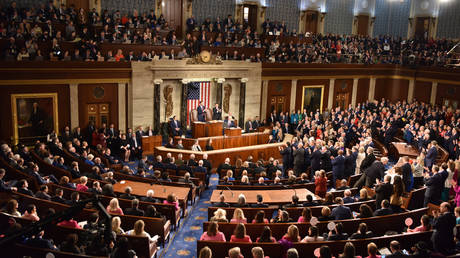
For decades, the architecture of political representation in China was built around those factories and campuses. If the Chinese Communist Party wanted to take the pulse of the nation, it looked to the steelworkers, the farmers, the engineers, and the local bureaucrats. Those were the people chosen to sit in the Great Hall of the People, raising their hands in unison to ratify the direction of the world’s second-largest economy. For another perspective on this development, check out the latest coverage from BBC News.
That world is disappearing. And Beijing knows it.
In a move that signals a profound recalibration of how power connects with the modern workforce, the Party has quietly opened its doors to a radically different kind of delegate for its upcoming national congress. The directive is clear: go find the delivery drivers, the ride-hail operators, the long-haul truckers, and the livestreaming influencers. Bring them into the fold. Give them a seat at the table.
At first glance, this looks like a routine bureaucratic update, the kind of dry political news that gets buried on page six of a financial daily. Look closer, however, and you will see one of the most consequential socio-political adaptations of the twenty-first century. This is not merely about diversity in a parliament; it is a high-stakes race to absorb an entire shadow economy before it drifts permanently out of reach.
The Vanishing Factory Floor
To grasp why a government would actively recruit people who sell lipsticks on camera or race against traffic on mopeds, you have to look at the sheer, staggering math of China’s labor shift. According to data from the All-China Federation of Trade Unions and national statistical bureaus, China is now home to roughly 84 million "new employment form" workers. When you widen the lens to include all flexible, freelance, and gig-economy participants, that number swells to an astonishing 200 million people.
Two hundred million. That is larger than the entire population of Brazil, operating largely outside the traditional employment structures that once served as the primary conduit for state organization and social welfare.
I remember walking through the industrial districts of Dongguan fifteen years ago. Back then, the social contract was visible in concrete and steel. Massive dormitories sat directly beside sprawling assembly plants. When the shift whistle blew, tens of thousands of workers poured out of the gates wearing identical uniforms. Organizing them, taxing them, providing them with healthcare, and—crucially—representing them politically was a straightforward logistical exercise. You simply went to the factory floor. The factory was the community, the safety net, and the political unit all rolled into one.
Today, many of those dormitories are quiet, or they have been converted into fulfillment centers for e-commerce giants. The workforce has shattered into millions of individual nodes, scattered across sprawling metropolises and connected only by fiber-optic cables and GPS signals.
Consider what happens when an economy undergoes that kind of fragmentation. Think of the traditional political system as a vast irrigation network designed to water a series of large, neatly plowed fields. Suddenly, the landscape changes. The big fields vanish, replaced by millions of tiny, scattered potted plants sitting on balconies across the country. If you keep pouring water into the old canals, the water misses the roots entirely. The plants wither, or they start drawing moisture from somewhere else.
For Beijing, leaving 200 million workers outside its formal political apparatus is an existential vulnerability. If the Party claims to be the vanguard of the working class, it cannot afford to have the fastest-growing segment of that class feel invisible, unrepresented, or alienated. By explicitly instructing local branches to nominate gig workers and digital creators as congress delegates, the leadership is attempting to rebuild the irrigation system in real time.
The Algorithm as the New Boss
Why does this matter to the person on the street? Because the friction between the gig worker and the tech platform has become one of the defining social tensions of modern China.
Return for a moment to our hypothetical courier, Wei, on his rain-slicked scooter in Shenzhen. In the early days of the platform economy, app-based work was hailed as a miracle of freedom. You were your own boss. You worked when you wanted. You earned what you put in.
Then came the optimization.
As competition among delivery platforms intensified, the algorithms grew ruthless. Delivery windows shrank by minutes, then by seconds. A single late drop-off—caused by a broken elevator, a security guard demanding registration at a gated compound, or a sudden downpour—could trigger automated financial penalties that wiped out half a day’s earnings. Couriers began running red lights, riding against traffic, and risking their lives simply to outrun a digital countdown clock on their handlebars.
In 2020, a viral investigative report in China exposed just how tightly the algorithm had wrapped itself around the throats of delivery riders, sparking a wave of public outrage and sympathy. Suddenly, the delivery driver was no longer just a convenient service provider; he was a symbol of hyper-capitalist exhaustion.
Around the same time, whispers of labor unrest began surfacing. Scattered protests broke out over wage cuts and arbitrary rule changes. For a governing apparatus obsessed with social stability, the message was unmistakable: you cannot leave the livelihoods of tens of millions of young, mobile, tech-savvy workers entirely to the mercy of private tech monopolies and opaque computer code.
Over the past few years, Beijing has responded with a two-pronged strategy. First, it forced tech giants like Meituan and Ele.me to relax their algorithmic deadlines, improve accident insurance, and allow riders to unionize under state-backed federations. Second, it began building physical "courier stations" across major cities—small, air-conditioned hubs where drivers can charge their phones, drink hot water, use the restroom, and, subtly, interact with local Party organizers.
Elevating gig workers to the status of congress delegates is the capstone of this effort. It transforms the delivery rider from a marginalized subcontractor into a recognized pillar of the national economy. When a courier in a yellow uniform sits in a provincial assembly hall next to a university president and a state bank executive, the symbolism is deafening. It tells millions of exhausted workers: We see you. You belong to the system, and the system belongs to you.
The Persuaders in the Ring Light
Yet, the inclusion of delivery drivers is only half the story. The other half—the recruitment of livestreamers, content creators, and social media influencers—is perhaps even more fascinating, and infinitely more complex.
Why would a traditionalist political party want influencers in its ranks?
To answer that, you have to understand how information and trust actually move through modern society. Legacy media no longer holds a monopoly on public attention. Today, a charismatic twenty-five-year-old livestreaming from a rural orchard in Yunnan can move more agricultural produce in four hours than a state-run distribution network could move in a month. A short-video creator explaining tax policy or historical trivia in plain, punchy Mandarin commands more genuine audience loyalty than a thousand official broadcasts.
Influencers are the new town criers. They are the trusted voices in the ear of the consumer, the commuter, and the teenager.
Let us look again at Lin, our hypothetical livestreamer in her high-rise apartment. For years, the relationship between Beijing and the influencer economy was marked by deep suspicion. Regulators watched warily as live-commerce exploded into a multi-hundred-billion-dollar juggernaut, bringing with it tax evasion scandals, counterfeit goods, vulgarity, and the worship of extreme wealth. High-profile takedowns of mega-influencers—most notably the staggering $210 million tax evasion fine levied against livestreaming queen Viya in 2021—served as a stern warning that fame on the internet did not place anyone above the law.
Crackdowns, however, are a blunt instrument. You can punish bad behavior, but you cannot regulate your way into genuine cultural influence. Eventually, policymakers realized that fighting the tide of digital media was futile. The smarter play was to ride it.
By bringing vetted, socially responsible influencers into the political fold, the Party achieves two goals simultaneously. First, it co-opts their massive distribution networks. An influencer who is also a Party delegate becomes an organic, relatable ambassador for national policies—whether that means promoting rural revitalization by selling local farm goods online, or encouraging young people to embrace vocational training.
Second, it sends a signal to the sprawling digital creator economy that there is a legitimate, respectable career path inside the mainstream establishment. It tells young people staring into ring lights across the country that they do not have to choose between chasing internet clout and serving their country. They can do both, provided they play within the guardrails.
The Delicate Art of Co-optation
It is easy, from a Western vantage point, to view this entire development with cynicism. Critics will rightly point out that becoming a delegate in China’s political system is nothing like winning a contested election in a liberal democracy. Candidates are rigorously vetted, screened for ideological alignment, and expected to champion consensus rather than opposition. A delivery driver sitting in a regional congress will not suddenly stand up and call for independent labor unions or radical political overhaul.
To dismiss this as pure theater, however, is to misunderstand how responsive authoritarian governance actually works.
History shows that resilient political systems survive not by remaining rigid, but by absorbing emerging social forces before those forces calcify into organized opposition. During the early 2000s, the Chinese Communist Party made a famously controversial decision to allow private entrepreneurs—capitalists, in plain terms—to join its ranks. Traditionalists were horrified. How could a party built on socialist principles welcome factory owners and billionaires? Yet that single adaptation anchored the booming private sector to the state for two decades, fueling an unprecedented economic miracle while neutralizing the emergence of an independent political class of business elites.
What we are witnessing today is the digital-age sequel to that maneuver.
The new economic powerhouses are no longer just the owners of capital; they are the connectors of the digital grid—the platform workers who keep cities running and the content creators who shape public sentiment. By folding them into the delegate selection process, Beijing is creating an early-warning radar system.
Think about what happens when a real-life delivery driver sits in a committee meeting with local transport officials. He may not challenge the overarching political framework, but he will certainly tell them which intersections lack safe scooter lanes, how arbitrary parking fines are destroying drivers' incomes, and why algorithmic insurance loopholes leave injured riders destitute. Those granular, lived grievances are precisely the kind of data points that central planners desperately need to prevent small local frustrations from boiling over into widespread unrest.
Still, there is an undeniable tension at the heart of this experiment. Can you truly represent the raw, chaotic energy of the internet inside a highly scripted political institution?
Authenticity is the lifeblood of the influencer. Audiences follow creators because they feel unvarnished, spontaneous, and slightly rebellious. The moment a creator begins speaking in stiff, bureaucratic jargon, the audience swipes away. Similarly, a gig worker who becomes a celebrated political delegate risks losing touch with the brutal, day-to-day precarity of the streets that made his voice valuable in the first place. If he trades his rain-soaked helmet for a tailored suit and a permanent seat in a government office, he ceases to be a courier and simply becomes another bureaucrat.
Navigating that paradox will require a delicate touch from both the state and the individuals chosen to bridge these two worlds.
The Human Pulse Behind the Screen
Step back from the geopolitics and the economic theory for a second, and consider the sheer human drama of this shift.
For most of human history, the people who moved goods across cities and the people who entertained crowds in public squares occupied the lowest rungs of the social ladder. In imperial China, merchants and performers were routinely looked down upon by the scholar-official class—the educated elites who passed grueling civil service exams to earn the right to govern. That cultural divide persisted, in various forms, well into the modern era. Manual laborers were praised in abstract slogans, yet often treated as second-class citizens in gleaming urban centers. Digital entertainers were dismissed as frivolous kids chasing easy money.
Now, the scholar-officials are actively recruiting them.
Imagine being a twenty-eight-year-old woman who spent the last five years hauling freight in an eighteen-wheeler across the mountain passes of Sichuan, documenting her lonely, exhausting life on a short-video app to stay awake at truck stops. You never went to an elite university. You do not have family connections in Beijing. Your office is a cramped cab smelling of diesel and instant coffee. And then, one Tuesday morning, local officials reach out to tell you that your voice—your actual, unpolished experience of the open road—is needed to help shape national logistics and labor policy.
That moment carries a profound psychological weight. It validates a way of life that millions of people live every day, often feeling invisible to the wealthy urbanites who order their groceries with a tap on a glass screen.
We often talk about the future of work in cold, clinical terms—automation, artificial intelligence, platform economics, labor elasticity. We forget that behind every delayed delivery notification is a human heart beating faster in traffic. Behind every viral video clip is a person wrestling with burnout, algorithmic anxiety, and the desire to matter.
By pulling gig workers and influencers into the formal halls of power, China is acknowledging a truth that governments everywhere are struggling to confront: the center of gravity in human society has shifted. Power no longer resides solely in boardrooms, factories, or traditional newsrooms. It lives in the palm of the hand, glowing on a six-inch screen at midnight, carried forward by millions of people hustling through the neon rain.
The scooter’s taillight fades into the mist at the end of the avenue, the chime sounds again on the handlebars, and another order is accepted.