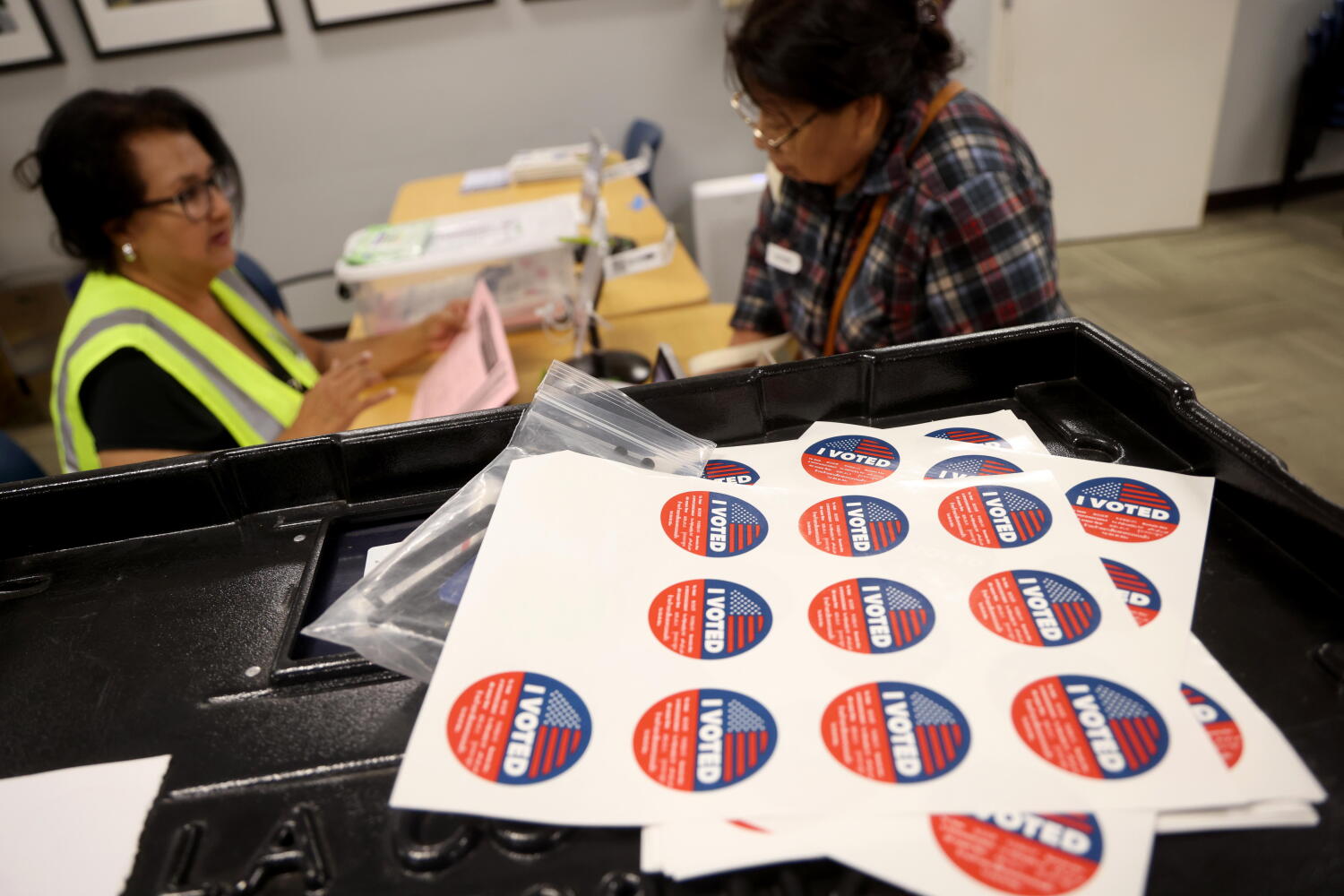
The fluorescent lights in a middle school gymnasium hum at a frequency that rattles your teeth. It is six in the morning on a Tuesday in November, and the air smells faintly of floor wax, damp wool coats, and burnt drip coffee.
For most political pundits, this room is just a data point. It is a precinct in a swing district, a tiny colored polygon on a glowing touch-screen map in a Manhattan studio. To them, the campaign season that brought us here was a series of predictable shocks—a chaotic symphony of last-minute polling swings, unexpected primary upsets, and billions of dollars spent on thirty-second attack ads designed to make you flinch.
They call it a season of surprises. They are wrong.
Nothing about Tuesday’s midterm elections is actually a surprise if you stop listening to the television and start listening to the silence at the kitchen table.
Consider a hypothetical voter named Elena. She is forty-two, works as a physical therapist in an aging suburban clinic outside Columbus, and spent the last six months ignoring every single text message from every single campaign committee. On the surface, Elena is the exact kind of voter who breaks polling models. She voted for one party in the last presidential race, donated twenty dollars to an opposing candidate during a local school board fight two years ago, and hasn't answered a call from an unknown area code since 2019.
When pollsters try to categorize Elena, their spreadsheets fracture. They label her "undecided" or "volatile."
In reality, Elena is simply exhausted by the theater of it all. And she is far from alone.
The Myth of the Predictable Wave
To understand why modern midterm elections feel like a rollercoaster with missing bolts, we have to look at the basic math of American off-year voting. Historically, midterms have functioned like a gravitational law. The party holding the White House almost always loses ground in Congress. Since the Civil War, the president’s party has lost House seats in nearly every single midterm cycle, with only a tiny handful of exceptions—1934, 1998, and 2002, moments defined by profound national crisis or rare political anomaly.
Consultants built entire empires on this clockwork predictability. They assumed voters operated like a simple pendulum: swing left in a presidential year, swing right two years later to restore balance, rinse, repeat.
Then the pendulum broke.
Over the last few election cycles, the traditional rules of midterm gravity began to warp. Instead of a neat, uniform wave washing over the country, we started seeing localized tsunamis moving in opposite directions at the exact same time. A suburban county in Pennsylvania might lurch dramatically toward one party while a rural county two hours west bolts just as violently toward the other.
The surprise of this campaign season wasn't that the polls were erratic. The surprise was that the political class still expected millions of complicated human beings to behave like herd animals.
What Happens When the Noise Stops Working
I remember standing outside a county clerk’s office in Michigan four years ago, watching an elderly man lean against a brick wall just to catch his breath before walking inside to drop off his absentee ballot. He wasn't wearing a campaign button. He didn't have a bumper sticker on his sedan. When a local reporter asked him which issue brought him out in the freezing rain, he looked at the microphone as if it were an alien artifact.
"My granddaughter's insulin," he said quietly. "And the bridge over the river that's been closed since May."
That was it. Two sentences. No talking points. No ideological manifesto.
Compare that quiet, heavy reality to the billion-dollar circus that dominates a modern campaign season. Over the past few months, campaigns across the country shattered fundraising records, pouring staggering sums into digital micro-targeting and saturation television buys. Every week brought a new "October surprise" engineered in a war room—a leaked audio clip, an out-of-context quote, a sudden endorsement meant to dominate a forty-eight-hour news cycle.
Yet something strange happened when those ads hit living rooms this fall. Voters didn't radicalize. They tuned out.
Behavioral economists have a term for this: habituation. When a stimulus is repeated constantly at maximum volume, the human brain stops registering it as an emergency and starts treating it like background static. Think of living next to a freight train track. The first night, the whistle shakes you awake in a cold sweat. By the third month, you sleep right through it.
Campaign strategists spent the last year blowing the train whistle louder and louder, convinced that panic was the only emotion capable of driving midterm turnout. They forgot that fear has a half-life. Once a voter realizes that every election is being sold as the literal end of civilization, the threat loses its currency.
The Invisible Stakes in the Ballot Booth
If fear isn't driving the surprises of this midterm cycle, what is?
Look closer at the ballot itself. Not the top of the ticket, where Senate and House candidates trade rehearsed insults under studio lights, but the bottom half of the page.
In state after state this Tuesday, the real fireworks are happening in the fine print. Ballot initiatives, state supreme court races, local bond measures, and secretary of state contests have quietly become the true battlegrounds of American life. Voters who feel completely alienated by national party brands are showing up in historic numbers to vote directly on policies that touch their daily existence—reproductive rights, minimum wage hikes, property tax caps, public school funding, and the rules governing how future elections will be run.
This creates a fascinating, deeply human contradiction inside the voting booth.
Picture a voter—let's call him Marcus, a small-business owner in Arizona who fixes commercial refrigeration units. Marcus despises national political rhetoric. He thinks both major parties in Washington spend too much money and listen to nobody. If you ask him his party affiliation, he will tell you he doesn't have one. Yet when Marcus steps behind the privacy screen on Tuesday, he isn't casting a blind party-line vote. He is assembling a custom mosaic. He might vote for a fiscal conservative for the U.S. Senate because he is terrified of inflation eating his profit margins, while simultaneously voting yes on a ballot measure to expand state healthcare access because his sister works retail without benefits.
Pollsters call this ticket-splitting, and for twenty years they declared it dead. They assumed polarization had welded every voter to a single party column from top to bottom.
This campaign season proved them wrong. When national politics feels broken, voters don't stop caring; they become surgical. They start treating their ballot like a toolbox rather than a team jersey.
The Anatomy of a Modern Campaign Upset
When a candidate pulls off a shock victory on Tuesday night—and several will—the post-mortem commentary will inevitably focus on the flashy moments. Pundits will point to a viral debate gaffe in late September or a massive ad buy in the final week.
They will miss the quiet work that actually won the race.
In almost every major upset of the past decade, the winning campaign did something decidedly unglamorous: it showed up early, knocked on doors in neighborhoods the opposition wrote off, and talked about kitchen-table mechanics rather than cable-news abstractions.
Consider the geography of a swing district. Most congressional maps are drawn with surgical precision to be safe for one party or the other, leaving only a few dozen genuinely competitive districts across the entire nation. Inside those narrow battlegrounds, victory rarely comes from converting a die-hard partisan from the other side. That almost never happens. Victory comes from persuading a tired, skeptical neighbor that their single piece of paper actually matters.
It happens on a Tuesday afternoon when a local candidate stands in a diner parking lot in rural Georgia or suburban Nevada, listening to a retired teacher explain why she can't afford her property taxes anymore. There are no cameras there. Nobody clips it for social media. It does not move a national tracking poll.
It just moves one vote. And then another. And then five thousand more, until a race that looked locked up in August suddenly flips by half a percentage point at two in the morning.
Why the Polls Keep Flinching
If you find yourself staring at election forecasts tonight feeling a knot of anxiety in your stomach, take a breath. You are not crazy for distrusting the numbers.
Polling has become one of the hardest jobs in modern science. Twenty years ago, a pollster could dial a thousand random landline numbers on a Tuesday evening and reach a clean, representative cross-section of the American public. Today, response rates have plummeted into the single digits. The people willing to spend twenty minutes answering a stranger's questions about politics on their cell phone are, by definition, unusually engaged—and often unusually partisan.
To compensate, pollsters use complex mathematical weighting to guess who will actually show up to vote. If they guess wrong about whether young voters in college towns or retirees in rural counties will turn out in higher numbers, their entire model tilts off its axis.
Think of a weather forecast trying to predict the exact path of a hurricane forty-eight hours before landfall. The meteorologists know a massive storm is coming. They know the barometric pressure and the wind speeds. What they cannot see is the tiny, invisible shift in upper-atmosphere temperature that nudges the storm thirty miles north at the last possible second.
Human beings are that upper-atmosphere shift.
No algorithm can measure the quiet decision a nurse makes at the end of a twelve-hour shift on Tuesday evening, exhausted and sore, deciding whether to drive straight home to her kids or make the ten-minute detour to the community center before the polls close at eight.
The Weight of the Curtain
Step back inside that middle school gymnasium for a moment.
It is late afternoon now. The early-morning rush of commuters has faded, replaced by a steady stream of parents picking up children from after-school programs, shift workers in reflective vests, and elderly couples walking arm-in-arm across the polished basketball court.
The fluorescent lights are still humming. The poll workers, most of them retirees who have been sitting at folding tables since dawn for barely minimum wage, are tired, their eyes red-rimmed, their voices raspy from repeating the same instructions four hundred times.
"Sign here, please. Take this privacy sleeve. Put your ballot into the scanner when you're finished."
There is nothing cinematic about this room. There are no sweeping orchestral scores, no dramatic slow-motion shots of flags waving in the wind. Just the soft, rhythmic whir-clunk of the optical scanner pulling another sheet of heavy cardstock into the locked metal box.
Yet every single shockwave of this chaotic campaign season—every billion-dollar ad campaign, every breathless cable panel, every heated argument at a family dinner table—narrows down to this exact, unremarkable transaction.
Democracy does not actually live in Washington. It does not live in polling averages or campaign war rooms. It lives in the three feet of space between a folding privacy screen and a ballpoint pen, where a single citizen stands completely alone with their own conscience, deciding what kind of country they want to wake up to on Wednesday morning.
The scanner whirs. The paper disappears. And the numbers on the wall begin to change.