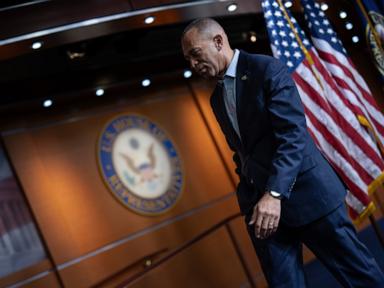
The fluorescent lights in the basement of the United States Capitol have a specific hum. If you have ever spent a bleak November week sitting on the cold marble floors outside a closed caucus room, you know that sound intimately. It is the low, electric buzz of career survival.
Inside those heavy oak doors, away from the cameras and the carefully manicured press releases, the Democratic Party is doing something it rarely does in public. It is grieving. And right after grief comes anger. You might also find this similar article insightful: Inside the Alberta Driver’s Licence Renewal Mess and the Three Exemptions Meant to Fix It.
When House Democrats gather to elect their leaders for the new Congress, the official dispatches from Washington make the whole affair sound like a polite board meeting. We read about procedural votes, committee assignments, and seniority rules. We see smiling photographs of lawmakers patting each other on the back. Those stories miss the blood on the floor.
Leadership elections in the House of Representatives are not administrative housekeeping. They are brutal, closed-door referendums on why a political party failed to connect with the country, and who gets to hold the steering wheel when the car is already in the ditch. As extensively documented in latest articles by The Guardian, the implications are significant.
The Weight of the Gavel
To understand what is actually happening in those basement rooms right now, strip away the titles and think about a family business that just lost its biggest client.
Consider a hypothetical lawmaker—let us call her Sarah—representing a purple district in the Midwest. Sarah survived her election by fewer than three thousand votes. She spent the last eighteen months knocking on doors in the rain, listening to voters tell her that groceries cost too much, that Washington feels broken, and that nobody in power seems to understand the sheer exhaustion of working two jobs just to stay afloat.
Sarah walks into the caucus room carrying the terror of those three thousand votes. Across the aisle from her sits a committee chairman who has held a safe urban seat for thirty-four years, whose primary political threat is a primary challenger from the left, and whose daily reality is entirely insulated from the economic anxiety tearing through Sarah's district.
Both of them get one secret ballot.
That single piece of paper is where the real war happens. For decades, the House Democratic Caucus operated like an old-world guild. You arrived as an apprentice. You kept your head down. You raised money for the party, voted the party line, and waited your turn. Seniority was the supreme currency. If you lived long enough and kept winning your district, eventually you got the gavel. You got the big office. You got the power to decide which bills lived and which died in committee.
That system works brilliantly when you are winning. When you lose, seniority starts looking less like wisdom and more like fossilization.
The Generational Fault Line
Look at the mechanics of this leadership fight, and you will see a party wrestling with a fundamental identity crisis. The push for change isn't just about swapping out a few names at the top of the letterhead; it is a rebellion against the very idea that time served equals the right to rule.
In recent cycles, the Democratic Party underwent a historic changing of the guard at the very top when Nancy Pelosi, Steny Hoyer, and Jim Clyburn stepped aside from their top leadership posts, clearing the way for Hakeem Jeffries, Katherine Clark, and Pete Aguilar. That transition was hailed as a smooth, unified passing of the torch.
It was also unfinished business.
While the top three faces changed, the vast machinery underneath them—the powerful ranking members of committees like Appropriations, Energy and Commerce, and Ways and Means—remained largely locked in place by the iron grip of seniority. In the House, committee leaders are the true architects of policy. They control the messaging, the subpoenas, and the legislative agenda. When younger, battle-tested members from swing districts look at the roster of committee leaders and see lawmakers in their seventies and eighties holding onto gavels by sheer force of habit, the frustration boils over.
This is not mere ageism. It is a dispute over strategy and stamina.
Modern politics is an asymmetrical, twenty-four-hour brawl fought across fragmented media ecosystems. A committee leader today cannot simply rely on mastering the arcane rules of parliamentary procedure or delivering a stern speech on the House floor that three thousand people watch on C-SPAN. They have to be relentless communicators capable of breaking through algorithmic noise, translating complex policy into visceral human terms, and taking the fight directly into hostile media territory.
Many rank-and-file Democrats believe their current leadership structure is built for a political world that vanished twenty years ago. They watched the party struggle to articulate a cohesive, working-class economic message while incumbents clung to institutional norms. Now, behind closed doors, they are asking a terrifying question: What is the point of seniority if it leads us straight into the minority?
The Anatomy of a Secret Ballot
If you want to understand why these elections induce sheer panic in seasoned politicians, you have to understand the psychology of the secret ballot.
Publicly, members of Congress are masters of loyalty. They will praise a colleague to a reporter's face, co-sponsor their bills, and attend their fundraisers. The moment they step behind the curtain in the caucus room, all of that social lubrication evaporates. Nobody knows how you voted. Your staff doesn't know. The party whips don't know. The lobbyist who funded your campaign doesn't know.
Silence.
In that silence, years of quiet resentment suddenly find a voice. A ranking member who treated junior colleagues with condescension during a markup hearing suddenly discovers they are thirty votes short of keeping their seat. A rising star who spent months quietly helping swing-district members craft local messaging finds themselves vaulted into a leadership role over a thirty-year veteran.
These contests are fought through a grueling, invisible campaign of whispered hallway conversations, late-night phone calls, and intense lobbying inside the Steering and Policy Committee—the powerful internal body that nominates committee leaders before the full caucus votes.
Let us be honest about how confusing and opaque this process is to the average voter. Most Americans can barely name their own representative, let alone explain the difference between the Democratic Caucus Chair and the Ranking Member of the House Rules Committee. And yet, the outcomes of these obscure internal elections dictate what issues Congress actually fights for over the next two years.
If the caucus rewards institutionalists who prioritize procedural caution and bipartisan compromise, the party's posture will be defensive, incremental, and focused on protecting existing programs. If the caucus revolts and installs aggressive, younger communicators in key committee slots, the strategy shifts immediately toward confrontation, populist economic messaging, and aggressive oversight.
The Risk of the Rebellion
Rebellions are intoxicating, right up until the morning after.
The members pushing for a dramatic shake-up in House leadership face a genuine dilemma, and it is worth acknowledging the legitimate counterargument made by the party's old guard. Institutional memory is not a trivial thing. Knowing how to count votes, how to bury a poison-pill amendment in a thousand-page appropriations bill, and how to outmaneuver an opposing Speaker during a government shutdown are skills learned through scar tissue.
When you purge veteran lawmakers in the name of fresh energy, you also throw away decades of legislative muscle memory. You risk replacing seasoned tacticians with media-savvy performers who know how to go viral on social media but have no idea how to pass a farm bill.
Furthermore, internal bloodletting leaves wounds that take years to heal. A bruised veteran stripped of a gavel does not simply fade quietly into the background; they become a center of gravity for discontent, whispering from the backbenches and nursing grievances when the party needs absolute unity on the House floor.
Yet, playing it safe carries the highest risk of all. History is ruthless to political parties that mistake survival for success. In 1994, 2010, and 2016, parties that clung to outdated messaging and entrenched leadership structures were swept aside by voters demanding disruption. Voters do not care about Capitol Hill seniority. They do not care whose turn it is to sit at the head of the table. They care about whether the people they sent to Washington look like they are fighting with every ounce of urgency they possess.
The Ghost in the Caucus Room
Every Democratic lawmaker walking into the Capitol this week knows who the invisible presence in the room is. It isn't Hakeem Jeffries, and it isn't any of the challengers angling for committee posts.
It is the voter who stayed home, or worse, the lifelong union worker who looked at the ballot, felt nothing, and voted for the other side.
When the heavy oak doors finally swing shut and the secret ballots are dropped into the boxes, the tally will be announced in dry, parliamentary language. Reporters will rush to their phones to file stories about vote counts, committee rosters, and party unity.
Do not be fooled by the polite applause when the winners emerge into the hallway. Look instead at the faces of the lawmakers walking quickly toward the elevators, their eyes fixed on the marble floor, already calculating whether the changes they just made will be enough to save them when the storm comes back around in two years.