Two in the morning smells like wet plaster and burned wiring.
Before the sirens wail, before the news tickers scroll across screens in Paris and London and New York, there is a specific, terrifying sound that precedes a Shahed drone strike on the outskirts of Kyiv. Locals describe it as an airborne lawnmower, a low, rattling buzz that grows steadily louder until the air itself seems to vibrate against your teeth. Then comes the silence. That half-second vacuum where the engine cuts out and gravity takes over is the longest moment in a human life. Meanwhile, you can find other stories here: Stop Calling It Random Terror Why Strikes Near Kyiv Follow a Cold Mathematical Logic.
In the suburbs surrounding the Ukrainian capital—places like Vyshhorod, Brovary, and Bucha—residential apartment blocks were built during the Soviet era to house teachers, mechanics, and railway workers. They are nine-story monoliths of prefabricated concrete panels, designed to withstand harsh winters, not fifty kilograms of high explosives delivered from a thousand miles away. When an attack drone strikes an upper floor near Kyiv, the structural logic of these buildings turns against the people sleeping inside them. One shattered load-bearing wall causes the concrete slabs above to pancake downward, trapping families in pockets of pitch-black dust where a living room used to be.
The Architecture of a Broken Night
Consider a hypothetical scenario, rooted in the exact operational reality of the State Emergency Service of Ukraine (DSNS) during these overnight raids. Imagine Olena, a thirty-four-year-old pharmacist living on the seventh floor of a panel building just north of the Kyiv city limits. Her apartment is a collection of small domestic victories: a newly tiled kitchen, a radiator that finally stopped clanking last November, a framed photograph of her son’s first day of school sitting on a narrow bookshelf. To see the bigger picture, we recommend the recent article by BBC News.
At 2:14 AM, the air raid alert chimes on her phone, a sharp, synthetic pulse that has become the ambient soundtrack of Ukrainian sleep. Like millions of residents who have endured years of relentless aerial bombardment, Olena faces an impossible psychological calculus every single night. Do you wake a seven-year-old child, bundle him into winter boots, and spend four hours freezing in a damp basement corridor, knowing you still have to open the pharmacy at eight in the morning? Or do you pull the duvet tighter, apply the "two-wall rule"—moving into the windowless hallway so at least two barriers stand between your body and the outside glass—and pray the trajectory curves away?
Most nights, nothing happens. The brain adapts to terror by turning it into routine.
Until the night the lawnmower buzz stops directly overhead.
When a Russian long-range attack drone, typically an Iranian-designed Shahed-136 or its domestically produced Russian variant, the Geran-2, slams into a residential facade, the physics are brutal. The impact doesn't just blow out windows; it superheats the air, ignites household gas lines, and turns cheap laminate flooring and polyester curtains into toxic black smoke within seconds.
In that windowless hallway, Olena wouldn't hear a cinematic explosion. Survivors consistently report that at close range, a strike isn't a sound at all—it is a physical blow. A wall of pressure hits the chest, knocking the breath out of the lungs while darkness falls instantly as the municipal grid trips. Suddenly, the familiar geometry of home vanishes. The floor tilts at a thirty-degree angle. The smell of lavender laundry detergent is replaced by the choking, metallic taste of pulverized concrete.
Inside the Red Zone
This is the exact moment where standard news dispatches usually begin and end. A headline flashes: Rescuers continue their intervention after a Russian drone attack on a residential building near Kyiv. It is clean. It is accurate. And it completely obscures the grueling, agonizing reality of what "continuing their intervention" actually means on the ground.
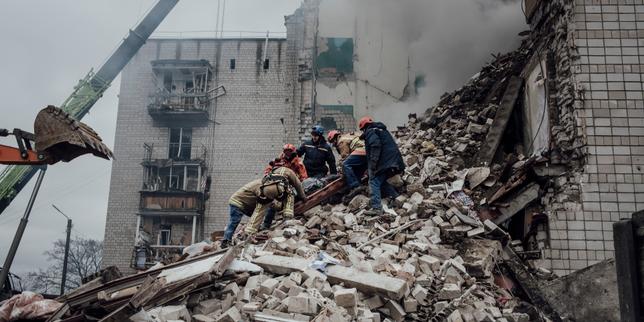
When the first DSNS fire trucks and heavy rescue units arrive at a burning apartment block outside Kyiv, they are not walking onto a controlled film set. They are entering an active combat zone. Russian forces frequently employ what military analysts call "double-tap" strikes—launching a second wave of drones or missiles at the exact same coordinates twenty to forty minutes after the initial impact, specifically timed to kill firefighters, paramedics, and police officers rushing to pull civilians from the rubble.
Every rescuer climbing those smoke-choked concrete stairwells knows the clock is ticking in two directions: the air supply running out for someone trapped beneath a collapsed ceiling slab, and the radar screens at air defense command tracking a second swarm crossing the Dnieper River.
The work itself is a agonizing exercise in contradictions. Heavy cranes are needed to lift multi-ton concrete panels, yet the vibration of heavy machinery can trigger a secondary collapse that crushes a survivor hiding in a void space three feet below. Rescuers have to oscillate between brute industrial force and surgical delicacy.
Every fifteen minutes, the order goes out across the site: Silence.
Generators are killed. Hydraulic cutters stop whining. Dozens of men and women in heavy soot-stained bunker gear freeze in the dark, pressing their ears against jagged chunks of concrete, listening for the faintest tap of a spoon against a radiator pipe, a muffled cry, or the whimpered bark of a trapped family dog. In those minutes of absolute quiet, broken only by the hiss of water hitting smoldering timber and the distant thud of anti-aircraft fire on the horizon, the war strips away all geopolitical abstraction. It is simply human beings trying to find other human beings in the dark.
Why the Suburbs Keep Taking the Hit
To understand why residential buildings on the periphery of Kyiv bear such a disproportionate brunt of these attacks, you have to look at how modern air defense works. Kyiv itself is protected by one of the densest, most sophisticated multi-layered air defense umbrellas in the world, integrating Western systems like Patriot and IRIS-T batteries with mobile fire groups mounted on pickup trucks.
Because penetrating the center of the capital has become extraordinarily costly for Russian planners, launch trajectories frequently hug the suburban belt—towns and villages just outside the municipal ring where critical electrical substations, logistics hubs, and industrial warehouses sit interspersed with dense commuter housing.
To navigate past radar detection, attack drones are programmed to fly dangerously low, sometimes skimming just fifty to a hundred meters above the ground. At that altitude, a slight navigational error, a gust of crosswind, or the physical debris of a drone intercepted mid-air by Ukrainian anti-aircraft gunners means the payload doesn't land in an open field. It hits the seventh floor of a commuter apartment block.
To call this "collateral damage" is to use a phrase invented by people who have never had to sweep shattered double-glazed glass out of a child's crib. Whether a strike is caused by deliberate targeting of civilian infrastructure or the reckless deployment of low-accuracy munitions over populated neighborhoods, the result at street level is identical. A home is erased. A community is fractured.
The Invisible Aftermath
When the fires are finally extinguished—often hours after sunrise, when pale winter light reveals the blackened, hollow eye sockets of blown-out apartments—the television cameras pack up and move on to the next breaking story.
Yet for the people standing behind the yellow police tape in mismatched coats, the crisis has barely begun.
Notice what happens next in the hours following a strike near Kyiv. Municipal buses roll up to serve as temporary warming centers. Volunteers from local charities arrive with thermoses of hot sweet tea, foil blankets, and rolls of heavy-duty plastic sheeting. Because in a Ukrainian winter, a shattered window is not a minor repair; it is an existential threat to the entire building. If freezing temperatures penetrate the exposed interior of an apartment block, the central heating pipes burst, flooding the lower floors and rendering an entire ninety-unit building uninhabitable within forty-eight hours.
So, while structural engineers inspect the compromised load-bearing walls to decide whether the building can be saved or must be condemned, neighbors who barely knew each other's names the day before form human chains. They haul plywood sheets up seven flights of unlit stairs. They staple plastic across gaping holes where balconies used to be, racing against the dropping thermometer.
I remember standing outside a damaged building in the Kyiv region after an early morning raid, watching an elderly man methodically sweeping shards of window glass off the hood of his battered Lada. His face was streaked with gray ash, his hands trembling slightly from adrenaline shock, yet his movements were entirely calm, almost rhythmic. When asked where he would sleep that night, he didn't offer a speech about geopolitics or military strategy. He pointed up at the third floor, where a blue curtain was fluttering wildly through a jagged hole in the brick wall, and said simply that he had to find his cat before the wind picked up.
That is the texture of endurance that never makes it into a breaking news ticker. It is not loud or heroic in the way movies portray war. It is stubborn, exhausted, and deeply domestic.
The Cost of Looking Away
There is a dangerous psychological trap that sets in when a conflict stretches across years: the normalization of tragedy. Readers in peaceful cities scroll past a headline about another drone strike near Kyiv, register the familiar phrasing—emergency services working at the scene, casualties being clarified—and feel a muted, distant sympathy before swiping to the next item.
We begin to treat these strikes like weather reports. Unfortunate, inevitable, part of the background noise of the world.
This numbness is precisely what a campaign of sustained aerial terror is designed to achieve. The strategic objective of launching drones night after night into suburban skies isn't merely to destroy transformers or deplete air defense interceptors. It is to exhaust the human nervous system. It is an attempt to convince millions of ordinary people that nowhere is safe, that sleep is a luxury, and that the simple act of turning off the bedside lamp carries a lethal risk. And simultaneously, it bets on the world outside growing too bored, too desensitized, to care.
Understanding the reality behind a brief French or English news dispatch requires refusing that numbness. It requires looking past the sterile vocabulary of "interventions" and "incidents" to see the concrete dust settling on a child's schoolbook. It means recognizing that every single number in a casualty report represents a universe of disrupted routines, half-drunk cups of morning coffee, and families suddenly forced to rebuild a life from whatever fits inside a plastic grocery bag.
Down in the courtyard of that suburban apartment block, long after the last fire engine has pulled away and the generators have fallen silent, a rescuer sits on the bumper of an ambulance, peeling off blackened gloves. Across the street, high up on the seventh floor, a neighbor pulls a sheet of translucent plastic taut across a shattered window frame and drives a staple into the wood, sealing out the cold.