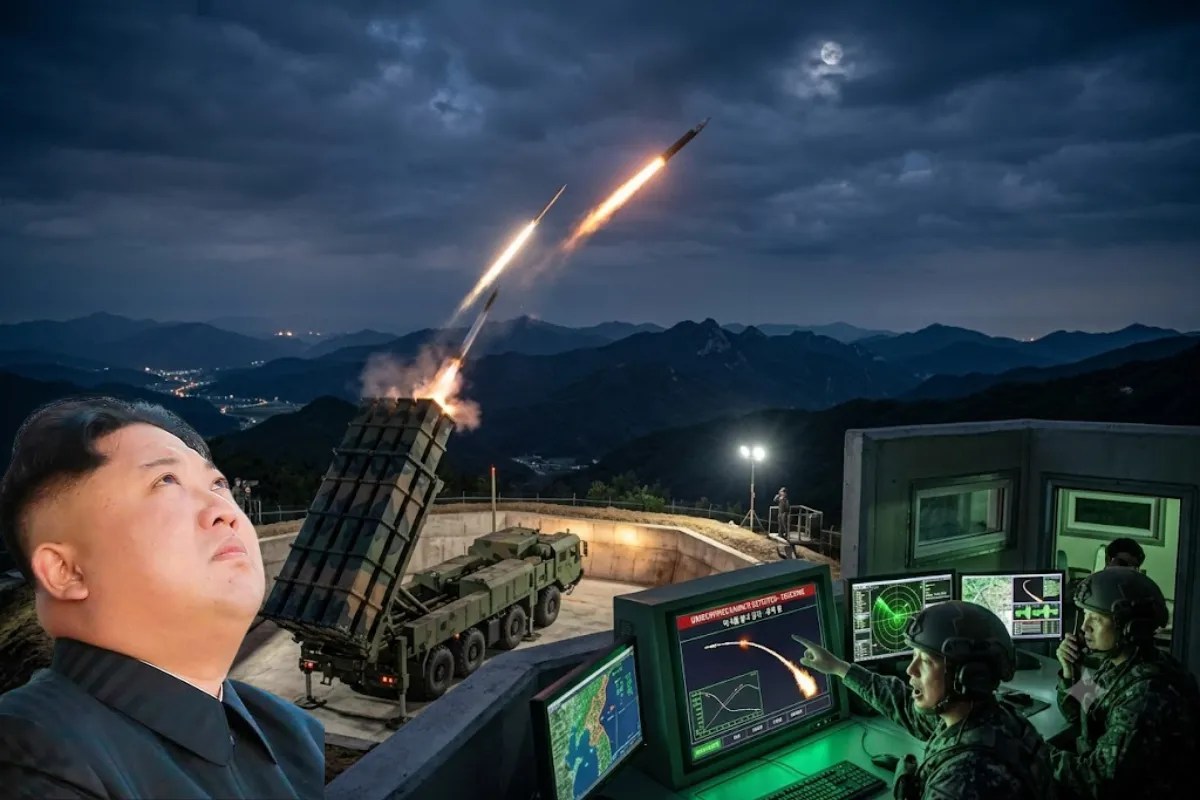
North Korea fired a barrage of approximately ten short-range ballistic missiles into its eastern waters, a calculated escalation arriving directly on the heels of a truncated United States and South Korean joint military exercise. The launch, originating from the capital region of Pyongyang, saw the munitions travel roughly 300 kilometers before splashing down outside Japanese territorial waters. This military exhibition was not a random display of routine posturing. It served as a direct rejection of Washington's attempt to trade reduced defense drills for a diplomatic opening.
The timing exposes a fundamental miscalculation in modern statecraft. When the White House abruptly ordered the Pentagon to slash the duration and scope of the annual Ulchi Freedom Shield exercises, officials in Washington framed the move as an olive branch. They assumed that cutting the 11-day defensive simulations in half would charm Pyongyang back to the negotiating table.
Instead, Kim Jong Un's regime treated the concession as a sign of institutional hesitation. Kim Yo Jong swiftly dismissed the gesture, noting that the underlying hostility of the alliance remains entirely intact regardless of how many training days are shaved off the calendar. The missile barrage was the physical manifestation of that dismissal.
The Anatomy of a Flawed Gesture
Defense analysts often point out that military exercises are the connective tissue of multinational deterrence. For decades, the structural readiness of the South Korean and American armed forces relied on comprehensive, multi-layered simulations designed to rehearse a coordinated response against potential aggression. By cutting these exercises short, political leadership inadvertently signaled a crack in the alliance's operational resolve.
Pyongyang reads these fractures with clinical precision. In the calculus of the Korean Workers' Party, unilateral scaling back of drills does not de-escalate tension. It validates their long-standing narrative that persistence through economic hardship and continuous weapons development eventually forces foreign adversaries to blink.
The ten short-range missiles fired during this latest episode are part of a broader trajectory. This marks a dense sequence of weapons tests for the year, showcasing not only political defiance but technical refinement. Short-range systems like these are increasingly sophisticated, built to evade regional missile defense architecture through depressed trajectories and maneuverable reentry phases.
Strategic Leverage and Regional Fallout
Seoul's presidential office convened immediate emergency security sessions following the splashes in the eastern waters, condemning the actions as a blatant violation of United Nations Security Council resolutions. Yet, condemnation carries little weight when the diplomatic track remains fundamentally deadlocked.
The North Korean leadership operates from a position of enhanced strategic confidence compared to the era of the 2018 and 2019 summits. Deepening alignment with global actors like Russia has cushioned Pyongyang against the full bite of international sanctions. They no longer view bilateral denuclearisation talks as an urgent economic necessity. Consequently, every gesture from Washington that lacks concrete sanctions relief is met with immediate kinetic skepticism.
Neighboring Tokyo also tracked the projectiles, registering familiar concerns over regional stability while noting that the munitions landed clear of economic zones. Behind closed doors, military planners in both Seoul and Tokyo are left to manage the operational fallout of a truncated defense posture. Joint readiness cannot be maintained on goodwill or executive social media posts. It requires grueling, unglamorous hours of tactical repetition in the field.
When political imperatives override tactical necessities, the deterrent posture suffers. The smoke clearing over the Sea of Japan offers a stark reminder that deterrence is built on ironclad consistency, not sudden diplomatic improvisations that leave allies questioning the durability of long-standing security commitments