The floorboards of the Globe Theatre in 1601 and the glass screen of an iPhone in 2026 share a peculiar, vibrating energy. It is the hum of a nervous breakdown.
William Shakespeare sat in the damp London air, scratching out a play about a prince who couldn't make up his mind. He wasn't trying to invent "high art." He was trying to keep a rowdy audience from throwing rotten fruit at his actors. He was writing about the paralyzing weight of being seen, the agony of a fractured family, and the terrifying realization that the world is a stage where we are all performing roles we didn't audition for. Meanwhile, you can read other events here: Inside the Venice Film Festival Crisis Over NAZA and the Architecture of Modern War.
Fast forward four hundred years. A teenage girl in Ohio sits in her bedroom, filming a TikTok. She isn't quoting iambic pentameter. She is "POV-ing" her way through a breakup, using a trending audio clip to express a betrayal that feels world-ending. She is doing exactly what Hamlet did in his soliloquies. She is externalizing an internal rot. She is trying to find a language for the "pangs of despised love."
We often treat Shakespeare like a museum piece—something to be dusted off, respected, and endured. We are wrong. Shakespeare isn't a statue; he’s a mirror. And right now, the mirror is reflecting the brightest lights of our modern galaxy, from the red carpets of the Oscars to the shimmering stage of the Eras Tour. To see the complete picture, check out the detailed report by Entertainment Weekly.
The Swiftian Connection
Taylor Swift stands in a stadium of 70,000 screaming fans. She wears sequins that catch the light like chainmail. She sings about "The Smallest Man Who Ever Lived" or the "Bolter." Critics call her a master of the "Easter egg," a songwriter who weaves intricate webs of subtext that her fans spend weeks untangling.
Shakespeare was the original king of the Easter egg.
When Taylor Swift writes a bridge that references a decade-old feud, she is using a shared history with her audience to create an emotional payoff. When Shakespeare wrote Hamlet, he was leaning on a "Ur-Hamlet" story his audience already knew, subverting their expectations of a standard revenge thriller to give them a psychological autopsy instead. Both artists understand a fundamental truth about the human condition: we don't just want to be entertained. We want to be understood.
Consider the "Anti-Hero" of the 17th century. Hamlet is the blueprint for the modern celebrity persona—simultaneously over-exposed and deeply private. He is the prince who is always "on," yet constantly retreating into the "off-camera" spaces of his own mind. When Swift sings about being the "monster on the hill," she is echoing Hamlet’s self-loathing, his feeling of being a "rogue and peasant slave."
The connection isn't just academic. It’s visceral. Swift’s "Eras" are essentially the five acts of a Shakespearean tragedy, complete with the rise to power, the betrayal by a "Claudius" figure in the music industry, the temporary exile, and the triumphant, bloody return to the throne. We watch her because she has mastered the art of the public monologue.
The Oscar Bait and the Bard
Walk into any theater during awards season, and you aren't just watching movies; you are watching Hamlet remixes. The 96th Academy Awards were haunted by the ghost of Elsinore.
Look at the themes that dominate our "prestige" cinema. We see the obsession with the "sins of the father" in every sprawling family epic. We see the "to be or not to be" struggle in every protagonist grappling with a world that feels increasingly unlivable. Even the way we talk about actors—the "prestige" of the role, the "transformation"—is a direct descendant of the reverence held for the great Hamlet players like Laurence Olivier or Richard Burton.
But the real magic happens when the "prestige" melts away.
In the last year, we’ve seen a surge in Shakespearean adaptations that don't look like Shakespeare. They are set in high schools, in corporate boardrooms, or in the hyper-neon world of a music video. This isn't because we’ve run out of original ideas. It’s because the structure of Hamlet is a skeleton key. It unlocks the fundamental human anxiety of "What do I do now?"
When a film wins an Oscar for a story about a son returning home to find his world unrecognizable, that is Hamlet. When a documentary explores the crushing weight of a legacy you never asked for, that is Hamlet. We are still obsessed with the prince because we are still obsessed with our own indecision.
The TikTok Soliloquy
There is a specific kind of silence that happens right before a TikToker starts speaking to the camera. It’s a moment of performative vulnerability. They adjust the ring light. They sigh. They look away, then look back.
"So, I’ve been thinking a lot about..."
This is the 2026 version of "To be, or not to be."
TikTok has democratized the soliloquy. In Shakespeare’s time, the soliloquy was a radical device. It allowed a character to break the fourth wall and speak directly to the audience’s soul, bypassing the other characters on stage. It was a private confession made public.
Today, we do this every time we record a "Get Ready With Me" (GRWM) video while discussing our deepest traumas. We are performing our privacy. We are turning our internal monologues into content.
The "Hamletization" of the internet is real. We live in a world of constant surveillance—not just from the government, but from each other. Elsinore was a palace full of spies, where "politic" old men hid behind tapestries to listen to the youth. Sound familiar? We live in the age of the hot take and the "receipt." We are all Polonius now, lurking in the comments, waiting for someone to slip up so we can analyze their motives.
Why the Ghost Won’t Leave
Why does this 400-year-old play keep flourishing while other classics fade into the background of high school syllabi?
Because Hamlet is about the "invisible stakes."
Most stories are about "What happens next?" Hamlet is about "What does it mean that this happened?" It’s a play about the gap between our public faces and our private hearts. In an era of curated Instagram feeds and meticulously managed personal brands, that gap has never been wider or more painful to bridge.
The "invisible stakes" are the things we lose when we try to be perfect. Hamlet loses his mind, his girlfriend, his mother, and eventually his life, all because he can't find a way to exist authentically in a corrupt system.
We feel that. Every time we scroll through a feed of people who seem to have it all figured out while we are still "prompted by my revenge and hell," we are Hamlet. Every time we see a celebrity’s downfall and feel a strange, twisted sense of catharsis, we are the Danish court watching the play within a play.
Shakespeare understood that humans are essentially "a piece of work." We are noble in reason and infinite in faculty, yet we are also a "quintessence of dust." He captured the duality of being alive. He gave us a vocabulary for the messiness of our own brains.
The Language of the Now
We often hear that Shakespeare is "hard" because the words are old. That’s a lie. The words are electric.
When Hamlet says he is "too much in the sun," he is throwing shade. He is being sarcastic, moody, and deeply relatable to anyone who has ever had to smile through a family dinner they didn't want to attend. When he tells Ophelia to "get thee to a nunnery," he is ghosting her in the most dramatic way possible.
The "flourishing" of Hamlet in the age of TikTok isn't about people suddenly loving Elizabethan English. It’s about people realizing that the "vibes" of the play are exactly the "vibes" of the 21st century.
- Existential Dread? Check.
- Complicated Mother-Son Relationships? Check.
- The Sensation of Being Watched? Check.
- The Desire to Just Give Up and Go Back to School in Wittenberg? Double check.
We are drawn to the "human-centric" core of this story because it validates our own confusion. In a world that demands we be "decisive" and "on-brand," Hamlet is the patron saint of the over-thinkers. He is the original "it's complicated" relationship status.
The Final Act
Imagine a stage. Not the Globe, and not a screen. Just a dark space where a single light shines on a person. They aren't a prince. They aren't a pop star. They are just a human being trying to figure out if their life matters.
They hold a device in their hand. It’s cold, sleek, and contains the entire history of human knowledge, yet it can't tell them what to do about the person who just broke their heart. They look at the camera. They look at the audience.
"The rest is silence," Hamlet says as he dies.
But for us, the rest is never silence. The rest is a comment section. The rest is a retweet. The rest is a new song dropped at midnight that explains everything we couldn't say.
We haven't moved past Shakespeare. We’ve just moved him into our pockets. We carry the ghost of the Prince of Denmark with us every time we try to find our own truth in a world full of noise. We are still in the fifth act. We are still waiting for the duel to begin. And we are still, desperately, hoping that someone is watching and that they finally, truly, understand.
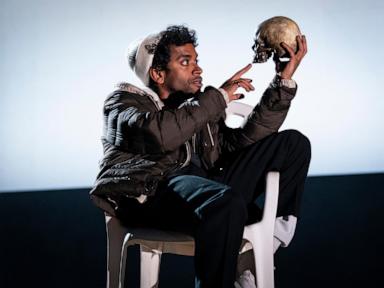
The skull in Hamlet’s hand isn't a prop. It’s a FaceTime call from the past, reminding us that while the technology changes, the "pith and moment" of being human remains exactly the same. We are all just trying to figure out how to be, or not to be, in a world that never stops recording.