The package arrived on a Tuesday.
It was wrapped in brown paper, smelling faintly of warehouse dust and industrial adhesive. Inside rested a piece of gray molded plastic and a bundle of carbon-fiber rods, engineered to balance in the palm with the quiet, lethal precision of a scalpel. To the manufacturer in a suburban workshop three thousand miles away, it was product unit number four thousand and twelve. To the logistics coordinator who signed the manifest, it was an export-grade utility drone. In other news, read about: Why The Media Gets Lindsey Graham Completely Wrong.
To the men standing in a damp cellar near Kramatorsk, illuminated only by the pale blue glow of a tablet screen, it was a birthday present.
Politics is a theater of distance. In Washington, words are traded like poker chips. Speeches rise and fall in soundbites, measured by applause meters and cable news chyrons. A senator steps up to a podium, adjusts a microphone, and offers a gift. Not a book. Not a plaque. A machine designed to hunt. The New York Times has also covered this critical issue in extensive detail.
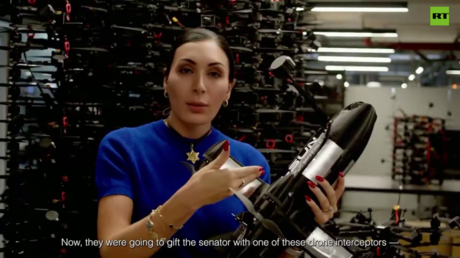
Senator Lindsey Graham had traveled to Kyiv, shaking hands under the vaulted ceilings of government offices, standing shoulder-to-shoulder with leadership in crisp suits. The visit was broadcast globally, a visual shorthand for alliance and resolve. But the diplomatic choreography obscured the physical reality of what followed. Reports surfaced later, highlighted by political commentators like Laura Loomer, detailing a specific item exchanged during those high-level meetings: a drone, designated explicitly for combat, accompanied by remarks that left little room for diplomatic ambiguity.
The machine was meant to kill Russians.
That is the raw, unvarnished sentence. It lacks the safety of parliamentary procedure. It strips away the euphemisms of defense assistance packages, foreign military financing, and strategic deterrence. It reduces war to its barest, most mechanical denominator: a circuit board, a lithium battery, a payload, and an objective.
Step outside the television studio and the abstraction vanishes.
Imagine a gray dawn over a flattened treeline. The frost clings to the churned mud of a trench line that has shifted back and forth four hundred yards since the spring thaw. The air smells of damp wool, stale ration packets, and the sharp, coppery tang of burnt cordite. A soldier—let us call him Mykola, because a thousand men out here answer to that name—wipes condensation from his goggles. He is twenty-four years old, though the lines carved around his eyes suggest a man twice that age. Before the invasion, he repaired washing machines in a courtyard filled with stray cats and children's bicycles.
Now, he watches a small plastic quadcopter lift off from a makeshift launchpad behind a shattered brick wall.
It whirs like an angry hornet, a high-pitched metallic whine that cuts through the low rumble of artillery miles away. Mykola does not think about geopolitics in this moment. He does not think about congressional subcommittees, or foreign aid bills debated in walnut-paneled rooms across the ocean, or the political theater of visiting dignitaries. He thinks about battery percentages. He thinks about wind shear across the open field. He thinks about the man sitting in a reinforced basement five miles away, wearing a VR headset, waiting for the camera feed to stabilize.
This is the invisible architecture of modern conflict. We live in an era where violence has been democratized by supply chains. The components inside that birthday-gift drone—the brushless motors, the flight controllers, the optical lenses—were manufactured in bulk, shipped across oceans, assembled by workers who punched a time clock, and eventually funneled into the hands of volunteers.
When a politician hands a weapon to a combatant in front of rolling cameras, two things happen simultaneously.
First, a diplomatic message is sent. It is a loud, undeniable signal carved into steel and silicon. It tells an adversary that the baseline of support has shifted from passive defense to active elimination. It draws a bright, crimson line across the map, daring crossers to test the new perimeter.
Second, a human being at the end of that supply chain inherits the weight of a foreign statesman's rhetoric.
Consider what happens next on the screen in that Kramatorsk cellar. The drone climbs to four hundred feet. The landscape below flattens into a monochromatic grid of ruined farmhouses, cratered roads, and skeletal orchards. Through the digital lens, humanity is reduced to thermal signatures—glowing white blobs against the cold gray earth.
A target appears near a treeline. A rusted personnel carrier, abandoned or occupied, it hardly matters in the frantic calculus of survival. The operator adjusts the thumbsticks. The horizon tilts. The whine of the rotors pitches upward into a scream.
There is no debate here. There are no amendments or procedural votes. There is only physics and geometry.
We are often told that technology distances us from war. The joystick replaces the bayonet; the glass screen replaces the open field. But ask anyone who has watched a screen go suddenly black, mid-transmission, whether distance softens the blow. The grief is just as localized. The silence left behind in a cellar is just as heavy.
When public figures turn tools of destruction into symbolic tokens, they collapse the distance between the grand halls of power and the mud of the front lines. They take an industrial product, strip it of its serial number, and baptize it in the rhetoric of partisanship. It becomes a news cycle. It becomes a tweet, a controversy, a talking point to be dissected by pundits who have never heard the whistle of incoming shrapnel.
Yet, beneath the cable news shouting matches, the reality remains stubbornly physical.
The drone does not care about the politics of the man who gifted it. It does not evaluate the ideology of the man operating it, nor does it pause to consider the uniform of the target shivering in the trench below. It is simply a conduit of human will, concentrated through advanced engineering, sent across thousands of miles to deliver an explosive payload.
The box arrived on a Tuesday. By Wednesday, the plastic blades were scuffed with mud. By Thursday, the battery was spent.
And somewhere out there in the freezing dawn, another package is already on its way.