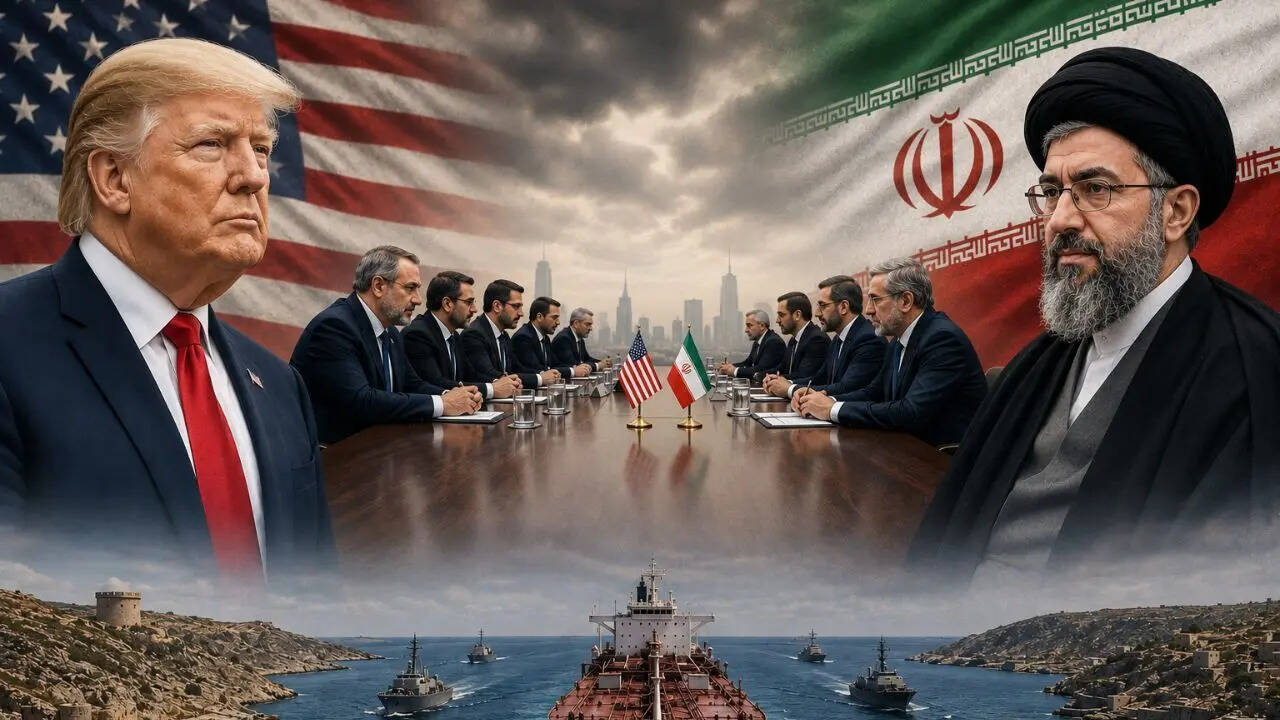
A pen strokes across a heavy sheet of paper in a climate-controlled room in Geneva, and thousands of miles away, a grocery store owner in Tehran decides not to close his doors for the winter.
We talk about geopolitics in the language of monsters and monoliths. We speak of "The United States" and "Iran" as if they are two giant chess pieces sliding across a board, rather than collections of millions of individuals trying to buy milk, pay rent, and survive the decisions of leaders they will never meet. When news broke of a sweeping new peace framework between Washington and Tehran, the headlines immediately did what headlines always do. They went big. They screamed about a three-hundred-billion-dollar private fund. They flashed graphics of one hundred billion dollars in frozen assets thawing out like some economic glacier. They calculated the precise flow of oil waivers.
But numbers that large stop meaning anything to the human brain. They become abstract noise. To understand what is actually happening behind the closed doors of this diplomatic breakthrough, you have to look away from the billion-dollar ledgers and look at the ice.
Consider a hypothetical baker in the central bazaar of Isfahan. Let us call him Alireza. For a decade, Alireza’s daily life has been dictated by an invisible, suffocating fog known as maximum pressure. When the United States cut off Iran's banking sector from the world, they did not just penalize government ministers. They cut the nervous system of daily commerce. If Alireza's industrial oven broke, he could not import a replacement part from Germany. He had to buy a bootlegged component smuggled through three different middle countries, paying four times the price in a currency that lost value between the morning prayer and the evening news.
The new deal is not a sudden eruption of world peace. It is a controlled release of pressure.
The Illusion of the Open Vault
The headline number—that towering one hundred billion dollars in frozen assets—evokes images of cargo planes stuffed with shrink-wrapped hundred-dollar bills landing at Imam Khomeini International Airport. The reality is far more sterile, far more restricted, and entirely devoid of drama.
Imagine your bank account is locked by a court order. The judge suddenly decides you can use your money again, but only if the bank manager accompanies you to the store, watches what you put in your cart, and hands the cash directly to the cashier.
That is the actual mechanism of the unfrozen wealth. The vast majority of these funds, trapped for years in South Korean, Japanese, and European banks, are not being handed over to the Iranian treasury to spend at will. Instead, they are being funneled into tightly monitored humanitarian channels.
The mechanism relies on a strict escrow system. If Iran wants to purchase childhood leukemia medication from a Swiss pharmaceutical giant, the payment moves directly from the overseas holding account to the Swiss manufacturer. The money never touches a bank in Tehran. It never enters the hands of the Revolutionary Guard. It is an economic umbilical cord, designed to sustain basic human life while keeping the state itself on a strict caloric deficit.
For the person on the street, however, this bureaucratic distinction matters less than the result. When specialized medical equipment and basic agricultural fertilizers begin flowing through customs without the terror of secondary American sanctions, the cost of living shifts. The atmospheric pressure drops.
The Three-Hundred-Billion-Dollar Ghost
Then there is the private fund. The announcements point to a staggering three hundred billion dollars in projected private investment over the next decade, a number meant to signal a total economic rebirth.
But capital is a coward. It does not run toward a country just because a politician signs a document. It waits. It watches. It remembers.
International corporations remember 2015. They remember the euphoria of the Joint Comprehensive Plan of Action, the rush of European executives booking every luxury hotel room in Tehran, eager to sign deals for airplanes, cars, and oil fields. They also remember how quickly those deals evaporated when the political wind shifted three years later, leaving billions of dollars in investments stranded in the sand.
"A signed treaty is just a piece of paper," a retired European corporate risk analyst told me recently, speaking on the condition of anonymity. "A treaty can be torn up by the next administration. What we look for isn't a signature. We look for deep compliance. We look to see if the plumbing works."
The plumbing, in this case, is the global financial network known as SWIFT. For an Iranian business to trade normally, its banks must be reconnected to this digital messaging system. Without it, they are deaf and mute. The peace deal promises a gradual reconnection, but it is conditional. It is a dimmer switch, not a light switch.
If Tehran complies with the nuclear limits and regional de-escalation milestones, the dial turns up. More electricity flows into the economy. If they falter, the dial turns back down to darkness.
The Oil Waivers and the Black Market Shadow
Nothing moves in the Middle East without the smell of crude oil. For years, Iran’s economic survival has depended on a shadow fleet—an armada of aging, unflagging tankers drifting across the oceans with their transponders turned off, selling discounted oil to independent refineries in China through back-alley financial networks.
It was an expensive way to live. The discounts Iran had to offer to entice buyers to risk American wrath were steep. The middlemen took massive cuts.
The new deal alters this calculus through the strategic use of oil waivers. By formally allowing countries like India, Turkey, and Japan to buy specific quotas of Iranian crude without facing penalties, the underground economy is brought into the daylight.
The impact is immediate.
- The Discount Vanishes: Iran no longer needs to sell its primary resource at fire-sale prices to survive.
- The Middlemen Starve: The network of smugglers, shell companies, and illicit bankers who grew fabulously wealthy off the sanctions regime suddenly find their services obsolete.
- The Flow Stabilizes: Predictable revenue allows for actual state budgeting rather than emergency crisis management.
But consider what happens next. The sudden return of hundreds of thousands of barrels of legal Iranian oil into the global market creates a ripple effect that reaches far beyond the Persian Gulf. It lowers the cost of diesel for a truck driver in Ohio. It shifts the geopolitical leverage of Saudi Arabia and the OPEC cartel. It alters the economic math of the war in Ukraine by providing alternative energy security to Europe.
The Real Stake is Time
The true currency of this deal is not dollars, euros, or barrels of oil. It is time.
For the Iranian leadership, the deal buys time to stabilize a domestic population weary of economic stagnation and systemic inflation. It offers a reprieve from the constant threat of societal collapse.
For the West, it buys time to handle a fractured European continent, a rising challenge in the Pacific, and a volatile domestic political landscape. It pushes the nightmare scenario of a nuclear-armed Persian Gulf further down the road, creating a diplomatic buffer zone where none existed for years.
It is easy to look at the immense figures detailed in the framework and see only a geopolitical transaction. A cynical trade of cash for centrifuges. But if you listen closely to the stories filtering out of the markets in Iran, the sentiment isn't one of grand ideological victory or deep love for the West. It is the quiet relief of a swimmer who has finally been allowed to come to the surface for air.
The fog has not cleared entirely. The sanctions architecture remains largely intact, a massive network of tripwires waiting for a single misstep. The trust between the nations is nonexistent, replaced entirely by intrusive verification protocols and cold, mechanical self-interest.
Yet, tonight, the price of bread in Tehran is slightly more stable than it was last week. The components for an industrial oven might actually clear customs by next month. The grand numbers on the diplomatic ledger have translated into a fragile, imperfect peace—measured not in the majesty of historical declarations, but in the simple, ordinary ability of people to look at tomorrow without terror.