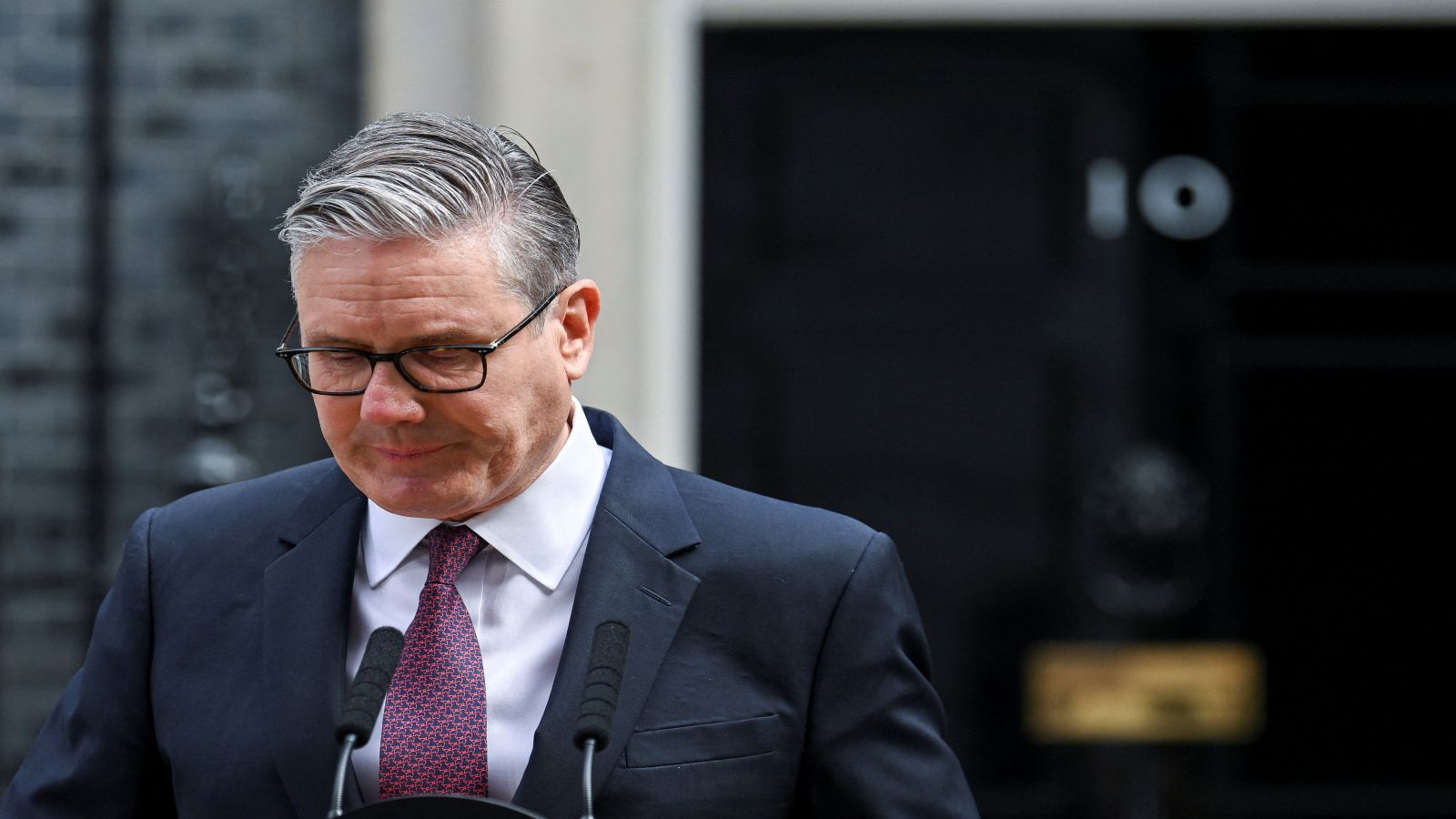
The black door at 10 Downing Street has a heavy brass letterbox, but it does not let in the sound of the street. Inside, the quiet is immense. It is the kind of silence that settles in old stone buildings after a long storm, when the people inside realize the roof is still leaking, no matter who is holding the map.
This morning, Keir Starmer stood in that quiet, knowing he was about to step back out into the rain.
Less than two years ago, he stood on the pavement outside that same door, his voice steady against the July heat. He had just delivered a historic victory for the Labour Party, securing 411 seats. The public, exhausted by fourteen years of Conservative infighting, three prime ministers in a single year, and a dizzying cycle of economic whiplash, wanted one thing above all else. They wanted a grown-up. They wanted a man who looked like an administrator because they believed administration was the antidote to chaos.
Instead, the machine broke him too.
To understand how a man with such a towering parliamentary majority found his voice cracking with emotion as he announced his departure today, you have to look past the spreadsheets. You have to look at the human cost of trying to govern a nation that has lost faith in the very idea of government.
The Toolmaker’s Son and the Architecture of Caution
We heard about his father a lot. During the election, it became a running joke among commentators how often Starmer reminded the public that his dad worked in a factory. But that detail matters because it explains his relationship with reality. He was not a creature of the Westminster bubble. He did not enter parliament until he was fifty-two years old, having already spent a lifetime climbing to the top of the legal profession as the Director of Public Prosecutions.
He viewed the world as a series of briefs to be read, evidence to be weighed, and procedures to be followed.
When he took over the Labour Party after its devastating defeat in 2019, he treated it like a failing corporate restructuring. He removed the radical left wing. He apologized for internal failures. He dragged the party toward the center by sheer force of bureaucratic will. It worked, but it left a vacuum where a grand vision should have been.
Consider what happens when caution becomes your only shield.
When Starmer walked into Downing Street in 2024, his support was wide but paper-thin. Only thirty-four percent of the electorate had voted for him. Most of them were not voting for a socialist dawn; they were voting against the previous tenants. They were handing a mandate to a manager, expecting him to fix the pipes.
But the pipes were rusted through. Two decades of stagnant wages, public services stretched to the absolute limit, and a crushing national debt left him with no money to spend. A manager without a budget is just a man taking complaints at a desk.
The Small Things That Break a Giant
Power in Britain does not always vanish in a grand ideological clash. Sometimes, it chips away in tiny, embarrassing fragments.
First came the donations. A public already struggling to pay their grocery bills watched as the multi-millionaire Prime Minister accepted free designer spectacles and high-priced tickets to see Taylor Swift. It felt small. It felt hypocritical. For a man whose entire brand was built on being the unflashy, decent alternative to Tory sleaze, it was a profound misjudgment.
Then came the choice that alienated his own base.
Desperate to prove his fiscal discipline to international markets, Starmer cut the winter fuel allowance for millions of pensioners. It was an act of cold, legal logic. It was meant to show he could make hard choices. Instead, it showed something else: a lack of political empathy. The left wing of his party, already suspicious of his centrist shift, began to walk away. By the spring of this year, urban progressives were abandoning Labour for the Green Party, while working-class communities turned their eyes toward Nigel Farage and Reform UK.
The political world changed around him, but Starmer remained fixed, relying on the same legalistic distance that built his career.
The US Ambassador and the Final Fracture
If the domestic strategy was a slow leak, the foreign policy choice was a sudden burst.
Seeking to navigate a complicated relationship with Washington ahead of Donald Trump’s second term, Starmer made a calculation. He appointed Peter Mandelson as the UK’s ambassador to the United States. Mandelson was a political heavyweight from the Tony Blair era, a man comfortable in rooms filled with the global elite. He was supposed to be the bridge to America.
Instead, the appointment revived old ghosts. Reports emerged detailing Mandelson’s historic social ties to Jeffrey Epstein. Worse, it was revealed that the appointment had skipped essential security vetting procedures.
For the average voter, this was the moment the illusion shattered. The man who promised to bring clean, boring competence to government had appointed a figure from the past without checking the paperwork. The justification crumbled.
The local elections in May became an execution ground. Labour candidates across the country found doors slammed in their faces. Voters weren't just angry; they were indifferent. Reform UK surged to twenty-seven percent in national polls, pushing Labour down to a precarious twenty percent.
Behind closed doors, the Parliamentary Labour Party panicked. Members of Parliament with slim majorities realized that Starmer’s name on the ballot was no longer an asset. It was a liability.
The Shift to Manchester
Politics is a brutal business because it smells blood instantly. As Starmer’s personal approval ratings plunged to forty-six points in the negative, his colleagues began looking for an exit strategy.
They found it in Andy Burnham.
The former Greater Manchester Mayor had spent years building a reputation as a different kind of Labour politician—someone who spoke with regional warmth rather than north London legalism. When a sudden vacancy opened in the parliamentary seat of Makerfield, Burnham saw his moment to return to Westminster. Starmer’s allies tried to hold the line, but the momentum was unstoppable. One by one, senior figures walked away. The resignation of John Healey as Defence Secretary over military spending effectively ended the Prime Minister’s final argument: that he was the only leader who could guarantee stability in a dangerous world.
This morning’s announcement was merely the formal acknowledgement of a reality that had already been decided in committee rooms and drafty constituency offices over the last six weeks.
Nominations for the leadership will open in July. By September, Britain will likely have its seventh prime minister in a single decade. The cycle of instability, the very thing Starmer was hired to cure, has outlived his premiership.
He was a decent man who believed that if you worked hard enough, read the brief thoroughly enough, and avoided big gambles, the system would work. He forgot that politics is not a court of law. It runs on faith, on narrative, and on the belief that the person at the top actually feels the weight of the country's struggle. When that belief died, the majority vanished with it.
The rain continues to fall on Downing Street, and the door remains closed, waiting for the next person who thinks they can fix the roof.