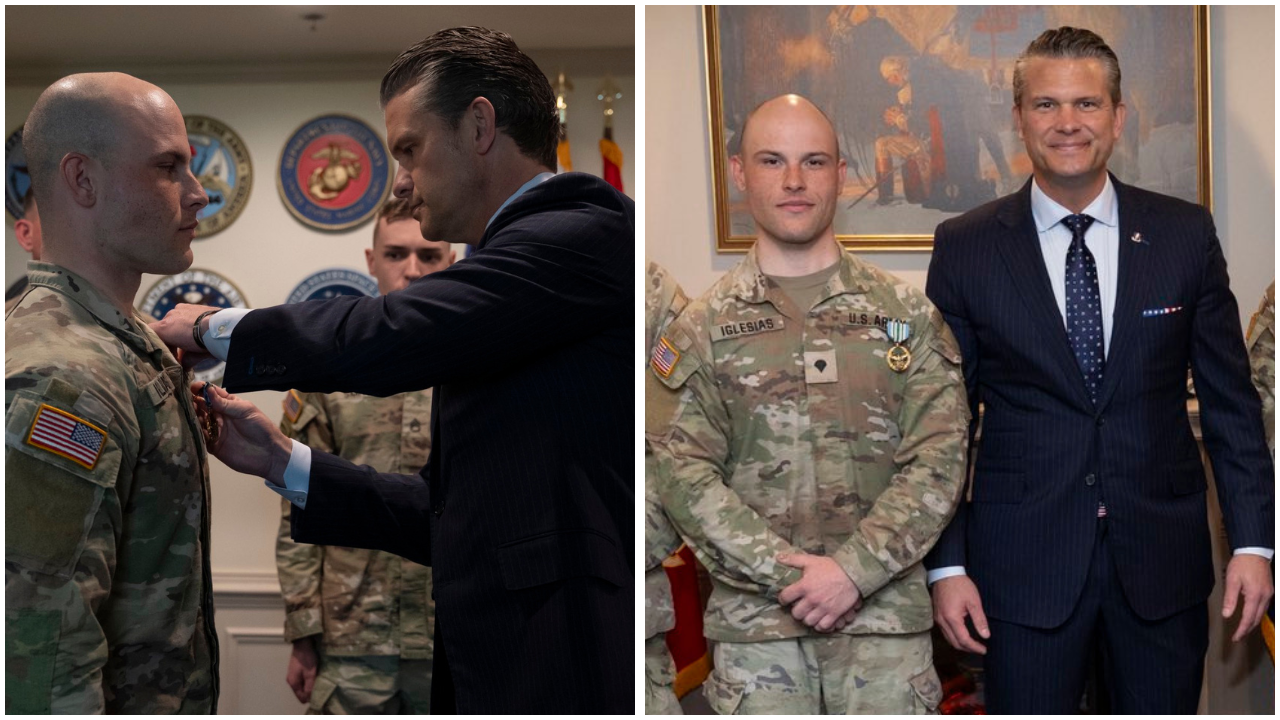
When Defense Secretary Pete Hegseth publicly praised an Army specialist for reprimanding fellow soldiers at a war memorial, viral commentators largely treated the moment as a simple victory for old-school military standards. That framing misses the deeper institutional tension at the heart of modern military leadership.
Public recognition of a junior enlisted soldier correcting peers in a sensitive setting highlights two competing principles in armed forces culture: decentralized accountability and formal chain-of-command discipline. Supporters of Hegseth's response argue that standards only survive when every service member, regardless of rank, enforces them on the spot. Critics and military historians, however, point out that turning viral moments of peer-to-peer scolding into top-down political theater can distort how unit cohesion and authority actually function.
The Myth of the Viral Standard-Bearer
In military doctrine, maintaining decorum at memorials and public sites is foundational. Service regulations across branches explicitly require personnel in uniform—and often out of uniform—to uphold conduct that reflects respect for fallen service members. When a specialist steps in to correct peers who fail to meet that standard, they are exercising what the Army calls "on-the-spot corrections," a basic expectation of professional soldiering.
Yet elevating a single recorded incident into a national leadership parable creates a skewed picture of military readiness. Standard enforcement in effective units is rarely dramatic, rarely filmed, and almost never resolved through public shaming. According to traditional non-commissioned officer (NCO) doctrine, the backbone of the U.S. military is the NCO corps—sergeants and staff sergeants trained to manage behavior privately, systematically, and within established unit structures.
When senior civilian leadership singles out a junior soldier for viral praise, it risks bypassing the intermediate leadership layers responsible for daily training and accountability. The public sees a viral clip of a specialist taking charge; the institution has to ask why NCOs were absent or ineffective in that moment, and whether rewarding filmed confrontations incentivizes performative policing over quiet unit discipline.
Decentralized Accountability vs. Chain of Command
The core debate surrounding the incident rests on a genuine doctrinal tension:
- The case for bottom-up enforcement: Military organizations cannot rely solely on senior leaders to spot every infraction. In combat and garrison alike, junior personnel must hold one another to standards immediately. Advocates of Hegseth's stance view the specialist's actions as proof that individual initiative remains strong despite broader cultural debates over military standards.
- The case for structural discipline: Military law and custom rely on predictable lines of authority. The Uniform Code of Military Justice (UCMJ) and service-level leadership manuals emphasize that correction should reinforce unit cohesion rather than fracture it. Publicly celebrating a junior soldier for berating teammates can complicate peer relationships, undermine local NCO authority, and turn internal unit matters into external media spectacles.
Neither perspective is absolute. An Army where specialists refuse to speak up when standards slip is fragile. At the same time, a force where senior officials use social media moments to validate individual reprimands risks substituting symbolic gestures for systemic leadership development.
The Role of Smartphones and Public Spectacle
Modern military incidents rarely stay inside the fence line. The presence of cameras transforms routine disciplinary moments into public referendums on military culture, politics, and leadership philosophy.
In past eras, a corrective exchange at a memorial stayed between the soldiers involved and their immediate squad leader. Today, once a video circulates online, political leaders and media outlets immediately attach broader narratives to it. For observers who believe military standards have eroded, the clip serves as validation. For those concerned about the politicization of the armed forces, official praise from the Pentagon's top civilian looks like an endorsement of public call-out culture over institutional process.
This dynamic creates an unintended consequence for commanders on the ground. Unit leaders must manage the fallout of viral attention while still maintaining trust among the soldiers involved. When a junior soldier becomes a minor public figure overnight for rebuking peers, integrating that soldier back into normal platoon dynamics becomes significantly more complex.
What Actually Sustains Military Standards
Long-term military effectiveness depends less on isolated moments of public correction and more on consistent, unglamorous institutional habits:
- Empowered NCO Leadership: Corporals and sergeants must have the time, training, and backing to set expectations before troops ever arrive at a public venue or memorial.
- Private Correction, Public Recognition: Traditional leadership principles hold that praise belongs in public while reprimands belong in private—or at least within the immediate chain of command—to preserve dignity and unit trust.
- Clear, Uniform Enforcement: Standards hold when they are applied evenly across ranks every day, not selectively highlighted when a camera happens to be rolling.
Focusing solely on whether the specialist was right to speak up overlooks the larger institutional question. True discipline is measured not by how dramatically a soldier scolds peers on video, but by whether a unit's daily culture prevents the lapse from happening in the first place.