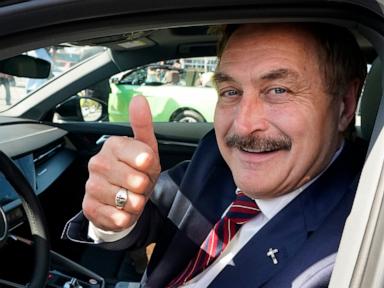
Donald Trump’s endorsement of MyPillow CEO Mike Lindell for Governor of Minnesota on July 15, 2026, acts as a high-stakes stress test of primary-to-general election capital conversion. The intervention, announced less than four weeks before the August 11, 2026, Republican primary, attempts to bypass the state’s formal party apparatus and install an insurgent loyalist. However, analyzing this endorsement through the lens of rational choice theory, signaling mechanics, and empirical polling reveals a widening gulf between primary victory optimization and general election viability.
While the endorsement shifts the immediate primary dynamics, it introduces severe structural discount factors to the Republican ticket's prospects in November.
The Signaling Model of Primary Endorsements
In political science, an endorsement is not merely a statement of preference; it is an information shortcut designed to minimize search costs for voters. In a crowded three-way primary—featuring Lindell, Minnesota House Speaker Lisa Demuth, and retired healthcare executive Kendall Qualls—voters face significant information asymmetry. Trump’s endorsement functions as a low-cost, high-intensity signal that solves this search problem for the populist base.
To model this effect, we can express the utility $U_i$ of a primary voter $i$ choosing candidate $c$ as:
$$U_{i}(c) = \beta_1 T_c + \beta_2 E_i(c) - \theta C_c$$
Where:
- $T_c$ represents the candidate's alignment vector with the national populist brand.
- $E_i(c)$ is the voter’s subjective estimation of the candidate's electability in the general election.
- $C_c$ is the political transaction cost associated with the candidate’s personal, legal, or financial liabilities.
- $\beta_1, \beta_2,$ and $\theta$ are the weights assigned by the voter to these attributes.
In a closed or semi-closed primary environment populated by highly motivated partisans, the coefficient $\beta_1$ (alignment) heavily outweighs $\beta_2$ (electability). By endorsing Lindell and praising him as "one of America's greatest and most hard working Patriots", Trump artificially inflates $T_L$ to its absolute maximum. This intervention is designed to offset Lindell’s high transaction cost ($C_L$), which includes outstanding property tax liens, ongoing litigation fallout, and persistent questions regarding state residency.
For a critical mass of primary voters, the endorsement transforms Lindell from a chaotic outsider into the official proxy of the national party leader.
The Three-Body Problem of the August Primary
The Minnesota Republican primary presents a classic three-body political problem. Each candidate represents a distinct faction within the contemporary conservative coalition:
- The Insurgent Populist (Mike Lindell): Backed by national populist energy, high name recognition, and a personal media network. Lindell's campaign bypasses traditional local structures in favor of direct-to-consumer political branding.
- The Legislative Pragmatist (Lisa Demuth): As House Speaker, Demuth commands institutional legislative relationships and local donor networks. Her campaign focuses on state-level executive governance and systemic oversight.
- The Endorsed Executive (Kendall Qualls): Having won the official Minnesota Republican Party endorsement at the state convention in May 2026, Qualls commands the legacy activist base. He positions himself as an executive capable of uniting corporate donors and grassroots organizers.
This division creates a highly fragmented primary electorate. Prior to the endorsement, Demuth and Qualls were locked in a competitive race for activist support, with Lindell trailing in conventional infrastructure but maintaining high baseline name recognition. Trump's intervention disrupts this equilibrium by forcing a zero-sum calculation on the primary electorate.
                          [Minnesota GOP Primary Electorate]
                                          |
                +-------------------------+-------------------------+
                |                         |                         |
     [The Populist Wing]       [The Institutionalists]    [The Party Activists]
                |                         |                         |
         (Mike Lindell)                (Lisa Demuth)             (Kendall Qualls)
                |                         |                         |
      * Trump Endorsement *       * Legislative Base *       * Party Endorsement *
Demuth's campaign has attempted to minimize the impact of the endorsement by emphasizing local agency, stating that "this race won't be won by national endorsements". However, empirical data from modern Republican primaries suggests that a direct endorsement from Trump carries a conversion rate that frequently overrides local party endorsements. The risk for the Minnesota GOP is that this intervention secures the nomination for a candidate who faces a severe general election discount.
The General Election Discount Function
While the endorsement optimizes Lindell's primary path, it simultaneously devalues his general election equity. Minnesota has not elected a Republican governor since Tim Pawlenty won re-election in 2006. Winning the statewide electorate requires a candidate who can minimize losses in the urban core (Hennepin and Ramsey counties), capture suburban swing voters in the "collar counties" surrounding Minneapolis-St. Paul, and maximize turnout in rural districts.
Data indicates that Lindell faces a steep structural discount across these critical voter segments. A June 2026 Star Tribune/KARE 11/Hubbard School poll outlines the baseline electoral mismatch:
- Democratic Nominee Amy Klobuchar vs. Mike Lindell: Klobuchar leads 53% to 36% (+17 points), with 11% undecided.
- Amy Klobuchar vs. Kendall Qualls: Klobuchar leads 48% to 37% (+11 points).
- Amy Klobuchar vs. Lisa Demuth: Klobuchar leads 48% to 40% (+8 points).
The delta between these matchups illustrates the specific cost of Lindell's brand. Against Demuth, Klobuchar is held under 50%, keeping the race within striking distance of a standard margin of error. Against Lindell, Klobuchar commands an absolute majority of the polled electorate. This 9-point swing from Demuth to Lindell represents the "moderate suburban penalty"—the portion of the electorate that rejects populist conspiratorial messaging even if they lean conservative on economic or fiscal policy.
Furthermore, the open-seat nature of the 2026 cycle—precipitated by incumbent Governor Tim Walz choosing not to seek a third term—should theoretically favor an organized opposition. However, the substitution of Lindell as the Republican standard-bearer alters the strategic landscape. Instead of a referendum on the incumbent party's 20-year governance record, the race is highly likely to pivot into a referendum on Lindell’s national controversies and litigation history.
Operational and Legal Liabilities as Capital Constraints
A political campaign is a corporate entity requiring capital, legal compliance, and operational stability. Lindell's campaign is burdened by several liabilities that act as balance-sheet constraints, limiting his ability to run a competitive general election operation against Klobuchar's highly disciplined organization.
The Residency Arbitrage Problem
To qualify under Article V, Section 3 of the Minnesota Constitution, a candidate for governor must have resided in the state for at least one year preceding the election. Lindell’s voter registration history introduces a critical vulnerability:
- He spent several years registered to vote in Texas.
- In a federal court filing in 2025, he legally designated himself as "a Texas citizen".
- While Lindell asserts he re-established residency in time to meet the statutory requirement, this ambiguity invites immediate post-primary litigation from Democratic-Farmer-Labor (DFL) aligned groups.
An unresolved constitutional challenge creates a high-risk environment for major donors, who are hesitant to allocate capital to a candidate whose name could be removed or challenged on the general election ballot.
Financial Exposure and Tax Liens
A campaign’s financial health is often correlated with the candidate's personal solvency, particularly for self-funded or highly visible business figures. Public records reveal that Lindell has failed to pay nearly $50,000 in property taxes on his Tonka Bay residence.
Simultaneously, his corporate entity, MyPillow, has been drained of liquid capital due to prolonged defamation lawsuits, culminating in a confidential settlement with Dominion Voting Systems in June 2026. These liabilities prevent Lindell from self-funding his campaign at the level required to match the DFL's structural spending advantages in the Twin Cities media market.
Tactical Reconfiguration for the Outgroups
The primary remains an open question, and the endorsement forces the Demuth and Qualls campaigns to immediately alter their tactical postures. Relying on conventional party networks is no longer sufficient to counter the top-down pressure of Trump's endorsement.
For Lisa Demuth, the strategic path requires leaning heavily into her legislative record as Speaker. She must frame the choice not as a loyalty test to national figures, but as an operational necessity to audit and correct state-level administrative failures. By focusing her rhetoric on local issues—such as the federal childcare spending fraud investigations that have targeted state executive agencies—Demuth can position herself as the only candidate capable of conducting a rigorous, professional overhaul of the state capitol. Her campaign must target suburban voters who desire center-right governance but are alienated by Lindell's personal style and legal complications.
Kendall Qualls faces a more difficult structural bottleneck. Having won the party's endorsement in May, his legitimacy rests on the traditional activist class. Because his base overlaps significantly with the voters most responsive to Trump, Qualls cannot afford to run a campaign of open opposition to the endorsement. His viable pathway relies on a quiet, high-efficiency voter turnout operation targeted at the state's traditional, non-populist conservative core. He must emphasize his military veteran credentials and corporate executive experience to argue that he offers a stable, low-risk alternative to the unpredictability of a Lindell candidacy.
If neither Demuth nor Qualls can consolidate the non-populist vote before August 11, the fragmented field will guarantee a Lindell victory. A split opposition allows Lindell to secure the nomination with a simple plurality, delivering the state party into a general election matchup where the empirical data points to a substantial, predictable defeat.