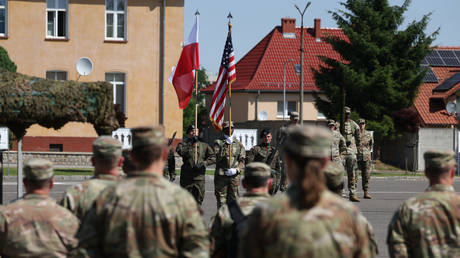
Poland isn't waiting around for permission to secure its borders. Warsaw is putting up roughly $4.4 billion (around 17 billion zloty) to fund infrastructure for a permanent United States military presence, a sprawling installation colloquially dubbed "Fort Trump". While critics grumble about the political branding, the reality on the ground is simple. Poland is willing to pay top dollar to lock in American boots permanently, shifting the security architecture of Eastern Europe in real time.
For years, the U.S. military footprint in Poland relied on rotational forces. Roughly 7,000 American service members cycle through the country on temporary tours, packing up and moving out every few months. Rotation is fine for deterrence on paper, but it lacks the permanence that sends an unshakeable message to Moscow. Warsaw wants a fixed anchor. By offering to cover the billions required for barracks, maintenance hubs, and family housing, Poland is removing every financial excuse Washington might have to say no.
What the $4.4 Billion Actually Buys
People look at the headline figure and assume it is just a handout. It is not. The money is earmarked for heavy infrastructure across four potential locations identified by Polish authorities. We are talking about modern airfields, logistics depots, maintenance facilities for advanced hardware like Patriot missile systems, and housing capable of supporting thousands of soldiers alongside their dependents.
Poland is also committing to cover steep operational expenses. Officials have floated proposals where the Polish taxpayer subsidizes individual service member deployment costs, sweetening the deal to ensure Washington views the base as a net-positive asset. When you spend nearly 5 percent of your gross domestic product on defense, you get to dictate terms. Warsaw is building one of the most formidable conventional armies on the continent, and Fort Trump is the crown jewel of that strategy.
The Political Tug of War Back Home
Of course, naming a military installation after an American president is bound to cause friction. Poland's national-conservative figures love the branding because it ties their security directly to Washington's political winds. At the same time, moderate factions in Poland's government argue that buttering up foreign leaders with flattering facility names looks overly subservient and risks alienating future U.S. administrations.
Yet, beneath the political theater, the pragmatic goal remains bipartisan in Warsaw. Whether the sign at the gate reads Fort Trump or something else entirely, the strategic outcome is identical. A permanent base changes the legal and military calculus. Under international defense rules, an attack on a rotational force is a diplomatic crisis; an attack on a permanent, heavily fortified U.S. base with families on site is an automatic catalyst for total war. That distinction is worth every single zloty to Polish planners.
What Happens Next for NATO
The Pentagon has signaled strong support for the operational concept, and formal decisions are expected to clear major hurdles. If the timeline holds, construction could wrap up and operations could kick off by 2029. Other front-line states are already watching closely, wondering if they should start writing their own checks to secure permanent American protection. Poland is setting an expensive precedent, and European defense spending will never look the same again.
Poland's U.S. base plan: What it means for NATO
This video breaks down the strategic implications of Poland's permanent base proposal and how it alters the broader NATO deterrence posture.


