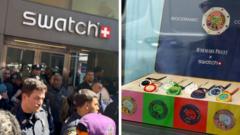
The rain in London at 4:00 AM doesn’t fall; it mist-coats the concrete, turning the pavement outside the Swatch store on Regent Street into a slick, grey mirror. If you stood there in the dark, you would smell the damp nylon of sleeping bags, the sharp tang of cheap energy drinks, and the unmistakable scent of human anxiety.
Hundreds of people are pressed against the glass. They are not waiting for a vaccine. They are not waiting for bread. They are waiting for a piece of bioceramic plastic that costs £207.
To the uninitiated, it looks like madness. To the economist, it looks like a textbook supply-and-demand squeeze. But to the people in that queue, it feels like life and death.
The launch of the Omega x Swatch MoonSwatch collaboration did not just spark chaotic scenes across global retail capitals; it exposed the raw, beating heart of modern consumer desire. It showed exactly what happens when luxury heritage is ground down, repackaged, and sold to a generation starved of a future they can actually afford.
Consider James. He is twenty-four, works in logistics, and has spent the last fourteen hours shifting his weight from one foot to the other on a freezing pavement. His hands are buried deep in his pockets, clutching a crumpled ball of bank notes. James will never own an Omega Speedmaster. The "Moonwatch"—the legendary chronograph worn by Apollo 11 astronauts—retails for upwards of £6,000. That is a down payment on a house James assumes he will never buy.
But today, for the price of a decent dinner out and a pair of trainers, James can walk away with something that bears the exact same silhouette. It has the same asymmetric case. It has the tachymeter scale. It says Omega on the dial.
This is the potent magic of the democratization of luxury. It is a intoxicating illusion.
By the time the store shutters rattle upward at 9:00 AM, the atmosphere has soured from weary camaraderie to something volatile. The queue has lost its shape, morphing into a pulsing wedge of shoulders and raised elbows. Voices rise over the hum of morning traffic. Security guards, vastly outnumbered, form a thin black line against the glass.
Then comes the surge.
The chaos that followed wasn't born from a love of horology. Nobody in that crowd was debating the merits of quartz movements versus mechanical calibers. The frenzy was fueled by a modern, hyper-accelerated form of alchemy: the knowledge that the plastic watch in that cardboard box could be instantly transuted into cold, hard cash.
Within minutes of the first transactions, the digital slipstream of the internet caught fire.
On online marketplaces and resale platforms, the £207 timepieces were appearing at markups of 400%, 500%, even 1,000%. Sellers were posting photos taken right on the shop floor, the ink on their Swatch receipts not yet dry. One seller, listing their watch on an auction site before they had even boarded the Tube home, watched the bids climb past £1,000 in real-time.
"I sold it for over a grand," one reseller later admitted, speaking with the breathless adrenaline of a bank robber who had successfully negotiated the getaway. "I walked out of the shop, sat on a bench, opened my phone, and by the time I got to Oxford Circus, my rent for the month was paid."
This is the quiet underbelly of the hype economy. For a specific subset of the crowd—the flippers, the hypebeasts, the opportunistic teenagers—the Regent Street sidewalk wasn't a retail queue. It was a trading floor.
The traditional watch industry, built on the pillars of Swiss discretion, heritage, and generational longevity, viewed the spectacle with a mixture of horror and fascination. For decades, luxury brands maintained their status through artificial scarcity and intimidating price barriers. You didn't just need money to buy a high-end watch; you needed the social capital to walk into a boutique on New Bond Street without the staff looking at your shoes.
The MoonSwatch smashed that paradigm to splinters. It took the ultimate insider symbol and threw it into the street.
Predictably, purists cried foul. They argued that by stamping the Omega logo onto a lightweight composite made of castor oil and ceramic, the brand was diluting its hard-won prestige. They called it cheap. They called it a gimmick.
But they misunderstood the psychological landscape of the modern consumer.
We live in an era of intense financial vertigo. The traditional markers of adulthood—property ownership, a predictable career trajectory, a stable retirement—have shifted out of reach for millions of young people. When the macro-economy feels fundamentally broken, the human desire for status and belonging does not simply vanish. It mutates. It attaches itself to objects that are attainable, yet exclusive enough to carry social currency.
A £207 bioceramic watch becomes a proxy for success. It is a tiny, wearable trophy that says, I was there. I survived the queue. I am part of the club.
As the afternoon sun finally broke through the London clouds, the scene outside the store began to clear, leaving behind a battlefield of discarded coffee cups, crumpled crisp packets, and the deflated energy of those who came away empty-handed. Swatch eventually closed the doors early, citing safety concerns as the crowds grew unmanageable. Police officers stood where the queue used to be, gesturing for disappointed latecomers to move along.
The great watch rush of 2022 was over, but the cultural tectonic plates had shifted permanently.
Weeks later, the resale prices began their inevitable, slow slide backward toward reality as supply caught up with the initial hysteria. The thousand-pound profits vanished, replaced by more modest margins. The hype moved on to the next drop, the next collaboration, the next artificial shortage.
Yet, if you look closely at James, who eventually made it through those doors and now sits on the Victoria line heading south, you see something that cannot be measured by a resale algorithm. He is staring down at his wrist. He moves his arm slightly, letting the dim carriage light catch the pale blue casing of his new watch.
He knows it is plastic. He knows it runs on a battery that costs less than a coffee. But for the next few hours, as he rides home through the dark tunnels beneath London, he is holding a piece of the moon.