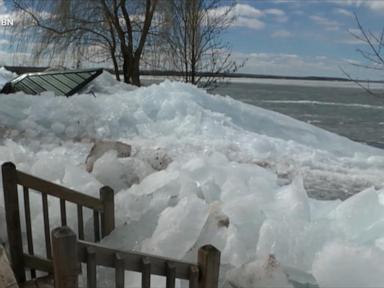
Riverine ice jams represent a nonlinear hydrological threat where traditional flood staging models fail to account for the kinetic energy of solid-state water. While standard flooding involves the gradual inundation of structural foundations by liquid water, ice-jam flooding introduces mechanical shearing forces and projectile dynamics. The recent events in Michigan illustrate a specific catastrophic failure point: the transition from static ice cover to a dynamic, fractured flow regime that exceeds the structural load-bearing capacity of residential envelopes.
The Mechanics of Ice Jam Formation
The transition of a river from a stable winter state to a flood state is governed by the hydraulic relationship between discharge volume and the frictional resistance of the surface ice. Three specific variables dictate the severity of an ice jam:
- The Thermal Gradient: A rapid increase in ambient temperature leads to "rotten ice," which lacks the structural integrity to stay anchored but maintains enough mass to create physical blockages.
- Hydraulic Surge: Significant rain-on-snow events or rapid snowmelt increase the river's stage (height). This creates a lifting force that detaches shore-fast ice.
- Geometric Constriction: Sinuous river bends, bridge piers, and narrowing channels serve as physical anchors for moving ice, leading to a rapid accumulation of "frazil" and "brash" ice.
When these variables converge, the river undergoes a phase transition from laminar flow to a jammed state. The water behind the jam accumulates potential energy, while the jam itself acts as a makeshift dam. The eventual failure of this dam releases a "surge" or "jave," propelling ice fragments downstream with a force calculated as $F = ma$. Given that freshwater ice has a density of approximately $917 kg/m^3$, a single cubic meter of ice carries nearly a metric ton of mass. When propelled by flood currents exceeding $2 m/s$, the resulting kinetic energy is sufficient to breach standard residential masonry and timber framing.
Kinetic Impact and Structural Vulnerability
The destruction observed in Michigan homes is not merely the result of water damage but of mechanical impact. Most residential structures are designed to withstand static loads (the weight of the house) and lateral wind loads. They are rarely engineered for the point-load impacts of ice floes.
The failure of a home's exterior envelope during an ice flood follows a predictable sequence:
- Hydrostatic Pressure: Rising water levels saturate the soil, increasing the pressure against basement walls. This often causes the initial structural compromise.
- Mechanical Shearing: As ice chunks move past a structure, they exert frictional forces that can "scrape" siding, windows, and doors from the frame.
- Mass Impact: Larger floes, often several meters wide, act as battering rams. If the velocity of the river is high, the impact force can exceed the shear strength of the anchor bolts holding a house to its foundation.
The debris field left inside a home—ice chunks the size of furniture—indicates a complete breach of the building envelope. Once the envelope is breached, the interior of the home becomes a catchment for the river’s bed load, filling living spaces with sediment, pollutants, and thermal mass that is difficult to remove without heavy machinery.
The Hydrodynamic Bottleneck
The primary driver of Michigan's ice-related catastrophes is the specific topography of its lowland river systems. Unlike mountainous regions where steep gradients flush ice through, Michigan's flat terrain results in lower flow velocities. This lower velocity allows ice to accumulate in thicker, more complex jams.
This creates a feedback loop:
The jam reduces the cross-sectional area of the river channel $\rightarrow$ The velocity of the water increases locally to maintain discharge $\rightarrow$ This high-velocity water erodes the riverbank and carries more debris into the jam $\rightarrow$ The total mass of the blockage increases.
The "ice run" that enters a residential area is the release of this accumulated mass. It is not a gradual rise in water, but a sudden influx of solids. For homeowners, the warning time is often measured in minutes, as the failure of an upstream jam sends a pulse of ice and water down the channel at speeds significantly higher than the base flow of the river.
Mitigation Limits and Engineering Realities
Standard flood mitigation strategies—such as sandbagging—are entirely ineffective against ice jams. A sandbag wall provides no resistance to the kinetic energy of a thousand-pound ice floe. Effective mitigation requires large-scale hydraulic engineering, which is often cost-prohibitive for smaller municipalities.
- Ice Booms: Floating barriers can be used to capture ice in slower-moving sections of the river, preventing it from reaching critical bottlenecks. However, these can fail during extreme surge events.
- Bubbler Systems: By releasing air at the bottom of the river, warmer water is brought to the surface to prevent ice formation. This is energy-intensive and only effective over small areas, such as around bridge piers.
- Mechanical Removal: Using amphibious excavators (such as the "Ice Breaker") to physically break up jams is the most direct intervention, but it requires mobilizing heavy equipment in hazardous, unstable conditions.
Structural resilience at the individual property level is similarly limited. Elevating a home (stilts or piers) can allow water and smaller ice chunks to pass underneath, but the piers themselves then become targets for impact. If a pier is struck by a major floe, the entire structure’s center of gravity shifts, leading to total collapse.
Risk Assessment and Insurance Gaps
A significant factor in the economic impact of Michigan's ice floods is the "flood vs. impact" distinction in insurance underwriting. Standard National Flood Insurance Program (NFIP) policies cover damage caused by the "overflow of inland or tidal waters," but the specific damage caused by ice impact can lead to complex claims disputes. If the ice causes a structural collapse before the water level reaches the home, the definition of "flooding" may be challenged by private carriers.
Furthermore, the recurrence interval for these events is changing. Traditional 100-year flood maps are based on historical liquid-water discharge. They do not accurately model the "ice jam frequency," which is driven by volatile freeze-thaw cycles rather than simple precipitation volume. As winters become more erratic, the probability of "mid-winter breakups"—the most dangerous type of ice event—increases.
Strategic Action for Riparian Asset Management
For municipalities and property owners, the strategy must shift from "resistance" to "managed vulnerability." Attempting to harden a structure against the kinetic force of a major ice run is an exercise in diminishing returns.
The primary tactical move for high-risk zones is the implementation of early-warning vibration sensors upstream. These sensors detect the seismic signature of a jam breaking before the surge reaches populated areas. On a structural level, the focus must be on "sacrificial architecture"—designing the ground floor of riverfront properties with breakaway walls and non-structural materials that allow ice and water to pass through the building footprint without destabilizing the primary load-bearing members.
Long-term asset protection requires the re-evaluation of riparian setbacks. If a property sits within a known geometric constriction of a river (a "choke point"), it is statistically certain to face ice-loading forces that exceed modern building codes. Relocation or the conversion of these zones into "green infrastructure" (parks or wetlands that can absorb ice mass without economic loss) is the only permanent solution to the physics of cryospheric flooding.