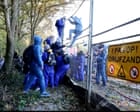
Hyperscale cloud infrastructure is no longer an abstract software layer insulated from localized geopolitical and environmental friction; the physical breach of a Microsoft AI data centre site in Amsterdam proves that capital-intensive compute deployments now face direct, asymmetrical operational risk at the perimeter. Most coverage treats activist intrusions at server facilities as isolated public relations events or minor trespassing incidents. That framing misunderstands the underlying economics and engineering vulnerabilities of modern artificial intelligence infrastructure. When environmental and anti-surveillance coalitions target physical construction and operational sites in Western Europe, they are exploiting a structural mismatch between the multi-billion-dollar rigidity of hyperscale capital expenditure and the low-cost agility of decentralized direct action.
To understand the operational impact of the Amsterdam breach, analysts must separate the immediate physical event from the systemic bottlenecks it exposes. The Netherlands—specifically the Amsterdam metropolitan area and the surrounding North Holland province, including hubs like Middenmeer and Schiphol-Rijk—sits at the intersection of transatlantic subsea cables and the Amsterdam Internet Exchange (AMS-IX). This geographic concentration makes the region indispensable for low-latency European cloud and AI workloads. However, that exact density creates acute resource contention over electrical grid capacity, municipal water allocations, and agricultural land zoning, turning routine infrastructure expansion into a flashpoint for civil resistance.
The Structural Anatomy of the Amsterdam Site Breach
Analyzing the intrusion requires stripping away sensationalist reporting and examining the mechanics of physical site security during the construction-to-commissioning lifecycle of a hyperscale facility. Data centres do not achieve Tier III or Tier IV physical security postures overnight. During active construction, expansion, or retrofitting for high-density AI compute racks, sites operate under a fragmented perimeter model managed by general contractors rather than permanent hyperscale security teams.
The Amsterdam incident demonstrates three distinct operational realities:
- Perimeter Asymmetry: Construction sites require continuous ingress and egress for heavy machinery, modular cooling units, and subcontracted labor. Standard temporary fencing and baseline patrol protocols designed to deter opportunistic theft fail completely against coordinated, non-violent direct action groups willing to accept arrest to achieve media visibility.
- The AI Compute Multiplier: Public opposition to data centres in the Netherlands shifted dramatically once facilities transitioned from general enterprise storage to dedicated AI training and inference clusters. Traditional cloud servers operate at roughly 5 to 10 kilowatts per rack; modern GPU-dense AI clusters routinely draw 40 to 100 kilowatts per rack. Activist coalitions explicitly target this power and cooling escalation, framing AI infrastructure as an extractive drain on national decarbonization targets.
- Reputational Contagion over Physical Destruction: Direct action groups breaching European tech infrastructure rarely aim to destroy hardware—an act that triggers severe felony charges and alienates mainstream environmental allies. Instead, the objective is operational disruption, visual documentation inside restricted zones, and forcing municipal regulators to re-examine permitting compliance.
A critical distinction must be maintained between verified operational facts and unconfirmed hypotheses regarding these incidents. It is an established fact that activists breached the site perimeter, halted localized activity, and linked their protest to energy consumption, water usage, and the geopolitical applications of Microsoft’s AI contracts. It is not verified that core compute hardware, proprietary silicon, or live customer data suffered physical compromise during the incursion. Conflating a perimeter construction breach with a compromise of an operational, air-gapped server hall obscures the actual risk profile.
The Three Pillars of European Hyperscale Friction
Why did Amsterdam become the focal point for physical resistance against Microsoft’s infrastructure footprint? The breach is the downstream consequence of three compounding pressures governing European digital infrastructure.
1. Grid Congestion and the Zero-Sum Power Equation
The Dutch electricity grid operator, TenneT, along with regional distribution operators like Liander, faces severe transmission bottlenecks across North Holland. Industrial electrification, residential heat pump adoption, and renewable generation curtailment have pushed local substations to maximum capacity. When a hyperscale operator secures power purchase agreements (PPAs) and grid connections capable of sustaining tens or hundreds of megawatts for AI workloads, local manufacturers and housing developers experience tangible connection delays. In the public consciousness, cloud compute ceases to be an invisible utility and becomes a direct competitor for finite electrons.
2. Water Stress and Cooling Thermodynamics
Despite the Netherlands' historical association with water management, summer droughts and salinization of freshwater aquifers have turned industrial cooling water into a fiercely contested resource. Legacy evaporative cooling towers consume millions of liters of potable or surface water annually to reject heat from server halls. Even though modern Microsoft designs increasingly utilize closed-loop liquid cooling and outside-air economization—which drastically reduce water usage effectiveness (WUE) ratios during temperate Dutch weather—public perception remains anchored to earlier controversies, such as the 2022 disclosures regarding water consumption at the Middenmeer facility during heatwaves. Activists exploit this lag between legacy engineering data and current closed-loop deployments to mobilize local agrarian and environmental constituencies.
3. Regulatory Whiplash and Zoning Moratoriums
The Dutch national government previously enacted temporary moratoriums on hyperscale data centres exceeding specific megawatt thresholds and square-footage footprints, routing permitting authority back toward national ministries rather than local municipalities. While existing projects and specific metropolitan zones retained pathways for expansion, the regulatory signal was unambiguous: unchecked hyperscale sprawl is no longer politically viable. When physical protests occur at an Amsterdam site, they exert immediate political pressure on municipal councils to tighten environmental impact assessments (EIAs) and enforce stricter heat-reuse mandates.
The Cost Function of Physical Disruption
In financial modeling for hyperscale infrastructure, physical security breaches are rarely priced correctly because analysts default to direct property damage metrics. If a fence is cut and work halts for six hours, direct remediation costs appear negligible against a multi-hundred-million-euro capital budget. That accounting method misses the true cost function of physical direct action.
The actual financial damage manifests across four secondary vectors:
- Schedule Slippage and Carrying Costs: Hyperscale AI deployments operate on compressed timelines dictated by GPU supply chains and enterprise contract commitments. A single day of regulatory stop-work orders or forensic site sweeps delays revenue recognition on hardware that depreciates rapidly as newer silicon architectures enter the market.
- Permitting Audit Triggers: Visible perimeter breaches invite immediate scrutiny from municipal building inspectors, labor authorities, and environmental agencies. What begins as a trespass incident frequently escalates into comprehensive compliance audits covering contractor safety, noise ordinances, diesel backup generator testing, and wastewater discharge.
- Insurance and Financing Friction: Institutional infrastructure funds and insurers underwriting data centre construction increasingly incorporate ESG (Environmental, Social, and Governance) and civil unrest riders into risk assessments. Repeated direct action incidents elevate risk premiums and complicate debt covenants for joint-venture development partners.
- Talent and Vendor Attrition: Subcontracted electrical engineers, HVAC specialists, and local logistics providers face harassment or operational delays when working on contested sites, forcing general contractors to pay hazard or retention premiums to maintain project velocity.
Operational Limitations of Conventional Countermeasures
Hyperscale operators typically respond to site intrusions by escalating physical hardening—deploying taller anti-climb fencing, thermal perimeter cameras, microwave motion sensors, and private security patrols. While necessary for baseline compliance, this purely kinetic security posture carries severe strategic limitations in the European regulatory environment.
First, aggressive militarization of a civilian construction perimeter in an urban or peri-urban European zone validates the activist narrative that tech conglomerates operate as unaccountable, extractive enclaves. Heavy-handed private security tactics create viral video assets that amplify activist recruitment far more effectively than the initial breach ever could.
Second, perimeter hardening does nothing to resolve the underlying resource bottlenecks driving the protests. Sensors detect intruders; they do not expand substation transformer capacity or negotiate district heating integration with surrounding municipalities. Treating a socio-political and resource-allocation conflict purely as a physical security problem guarantees recurring operational friction.
Third, intelligence gathering on decentralized activist networks faces strict legal boundaries under European privacy and civil liberties frameworks. Unlike state-sponsored espionage threats tracked through traditional cyber-physical threat intelligence, direct action coalitions organize through loosely affiliated, semi-public assemblies where distinguishing between lawful civil protest and unlawful site intrusion prior to execution is operationally difficult.
Strategic Execution for Hyperscale Infrastructure Operators
To insulate AI infrastructure deployments in Amsterdam and comparable Tier-1 European hubs from physical disruption, operators must integrate physical security, grid engineering, and municipal diplomacy into a single operational framework.
Phase 1: Lifecycle-Synchronized Perimeter Hardening
Security architecture must decouple from general contractor control during high-risk transition windows. Operators should implement tiered perimeter zones before high-value electrical switchgear or GPU racks arrive on site, utilizing non-lethal active deterrence—such as automated acoustic warnings, high-lumen strobe lighting, and rapid police liaison protocols—rather than relying solely on passive chain-link barriers during construction phases.
Phase 2: Radical Telemetry Transparency
Secrecy breeds activist mobilization. Hyperscale operators should publish real-time, third-party-audited telemetry for each regional facility, detailing live Power Usage Effectiveness (PUE), Water Usage Effectiveness (WUE), source percentages of renewable energy matching, and exact megawatt-hours exported to local municipal district heating networks. Stripping activists of informational ambiguity forces public debate onto verifiable engineering metrics rather than worst-case projections.
Phase 3: Pre-Permitting Grid and Heat Co-Investment
Future capacity expansions in grid-constrained markets like North Holland cannot rely on standard utility interconnection queues. Operators must structure capital expenditure to directly co-fund substation upgrades, grid-scale battery energy storage systems (BESS) that provide frequency regulation back to TenneT, and mandatory waste-heat recovery pipelines integrated into municipal residential heating grids. When a data centre operates as a net stabilizer for local energy and heating infrastructure, local political leadership acquires a direct fiscal and electoral incentive to defend the facility against disruption.
The era of frictionless physical expansion for cloud and AI infrastructure in Western Europe has permanently closed. Hyperscale operators that continue to treat physical sites as mere real estate shells for software deployment will face escalating delays, regulatory intervention, and recurring perimeter breaches; those that engineer their facilities as transparent, grid-stabilizing civic utilities will secure the physical durability required to scale AI compute.