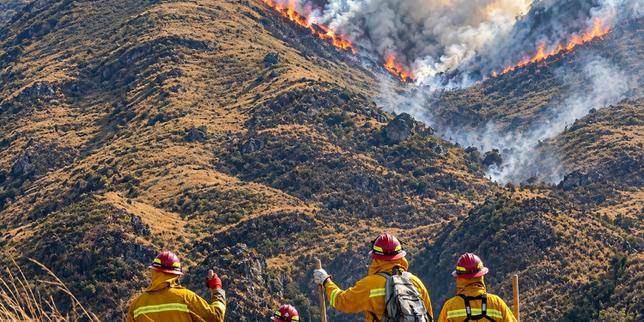
The headline Au Pérou, « le pays brûle » et le gouvernement de Keiko Fujimori regarde ailleurs captures a surface tension between ecological distress and executive distraction, yet framing the crisis as mere indifference obscures how political incentives in Lima interact with climate shocks. When wildfires sweep across Andean valleys and Amazonian margins while a newly installed administration prioritizes deregulation and macroeconomic stabilization, the clash stems from structural mismatches in state capacity, regulatory authority, and political survival rather than simple apathy.
Understanding Peru's compound emergency requires separating verified empirical dynamics from analytical hypotheses. Verified facts establish that Peru has faced prolonged political instability since 2016, including executive turnover and legislative friction, before Keiko Fujimori assumed the presidency on July 28, 2026. Between June and October 2026, hundreds of forest fires were recorded across Peru, burning farmland, homes, and natural vegetation amid a strengthening El Niño event and high temperatures, while demonstrations in Lima and regional cities linked environmental emergencies to citizen insecurity and living costs. By contrast, claiming that the executive deliberately ignores fires to favor specific land-clearing networks or that cabinet ministers act with calculated malice remains an educated hypothesis requiring forensic and budgetary verification. You might also find this related story insightful: Why Trump’s Russia Gamble Keeps Backfiring With Voters.
Deconstructing the Competitor's Narrative
A standard journalistic framing—that the country burns while leadership looks away—relies on a simple moral contrast: suffering on the ground versus detachment in the capital. That framing performs well emotionally because it compresses complex institutional failures into a single image. Yet it leaves three analytical gaps that weaken strategic foresight.
First, it treats wildfire outbreaks as a purely meteorological or episodic shock rather than a coupled socio-ecological system. Dry conditions and heat increase ignition susceptibility and fire spread, while agricultural land clearing, frontier expansion, and weak enforcement determine where ignitions occur and how rapidly they escalate. Second, it equates visible executive focus on economic reform or crime control with total inaction across the state, overlooking how ministries divide attention, statutory mandates, and fiscal buffers. Third, it underestimates the legal and administrative architecture already altered in recent years, such as shifts in forest zoning authority and debates over enforcement tools. As highlighted in detailed articles by The New York Times, the implications are significant.
The Three Pillars of Compound Crisis in Peru
To move beyond surface commentary, the situation can be organized into three interlocking pillars that govern how fires burn and how political actors respond.
- Climatic and Ecological Exposure: A strengthening El Niño raises temperatures and alters precipitation patterns across tropical and Andean zones, drying fuel loads and elevating both wildfire risk and downstream flood or landslide hazards. This climatic baseline interacts with localized land-use practices, including brush burning for agriculture and frontier clearing.
- Institutional and Regulatory Friction: Governance over land, forests, and enforcement spans national ministries, regional authorities, and prosecutorial bodies. Legal adjustments affecting forest zoning, permitting timelines, and investigative rules create ambiguity over who holds operational responsibility and how quickly rules can be enforced on the ground.
- Executive Priority Asymmetry: Any new administration enters office with a scarce bandwidth budget. The Fujimori government's public agenda emphasizes investment attraction, permitting speed, public security, and macroeconomic stability ahead of El Niño fiscal pressures. When rapid-onset emergencies like wildfires compete with structural economic programs and chronic street crime, emergency response often suffers from reactive rather than preventive allocation.
The Cost Function of Delayed State Response
In operational terms, delaying decisive fire suppression and preventive land management does not keep costs constant; it compounds them across time. Early containment requires localized readiness, rapid air or ground deployment, and clear command chains. When response lags, fires consume more biomass, damage adjacent smallholdings and infrastructure, degrade air quality, and trigger political mobilization that ties environmental grievances to broader distrust of state institutions.
This dynamic creates a classic attention bottleneck. Executive teams under pressure from congressional confidence dynamics, security anxieties, and macroeconomic forecasting tend to prioritize high-salience macro levers—such as investment frameworks or emergency decrees—over dispersed territorial management. Yet the fiscal cost function of disaster response is non-linear: a modest upfront investment in early detection, municipal coordination, and firebreak enforcement can avert far larger post-disaster relief, agricultural loss, and reputational damage.
A practical illustration clarifies the mechanism without inventing figures. Consider a highland or forest-edge district experiencing dry winds and seasonal agricultural burning. If local authorities lack real-time coordination with regional forestry units and emergency responders, a small agricultural burn can escape containment during peak afternoon winds. Once the fire crosses into steeper terrain or dense brush, suppression becomes slower and more hazardous, shifting the state from low-cost prevention to high-cost emergency containment and post-event recovery.
Missed Cause-and-Effect Chains
Standard commentary often treats protests over fires, crime, and living costs as separate complaints stacked onto a single march. A sharper causal map shows how these pressures reinforce one another.
First, ecological disruption feeds economic vulnerability. Fires and climate extremes threaten crops, livestock, local livelihoods, and transport corridors. For households already strained by inflation, extortion, or informal employment, an environmental shock is experienced immediately as an income and food-security shock.
Second, perceived state absence erodes institutional legitimacy. When citizens see rapid legislative action on certain political or economic priorities alongside slow or fragmented responses to local emergencies or street extortion, frustration generalizes into systemic anti-institutional sentiment. Street demonstrations then become a venue where ecological demands, security demands, and political grievances converge.
Third, regulatory ambiguity complicates enforcement. When statutory changes alter zoning rules, agency competencies, or investigative procedures, frontline officials face unclear mandates. Even well-intentioned directives from Lima can stall if regional agencies, police, and prosecutors operate with conflicting interpretations or insufficient field resources.
What Observers Commonly Ask About the Crisis
Observers trying to make sense of Peru's turmoil typically ask whether the fires are driven primarily by climate cycles or human land use, why a pro-market government appears slow on environmental emergencies, and whether protests can force a policy shift.
In practice, wildfires in fire-prone tropical and Andean landscapes rarely have a single cause. Climate anomalies like El Niño supply heat and dryness that lower moisture thresholds, while human ignition—whether from agricultural clearing, land speculation, or other activities—provides the spark and spatial pattern. Treating one factor as exclusive misdiagnoses the risk.
Similarly, a government focused on investment acceleration and macroeconomic stability does not necessarily intend environmental harm, yet its institutional design can under-weight ecological externalities. Fast-tracking permits or streamlining rules without parallel investment in monitoring, land titling clarity, and enforcement capacity increases friction between growth targets and territorial governance. Whether street protests alter that balance depends on coalition durability, congressional arithmetic, and whether demonstrations remain localized or disrupt key economic corridors.
Tactical Diagnostic Framework for Analysts and Operators
Anyone tracking or operating in Peru during heightened climate and political volatility can apply a four-step diagnostic sequence to separate noise from structural risk:
- Map spatial overlap, not just national totals. Cross-reference active fire alerts and El Niño hazard zones with agricultural frontiers, transport arteries, and protest hotspots to identify where physical disruption intersects economic choke points.
- Audit statutory and agency authority. Track which ministry or regional body holds active approval, zoning, or enforcement power over contested land and emergency response, noting where regulations remain pending or contested.
- Track fiscal reallocation rather than rhetoric. Watch budget transfers, contingency reserves, and emergency decrees to see whether resources actually move toward prevention and disaster response or remain concentrated in other portfolios.
- Monitor multi-issue protest coalitions. Distinguish single-sector grievances from coalitions linking environmental protection, public security, and cost-of-living pressures, as cross-issue alignment raises political mobilization capacity.
Limitations and Analytical Blind Spots
No analytical framework eliminates uncertainty in a fluid political and climatic environment. Public reporting on remote wildfires can lag behind ground conditions due to terrain, communications limits, and verification delays. Political alignment in Congress is also dynamic in a fragmented party system, meaning executive priorities can shift rapidly under legislative pressure or shifting public mood. Furthermore, attributing specific fire incidents to specific economic actors requires rigorous field evidence rather than correlation with seasonal trends or policy debates.
Strategic Play for Decision-Makers
For policymakers, investors, and risk teams operating in Peru, the decisive move is to treat climate-driven emergencies and governance bottlenecks as an integrated operational risk rather than a peripheral headline. Establish an early-warning trigger matrix that pairs El Niño meteorological advisories and regional fire or flood alerts with supply-chain routing contingencies, local community risk mapping, and explicit compliance checks on land and permitting rules. Pairing investment discipline with proactive risk containment protects asset continuity, community standing, and credibility far more reliably than reacting after smoke reaches the headlines.



