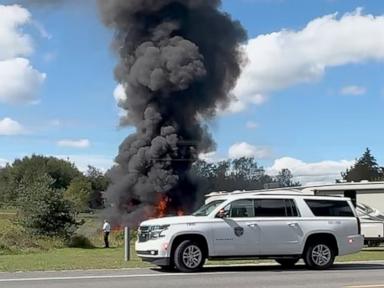
A routine military training flight turned into a chaotic local emergency when a Texas Air National Guard F-16 Fighting Falcon went down in Grand Traverse County, Michigan. If you only read the surface-level headlines, you probably think this was just another standard jet mishap where the pilot punched out and emergency crews hosed down a field.
You're missing the real story.
When a multi-million-dollar fighter jet crashes in a rural Midwestern community, the immediate threat isn't just the impact crater or the fireball. It's the invisible chemical hazard that forces local authorities to slap an urgent evacuation radius over civilian neighborhoods. Let's break down what actually happened during that tense afternoon in northern Michigan, why civilian areas had to clear out fast, and what this incident reveals about high-stakes military training deployments.
The Reality of the Crash Site and Pilot Survival
The incident unfolded on a Thursday afternoon when an F-16 from the 149th Fighter Wing—operating out of the Alpena Combat Readiness Training Center—experienced a catastrophic inflight emergency. Witnesses near Green Lake Township described hearing a massive explosion that rattled houses and filled the sky with thick black smoke.
People living just yards away thought a bomb had gone off. Debris littered local fields, and secondary detonations echoed across the countryside as the wreckage burned.
Yet, the primary victory of the day was human survival. The pilot managed to eject successfully before impact. Locals reported finding the aviator in the middle of a field, sitting upright with a bright orange parachute after a textbook ejection. Transported to a local hospital, the pilot was listed in stable condition. Military training kicked in exactly when it needed to, saving a life.
Why the Crash Sparked an Hourslong Evacuation
The real panic wasn't just about fire; it was about chemistry. Local emergency management and Michigan State Police established an immediate safety perimeter, ordering residents within a one-mile radius to evacuate or shelter indoors with windows tightly sealed.
Why the sudden lockdown? Fighter jets like the F-16 carry hazardous materials that remain dangerous long after the jet hits the ground.
Most notably, the F-16 uses an Emergency Power Unit (EPU) fueled by hydrazine. Hydrazine is an extremely toxic, volatile compound that smells vaguely like ammonia. If you can smell it, you're already breathing dangerous levels that can damage your central nervous system, liver, and lungs. First responders treat a downed F-16 like a hazardous materials site because a ruptured EPU releases carcinogenic and highly corrosive fumes.
This is why local officials didn't just cordon off a dirt road—they cleared out nearby homes, restricted local movement, and kept people away for hours until hazardous material teams could neutralize the site.
The Ripple Effects on National Guard Operations
Whenever a frontline fighter like the F-16 goes down during a domestic training rotation, the institutional response is swift and heavy. Following the crash, the Texas Air National Guard temporarily grounded related operations to review safety protocols.
Investigators from the Air Force are left piecing together the telemetry, maintenance logs, and wreckage. While official investigations take months, aviation experts immediately point toward common low-altitude hazards in the region. Northern Michigan's airspace sees heavy migratory bird activity during the fall, making bird strikes an ever-present hazard for single-engine jets operating at high speeds. Whether a flock of geese disabled the engine or a mechanical failure triggered the sequence, the incident highlights the inherent risks military pilots face every time they take off on domestic soil.
Next time you see a military jet roaring overhead during a cross-country deployment, remember that these training exercises carry real risks for both the flight crews and the rural communities sitting underneath the flight path.
F-16 crash in Michigan news coverage
This video provides local news coverage and eyewitness accounts of the Grand Traverse County crash site and the subsequent emergency response.