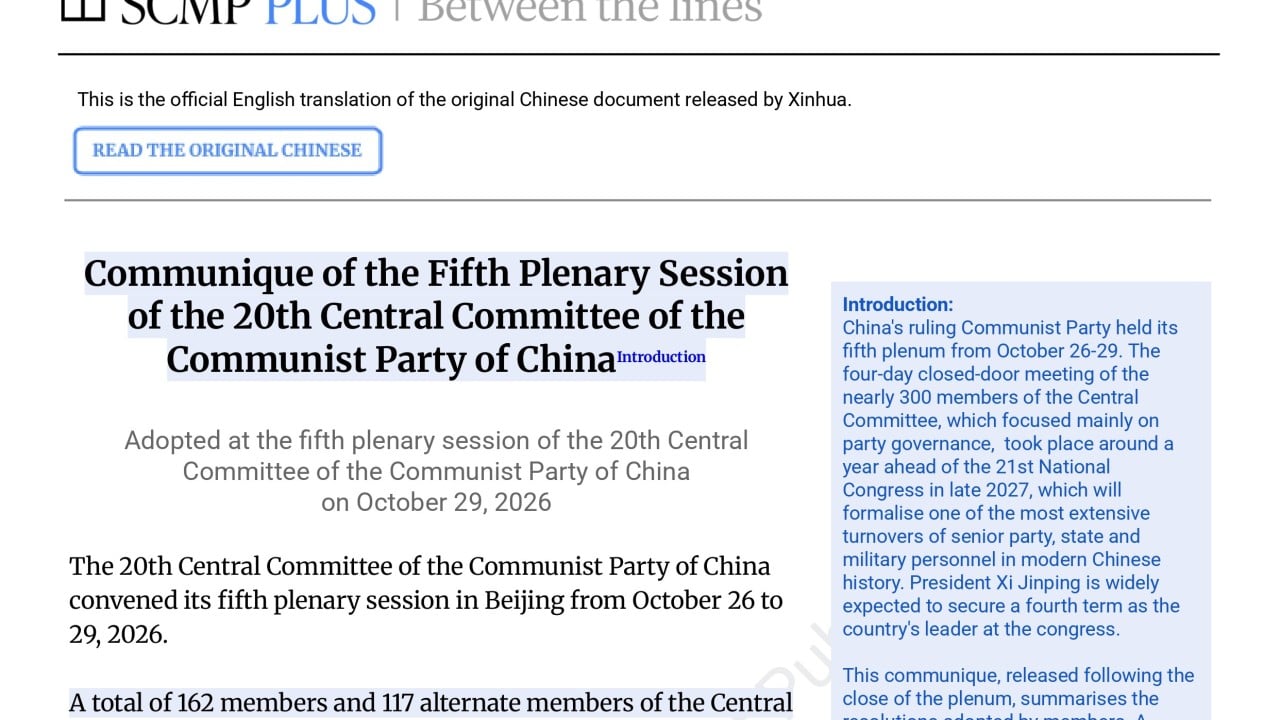
Most Western coverage of China’s fifth plenum readout reads like a translation of dry bureaucratic jargon. Analysts skim the surface, pick out a few buzzwords about "high-quality development," and miss the actual mechanics of how Beijing shifts capital and political power.
If you want to understand where the Chinese economy is heading, you can't just read the headlines. You have to look at what the Communist Party of China (CPC) Central Committee puts in its official communique, how the language changes from previous sessions, and what gets quietly dropped.
The Fifth Plenum—historically the gathering where the Party approves its next Five-Year Plan and long-range economic blueprints—isn't a public relations exercise. It's an internal signaling mechanism. When the readout drops, provincial governors, state-owned enterprise (SOE) executives, and private tech founders read every single character like their careers depend on it. Because they actually do.
Why China's Fifth Plenum Readout Matters More Than You Think
To understand the weight of a fifth plenum communique, you have to understand the rhythm of Chinese political cycles. Each Party Congress lasts five years, and the Central Committee typically holds seven plenary sessions during that span.
The Fifth Plenum sits right at the sweet spot of the five-year cycle. By this point, the leadership team has consolidated its positions from the earlier plenums. Now comes the hard part—setting the medium- and long-term economic agenda.
I've spent years tracking how Beijing communicates policy shifts, and the biggest mistake outsiders make is treating the readout as a wish list. It isn't. In China's political system, a plenum communique sets the ideological and administrative guardrails for the next half-decade. Once a phrase enters the fifth plenum readout, ministries in Beijing have to draft corresponding regulations, state banks have to adjust lending quotas, and local officials get evaluated on those exact metrics.
The Mechanics of the Communique
The document itself usually runs several thousand Chinese characters. It's released immediately after the four-day closed-door meeting in Beijing concludes, typically in October.
Notice what isn't in the initial readout. You won't find granular GDP targets or specific line-item budget allocations. Those numbers come later, usually at the National People's Congress (NPC) the following March. Instead, the fifth plenum readout establishes the direction of travel.
According to official publications from Xinhua News Agency and analyses by institutions like the Mercator Institute for China Studies (MERICS), the language in these communiques follows a strict hierarchy. Words placed in the opening paragraphs carry exponentially more political weight than topics mentioned near the end. When "technological self-reliance" or "national security" moves up the document, budgets across the entire country shift within months.
Decoding the Shifts in Economic Priorities
A classic example of how this works in practice happened with the Fifth Plenum of the 19th Central Committee in October 2020, which laid out the proposals for the 14th Five-Year Plan (2021–2025) and Vision 2035.
At the time, many commentators focused on the absence of a hard numerical GDP growth target in the readout. Some claimed Beijing was abandoning growth. Others argued the leadership was panicking over post-pandemic uncertainty. Both takes missed the point.
By dropping a rigid numerical target from the plenum communique, the Central Committee was signaling a structural pivot. Growth at any cost—the model that fueled China's rise for three decades—was officially over. The readout elevated "high-quality development" and "dual circulation" to core strategic pillars.
Dual Circulation and Domestic Demand
If you've read any analysis of recent Chinese economic planning, you've seen the phrase dual circulation. The concept sounds abstract, yet its practical meaning is straightforward.
Internal circulation refers to the domestic economy—Chinese consumers buying Chinese-made goods, supported by domestic supply chains. External circulation refers to international trade and foreign investment. The fifth plenum readout made clear that while Beijing isn't closing its doors to global trade, it intends to rely primarily on internal circulation to insulate itself from external shocks, tariffs, and export controls.
Here's why that matters for businesses operating in or competing with China:
- Supply chain localization accelerates. When the readout emphasizes "independent and controllable" supply chains, state subsidies pour into domestic semiconductor, aerospace, and industrial software firms.
- Consumer stimulus stays targeted. Unlike Western governments that handed out direct cash checks during downturns, Beijing's readout language consistently favors supply-side upgrades and targeted infrastructure over broad household handouts.
- Market access becomes selective. Foreign companies offering advanced manufacturing, green tech, or high-end medical equipment get welcomed. Foreign firms in sectors where domestic competitors have caught up face a much tougher regulatory environment.
According to research from the Center for Strategic and International Studies (CSIS), this pivot toward self-reliance wasn't a sudden reaction to trade friction. It had been building for years, and the fifth plenum readout simply codified it into binding Party doctrine.
Security and Development Become Two Sides of the Same Coin
One of the sharpest turns in modern fifth plenum readouts is how national security gets woven directly into economic planning. Historically, Chinese Party documents treated economic development as the primary task, with security handled in separate sections.
That separation is gone.
In recent plenum communiques, the Central Committee explicitly pairs "development and security" as twin priorities. Look closely at the phrasing used by Xinhua in official summaries—the Party now views economic vulnerabilities, technological bottlenecks, and financial debt not just as market risks, but as direct threats to national security.
This framing changes how regulators behave. When a sector like fintech, data security, or critical minerals gets framed through a security lens in a plenum readout, commercial profitability takes a back seat. State-owned enterprises get tapped to stabilize supply chains even if the short-term return on equity looks terrible. Private firms, meanwhile, find themselves navigating stricter compliance rules around data localization and cross-border capital flows.
What Happens to the Private Sector
There's a persistent myth that Beijing wants to eliminate private enterprise. The numbers don't back that up. Private businesses still generate roughly 60% of China's GDP, 70% of its technological innovation, and over 80% of urban employment, according to data regularly cited by China's National Bureau of Statistics.
Yet the fifth plenum readout reveals a clear hierarchy of expectations for private companies. The Party wants private entrepreneurs to focus on hard tech, advanced manufacturing, and green energy—sectors that solve national bottlenecks. Consumer internet platforms, real estate developers, and speculative finance get far less sympathy.
If you're an investor looking at Chinese equities, reading the plenum readout tells you which sectors have political tailwinds and which ones face regulatory headwinds. Betting against the priorities laid out in a fifth plenum communique is rarely a winning trade.
How to Read a Plenum Readout Like an Analyst
You don't need a doctorate in Chinese political science to extract real value from these documents. You just need a disciplined method for separating boilerplate Party rhetoric from genuine policy signals.
Start by comparing the new readout side-by-side with the previous plenum's communique. Analysts at organizations like the Asia Society Policy Institute often run word-frequency and phrasing comparisons for a reason. In CPC governance, continuity is prized, so any deletion or modification of a standard slogan is deliberate.
Look for New Formulations
In Chinese political language, new policy ideas get introduced as compact four-character or multi-word slogans, known as tifa (formulations). When a new tifa appears in a fifth plenum readout, it means internal consensus has been reached at the highest levels of the Politburo.
Pay attention to the verbs attached to key industries. Does the readout say to "support" an industry, "accelerate" it, or "vigorously develop" it? Those aren't stylistic choices by a speechwriter. They reflect the intensity of state backing and fiscal support that will follow in the subsequent Five-Year Plan outline.
Track the Personnel Context
A fifth plenum doesn't just pass documents; it also handles high-level Party discipline and Central Committee personnel adjustments. Sometimes alternate members get promoted to full members to fill vacancies left by officials removed for corruption or political missteps.
Watching which technocrats rise during a plenum tells you which policy portfolios are gaining influence. Over the past decade, officials with backgrounds in aerospace, defense engineering, and advanced manufacturing have steadily gained seats on the Central Committee—a clear reflection of the tech-centric priorities written into the plenum readouts.
Common Misconceptions About Fifth Plenum Announcements
Because Western media outlets have to summarize complex Chinese political events in 500-word news briefs, several distortions pop up every time a fifth plenum wraps up.
Misconception 1: The readout is the final Five-Year Plan.
It isn't. The fifth plenum approves the Proposals (Jianyi) for the Five-Year Plan. A few days after the brief communique drops, Xinhua publishes the full text of the Proposals, which is much longer and more detailed. Then, the State Council spends the winter drafting the actual Five-Year Plan Outline (Gangyao), which gets formally ratified by the National People's Congress the following spring.
Misconception 2: Everything in the readout happens overnight.
Policy implementation in China moves fast once a decision is locked in, yet structural shifts take years. Provincial governments have to translate national plenum goals into local five-year plans, which often creates friction between Beijing's long-term vision and local officials' short-term debt pressures.
Misconception 3: Silence on a topic means Beijing doesn't care.
Sometimes a major issue—like youth unemployment or local government debt—gets addressed through euphemisms rather than blunt language. A readout might talk about "improving the employment-first policy" or "preventing and defusing systemic financial risks." You have to translate the Party's protective phrasing into the underlying economic reality.
Practical Ways to Use This Information
Whether you're managing global supply chains, analyzing emerging markets, or tracking geopolitical risk, you can build a simple workflow around fifth plenum readouts instead of relying on second-hand summaries.
- Read the full English translation from Xinhua, not just news commentary. Xinhua publishes official English translations of both the initial communique and the full Proposals within days of the meeting. Read the primary source first so you see the exact structure and emphasis.
- Cross-reference the readout with the Central Economic Work Conference (CEWC). Held every December, the CEWC translates the fifth plenum's five-year vision into concrete macroeconomic targets for the immediate coming year. Comparing the October plenum readout with the December CEWC readout shows you how fast Beijing plans to move on fiscal stimulus and monetary policy.
- Watch ministerial work reports in the spring. When the Ministry of Industry and Information Technology (MIIT) or the National Development and Reform Commission (NDRC) releases its annual targets, match their funding priorities directly back to the key phrases in the fifth plenum readout.
Tracking China's fifth plenum readout comes down to pattern recognition. Strip away the ideological phrasing, pay attention to what moved up the priority list, and follow where the state directs its capital. That's where the real story sits.