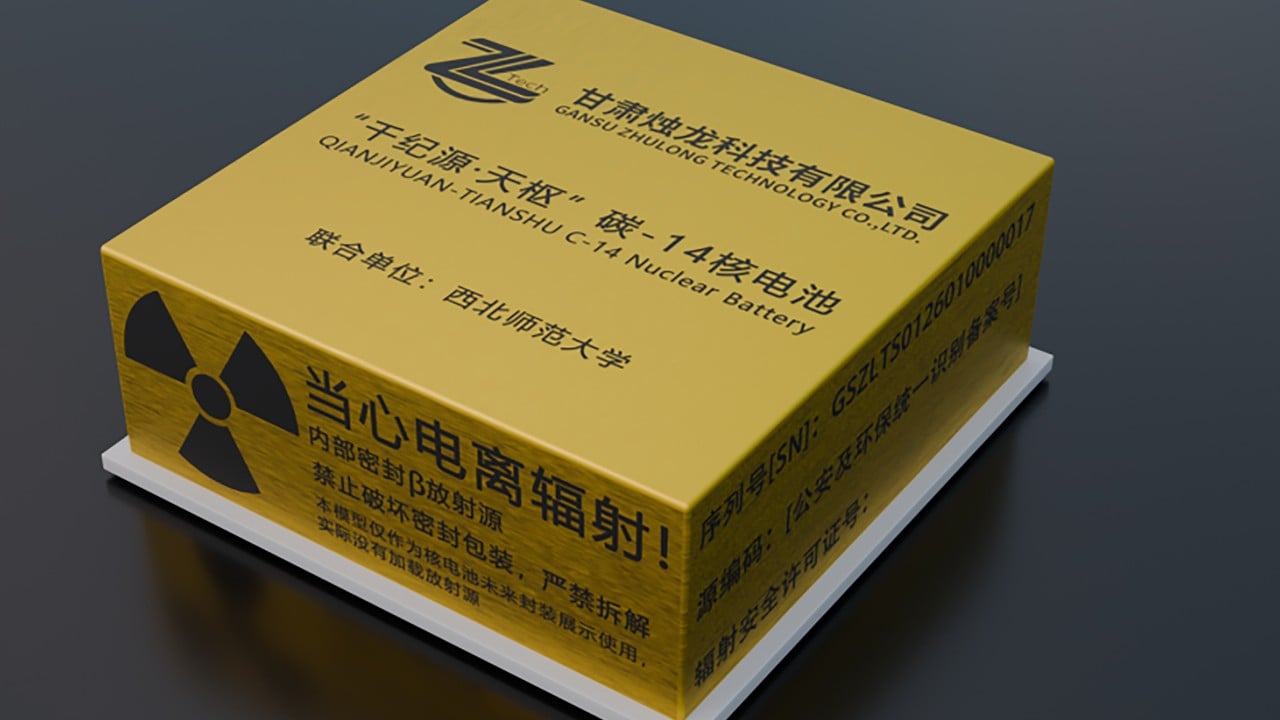
You have probably seen the breathless headlines. Stories about a battery that lasts thousands of years, eliminates the need to charge your smartphone, and completely changes how we think about energy. The latest spark in this internet frenzy is China's "Zhulong No. 1" (Candle Dragon One), a carbon-14 nuclear battery developed by Beita Pharmatech and Northwest Normal University.
It sounds like pure science fiction. A tiny power cell that runs on radioactive decay, shrugging off extreme temperatures while pushing out continuous power without a single visit to a wall outlet. But if you're waiting for a nuclear-powered iPhone that you can pass down to your great-grandchildren, you need a reality check.
The internet is wildly overselling what these batteries can actually do right now. Let's look at the real numbers, the actual science, and why this milestone matters—even if it won't power your laptop anytime soon.
The Reality Behind the Microwatt Milestone
To understand why people are losing their minds over this, you have to look at the longevity. The core of the Zhulong No. 1 relies on carbon-14, a radioactive isotope with a half-life of roughly 5,730 years. Because it decays so incredibly slowly, the battery can theoretically spit out electricity for millennia.
During laboratory testing, the engineering prototype ran continuously for months, powering LED light pulses and even juicing up a Bluetooth radio frequency chip to transmit signals. The battery is encased in silicon carbide semiconductor material. This is crucial because the silicon carbide acts as a shield, absorbing the beta-ray electrons emitted by the carbon-14 and converting them into electrical current. It keeps the radiation locked inside, making the device completely safe to handle.
It boasts an energy density of 2.2 Wh/g, which is about ten times higher than standard lithium-ion options. It can survive in punishing temperatures ranging from -100°C to 200°C. Sounds perfect, right?
Here is the catch that the hype cycles love to ignore: the total power output is measured in microwatts.
Specifically, the prototype generates a maximum output power of just 433 nanowatts, with a short-circuit current of 282nA and an open-circuit voltage of 2.1V. To put that in perspective, a standard smartphone requires a few watts of power to run. A single watt is one million microwatts. This means you would need millions of these tiny cells stacked together just to browse social media on your phone. The math simply doesn't work for consumer electronics.
Where Betavoltaics Actually Make Sense
If these cells can't power a flashlight without a massive footprint, why are research teams in China, the UK, and the US spending millions to develop them? Because for certain critical applications, traditional batteries are a logistical nightmare.
Think about a cardiac pacemaker. Right now, if you have a pacemaker, you're looking at a surgical replacement every 10 to 15 years just to swap out the battery. A tiny, low-power carbon-14 cell could theoretically provide a permanent energy source, eliminating the need for repeated, invasive surgeries. The same applies to advanced brain-computer interfaces that require minuscule, steady currents over decades.
Beyond medicine, the real value lies in environments where human maintenance is flat-out impossible:
- Deep-sea sensors measuring tectonic shifts on the ocean floor.
- Remote Internet of Things (IoT) sensors tracking climate data in polar regions.
- Space exploration probes traveling past the edge of our solar system where solar panels are useless.
In these scenarios, you don't need kilowatts of power. You need a tiny trickle of electricity that absolutely will not fail, no matter how cold, hot, or isolated the environment is.
The Geopolitical Race for Nuclear Waste
There is a fascinating environmental angle here that rarely gets enough attention. Carbon-14 isn't just a rare material we have to mine; it's a byproduct of nuclear power generation. Specifically, it builds up in the graphite blocks used to moderate reactions in certain types of nuclear reactors.
By extracting carbon-14 from this nuclear waste, scientists are effectively recycling a long-term storage headache into a long-term power supply. The UK Atomic Energy Authority and the University of Bristol have been working on their own version of this technology using a diamond structure.
China's rapid push into this space is directly tied to its massive domestic nuclear expansion. They are building reactors faster than anyone else on the planet. By mastering the supply chain for isotopes like carbon-14 and nickel-63, they aren't just aiming for cool tech gadgets—they're positioning themselves to dominate the advanced manufacturing and aerospace components of the next few decades.
What Needs to Happen Next
Don't expect to buy a nuclear battery on Amazon anytime soon. If you are an engineer or an investor looking at the micro-power landscape, the immediate focus isn't on maximizing raw wattage but on improving energy conversion efficiency.
The Chinese prototype managed an efficiency rate of over 8%, which is a solid step forward compared to older historical designs that struggled to hit a fraction of a percent. However, scaling production and dropping the manufacturing costs of silicon carbide and diamond-based semiconductors remain massive hurdles.
If you're designing ultra-low-power sensors or working in aerospace, keep your eyes on the development of hybrid energy storage systems. The most practical near-term application involves pairing these slow-trickle nuclear batteries with a small capacitor or secondary battery. The nuclear cell slowly fills the reservoir, and the capacitor unleashes the power in short, milliwatt-level bursts to transmit data before filling up again.
Stop waiting for the nuclear smartphone. Start looking at the invisible, unglamorous sensor networks that will quietly power the infrastructure of the next century.