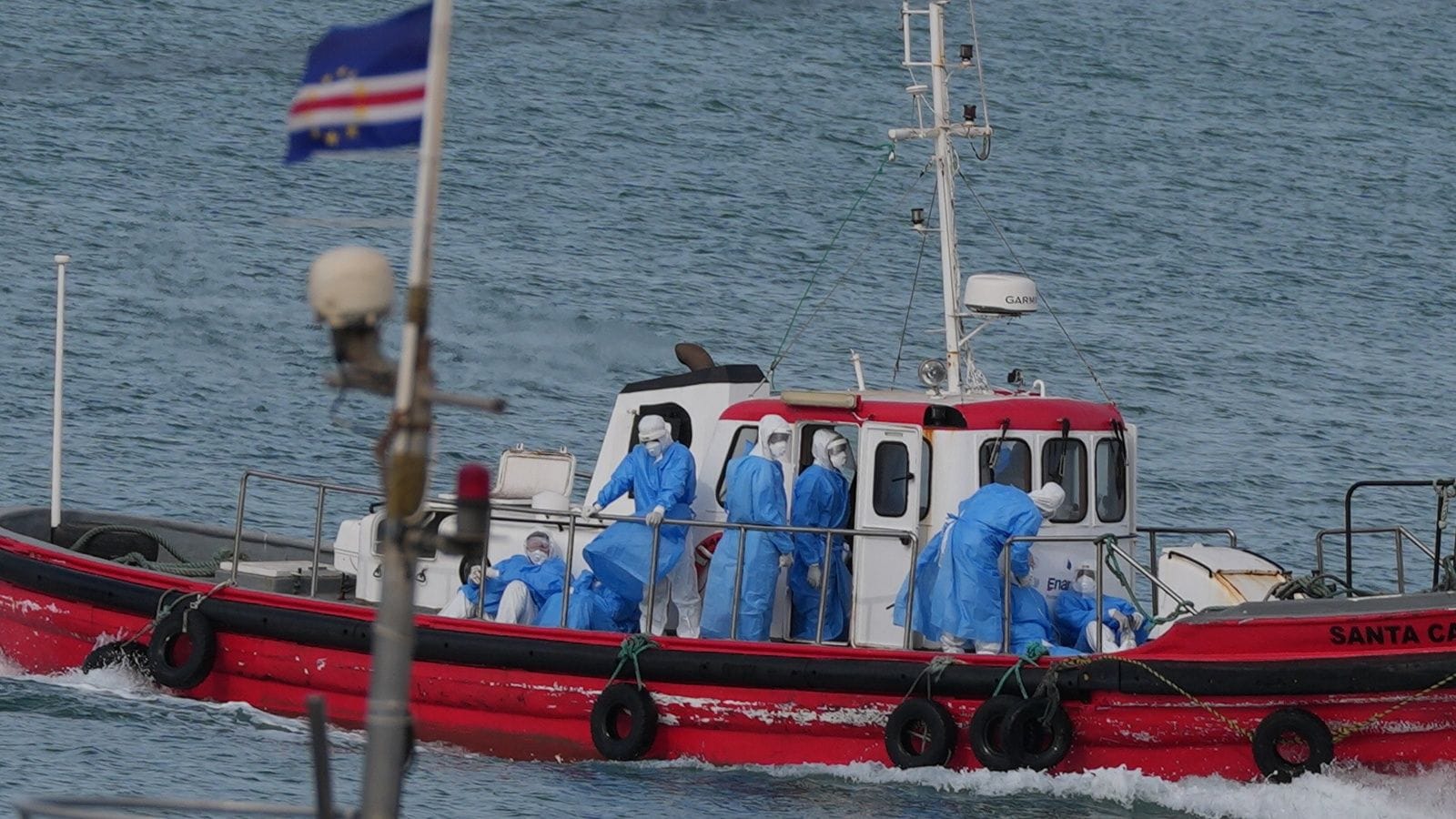
The evacuation of symptomatic passengers from a cruise vessel during a Hantavirus outbreak represents a breakdown in the primary biocontainment layer of maritime operations. While media narratives focus on the spectacle of the evacuation, the true analytical value lies in deconstructing the failure of the Vessel-to-Vector-Interface. Hantavirus is not an airborne respiratory virus in the vein of SARS-CoV-2; its presence on a ship indicates a failure of structural integrity and pest management rather than a failure of social distancing. To understand the risk profile of this event, one must evaluate the intersection of rodent biology, aerosolization physics, and the logistical constraints of maritime medicine.
The Mechanistic Path of Transmission
Hantavirus Pulmonary Syndrome (HPS) and Hemorrhagic Fever with Renal Syndrome (HFRS) are zoonotic diseases. They do not typically transition from human to human (with the rare exception of the Andes virus strain). Instead, the infection occurs through the inhalation of aerosolized viral particles found in the excreta of infected rodents.
The presence of the virus on a passenger ship suggests three specific failure points:
- Infiltration of the Sterile Perimeter: The primary defense against Hantavirus is the physical exclusion of Muridae and Cricetidae rodents. On a ship, these vectors enter via cargo pallets, mooring lines, or during dry-docking phases.
- The HVAC Amplification Loop: Once excreta are deposited in confined spaces, the ship’s forced-air ventilation system can act as a distribution network. If the humidity levels are low, the waste dries and becomes friable. Simple cleaning activities or mechanical vibrations then loft these particles into the breathing zone of passengers.
- Latency and Detection Lag: Hantavirus has an incubation period ranging from one to eight weeks. This creates a "detection blind spot" where a passenger could be infected at a previous port or during the early stages of a voyage, only becoming symptomatic when the vessel is far from high-acuity medical facilities.
The Cost Function of Maritime Evacuation
Evacuating passengers from a ship is a high-stakes logistical maneuver that incurs exponential costs and risks compared to shoreside medical transport. The decision to evacuate is governed by the Clinical Escalation Threshold, where the risk of the patient's condition deteriorating beyond the shipboard infirmary’s capability outweighs the physical risks of the transfer itself.
Variable 1: High-Acuity Resource Limitations
Cruise ship infirmaries are designed for stabilization, not long-term intensive care. A Hantavirus patient presenting with pulmonary edema requires mechanical ventilation and invasive hemodynamic monitoring. Most vessels carry a limited supply of ventilators; a cluster of cases immediately exhausts the local capacity, forcing an evacuation.
Variable 2: Operational Friction
The physical transfer of a patient via tender boat or helicopter hoist introduces trauma risks and potential environmental exposure. In the case of a viral outbreak, the "cold zone" of the ship must be protected, requiring stringent donning and doffing protocols for the medical team during the transfer. This slows the operation and increases the metabolic stress on both the patient and the providers.
Variable 3: Reputational and Economic Cascades
An evacuation is a public signaling event. It triggers a re-rating of the ship’s "Sanitary Score," often leading to canceled future bookings and increased scrutiny from port authorities. The economic loss is not merely the cost of the helicopter; it is the cumulative loss of operational days during the subsequent deep-cleaning and rodent-eradication phase.
Structural Vulnerabilities in Ship Design
To prevent Hantavirus, one must analyze the vessel as a biological habitat. Modern cruise ships are complex mechanical ecosystems with miles of cable runs, plumbing chases, and insulation layers. These "void spaces" provide the perfect nesting grounds for rodents.
The second limitation is the difficulty of Vector Surveillance. Traditional snap traps or bait stations are often insufficient in a 100,000-ton vessel. Infrared monitoring and pheromone-based detection are required to identify an intrusion before a colony establishes itself. The presence of a symptomatic passenger implies that the rodent population has reached a density where human-vector interaction is no longer incidental but statistical.
This creates a bottleneck in response: by the time a human is sick, the ship is already infested. The "Cleaning and Disinfection" (C&D) protocols must then shift from surface-level aesthetics to structural decontamination, involving the use of high-level disinfectants like 10% bleach solutions or stabilized hydrogen peroxide vapors in the interstitial spaces of the ship.
Epidemiological Differentiation: Hantavirus vs. Norovirus
It is a common error to conflate maritime outbreaks. The logic governing Hantavirus is the inverse of the logic governing Norovirus.
- Norovirus (Point-to-Point): Driven by human hygiene, high R0 (reproduction number), and rapid onset. Control depends on handwashing and surface cleaning.
- Hantavirus (Structural-to-Point): Driven by environmental failure, zero or near-zero R0 (non-contagious between passengers), and long incubation. Control depends on structural sealing and air filtration.
The evacuation of Hantavirus patients does not necessitate a full ship quarantine in the same way a respiratory pandemic would. Since the passengers are not shedding a virus that can infect their cabin mates, the focus remains on identifying the Point of Origin—the specific deck or storage area where the rodent excreta is located.
The Quantitative Risk Assessment of Shore-Side Port Response
Port authorities evaluate incoming vessels using a Risk-Impact Matrix. When a ship reports a Hantavirus case, the port must decide whether to grant "Pratique" (permission to enter the port and do business).
- If Pratique is denied: The ship becomes a "floating pariah," forced to remain at sea while medical resources are ferried out. This increases the mortality risk for the sick and the psychological stress for the healthy.
- If Pratique is granted: The port risks introducing an infected rodent population into its own infrastructure. The ship must be treated as a localized environmental hazard.
The triage process involves verifying the vessel’s Integrated Pest Management (IPM) records. If a ship cannot produce documented evidence of recent rodent inspections and negative results, the port is legally and ethically justified in demanding an offshore "Clearance Period."
Tactical Imperatives for Maritime Operators
Managing a Hantavirus event requires moving beyond crisis management into predictive structural engineering. The following protocols represent the gold standard for mitigation:
HEPA-Integrated HVAC Systems
Standard shipboard filters are designed for dust, not viral aerosols. Upgrading to HEPA-grade filtration in common areas and crew quarters provides a passive defense against lofted excreta. This is particularly critical in older vessels where ductwork may have accumulated debris over decades.
Ultrasonic and Physical Hardening
Mooring lines should be equipped with oversized "rat guards" that are inspected daily. Furthermore, the use of ultrasonic deterrents in food storage areas and cable trunks can create an "acoustic fence" that discourages nesting.
Biological Forensics
When a case is identified, the medical team must perform immediate serological testing to identify the specific Hantavirus strain. Identifying the strain allows investigators to trace the rodent species (e.g., Deer Mouse for Sin Nombre virus vs. Norway Rat for Seoul virus), which in turn identifies where the vessel was likely breached. If the strain is endemic to a specific port of call, the operator can focus their search on cargo received at that location.
Strategic Recommendation for Vessel Recovery
Following the evacuation of symptomatic individuals, the vessel must undergo a "Hard Reset." This is not a standard cleaning; it is a clinical remediation.
- Aerosol Suppression: Before any manual cleaning, all potentially contaminated areas must be sprayed with a non-aerosolizing disinfectant to "wet down" dust. Dry sweeping is strictly prohibited as it increases the risk of further infections.
- Destructive Testing: Random sampling of wall panels and ceiling tiles in and around the sick passengers' cabins is necessary to inspect for nesting materials.
- Vector Eradication Verification: The ship should not return to service until three consecutive nights of "Zero Trace" monitoring (using non-toxic tracking powder or motion-activated cameras) are achieved.
The immediate strategic play for the cruise line is to shift the narrative from "Sickness on Board" to "Environmental Integrity Restored." This is achieved through a transparent release of the IPM audit results and the validation of the HVAC filtration upgrades. Long-term viability depends on treating the ship not as a hotel, but as a sealed biological environment where the smallest breach in the hull's "pest-tight" integrity is treated with the same urgency as a hull breach that lets in water.