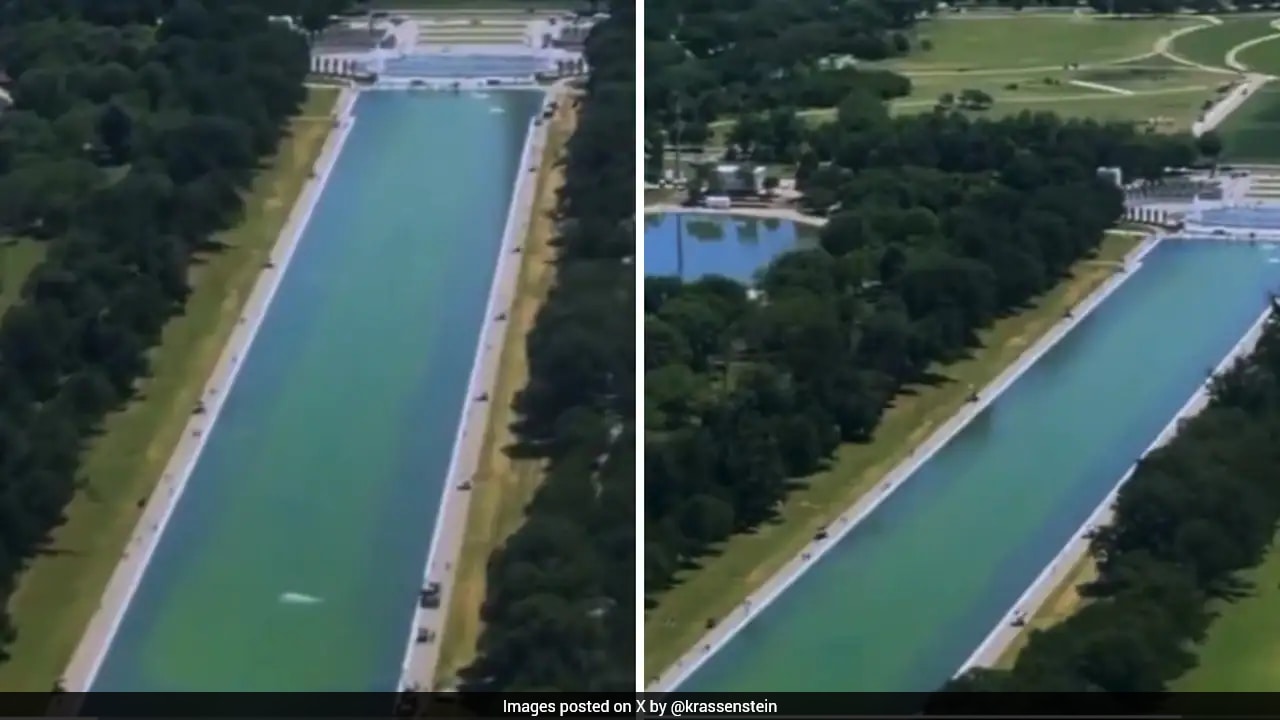
The federal government just spent over 14 million dollars trying to turn one of America’s most famous landmarks into a postcard-perfect sheet of royal blue. Less than two weeks later, it looks like a giant bowl of broccoli soup.
If you recently walked down the National Mall expecting to see the Lincoln Memorial Reflecting Pool glowing in a fresh coat of what has been dubbed American flag blue, you were probably disappointed. Instead of a pristine mirror reflecting the sky, the water turned a vivid, swampy green. Algae is back with a vengeance.
This isn't just a minor cosmetic hiccup. It is a massive, highly visible reminder that nature does not care about political promises or expensive paint jobs. The Trump administration fast-tracked this multi-million-dollar renovation, handing out a no-bid contract to waterproof the basin and coat it in an industrial-strength blue lining. They promised it would solve the site's chronic filth issues for good.
It didn't.
Now, park workers are out there in neon vests, desperately paddling around in skimmers and dumping hundreds of gallons of concentrated hydrogen peroxide into the water. It is a frantic scramble to save face before the massive crowd arrives for the upcoming July 4th celebrations. The whole situation raises a pretty obvious question. How does a 14-million-dollar modern cleanup project fail this spectacularly in just a few days?
The answer is a mix of basic physics, bad biology, and a refusal to listen to environmental science.
The Chemistry and Physics of a Giant Algae Incubator
To understand why the Lincoln Memorial Reflecting Pool algae bloom happened so fast, you have to look at what this pool actually is. It is not a high-tech swimming pool. It is essentially a massive, 2,000-foot-long concrete tray filled with shallow water sitting directly under the blazing Washington sun.
Algae needs three core ingredients to thrive. It needs stagnant water, plenty of sunlight, and a steady supply of nutrients. The Reflecting Pool provides all three in abundance, but the recent renovation managed to make the environment even more ideal for these organisms.
Let's talk about the paint. The decision to coat the bottom of the pool in a dark, rich blue was meant to make the water look deeper and more majestic. But think about basic physics for a second. Darker colors absorb light and hold onto heat. When the intense summer heat wave hit Washington, that dark blue bottom acted like a heating pad. It warmed the shallow water quickly, raising it right into the absolute sweet spot for rapid biological growth.
Marine biologists have pointed out that if you wanted to design a commercial bio-farm to grow algae as quickly as possible, you would build exactly what is sitting on the National Mall right now. It is shallow, it gets baked by the sun all day, and it stays warm for hours.
Then come the nutrients. The Reflecting Pool is a magnet for local wildlife. Hundreds of ducks and geese call the area home, meaning a constant stream of bird droppings ends up in the water. Duck poop is packed with phosphorus and nitrogen. In the world of aquatic biology, that is pure, high-octane fertilizer. When you combine warm water, endless sunlight, and tons of nitrogen, an algae explosion isn't just possible. It is guaranteed.
The Finger Pointing and the Nanobubble Defense
Predictably, the sudden return of the green sludge triggered an immediate political blame game. Officials from the Interior Department quickly dismissed the green hue, calling it nothing more than residual algae. They claimed the organism had been sitting dormant inside the pool's century-old cast iron supply lines while the basin was drained for eight weeks of construction. According to their narrative, flushing out the pipes naturally pushed the old sludge into the open, and it is just a normal part of the startup process.
The administration also took direct shots at past presidencies, claiming that former administrations spent millions on failed cleanups while leaving the pool broken and disgusting. There is a bit of history here, though. Every single president who has tried to fix this pool has run into the exact same green wall.
During the Obama presidency, a massive 34-million-dollar overhaul completely rebuilt the pool between 2009 and 2012. That project updated the system to pump water from the Tidal Basin rather than using expensive city tap water, aiming to keep the water moving. Yet, within weeks of reopening in 2012, the National Park Service had to drain and clean the whole thing at a cost of 100,000 dollars because algae completely carpeted the surface. Later, in 2017, the pool had to be emptied again to deal with a severe parasite outbreak that killed dozens of ducks.
The reality is that keeping a massive urban water feature clean is an ongoing battle, not a one-off construction project.
To fight back against the current bloom, the National Park Service is relying on a mix of old-school chemicals and newer tech. They deployed an expensive water purification system using ozone nanobubbler technology. These devices inject tiny, microscopic bubbles into the water. The nanobubbles are supposed to react with the water to create oxidizing agents that target and break down algae cells from the inside out, leaving behind clean, highly oxygenated water.
While the administration insists the nanobubblers are actively killing the bloom and that the dead organisms are being vacuumed up, the sheer volume of algae forced them to bring out the heavy artillery: gallons upon gallons of 12 percent concentration hydrogen peroxide.
Chemical Warfare on the National Mall
Watching workers dump boxes of hydrogen peroxide into a historic landmark is a wild sight. While some critics quickly accused the team of pouring dangerous bleach into the water, the science behind hydrogen peroxide is a bit different.
Hydrogen peroxide is a powerful oxidizer, but it is generally considered much safer for the surrounding environment than standard swimming pool chlorine. When it hits the water, it reacts quickly, creating oxygen radicals that rupture the cell walls of the algae. Once the reaction is finished, the chemical breaks down into harmless water and oxygen. It does not linger in the environment, and at the right concentrations, it will not poison the birds or the tourists walking nearby.
But relying on continuous chemical treatments highlights the fundamental flaw of the entire project. It is a temporary band-aid on a structural reality. You can dump all the peroxide you want into the basin, but as long as the sun is shining, the water is stagnant, and the ducks are swimming, the algae will keep coming back. The chemical treatments create a never-ending cycle of pouring money into a pool that naturally wants to be a swamp.
Real Solutions to a Century Old Problem
If you want to actually fix the Reflecting Pool, you have to stop treating it like a backyard swimming pool. You cannot just slap a fresh layer of fancy paint on the bottom, install a single filtration system, and declare the job done for the next century.
True maintenance of a massive open-air water feature requires a constant, aggressive strategy. First, water circulation has to be massive. Algae struggles to take hold in fast-moving water. If the pumps are not completely cycling the millions of gallons of water fast enough to prevent dead zones, stagnant pockets will always bloom.
Second, the nutrient input has to be managed. Controlling the waterfowl population or using specialized bio-filters that actively strip phosphorus and nitrogen out of the incoming water is far more effective than trying to kill the algae after it has already eaten and multiplied.
For now, the National Park Service is stuck in crisis mode, scraping the concrete and shocking the water to make sure the landmark looks presentable for the upcoming national holiday. The 14-million-dollar renovation gave the pool a striking new look, but it also proved that no amount of money can bypass basic environmental science. If you build a giant, warm, sunlit bird bath in the middle of a Washington summer, it is going to turn green. Honestly, it is just what nature does.