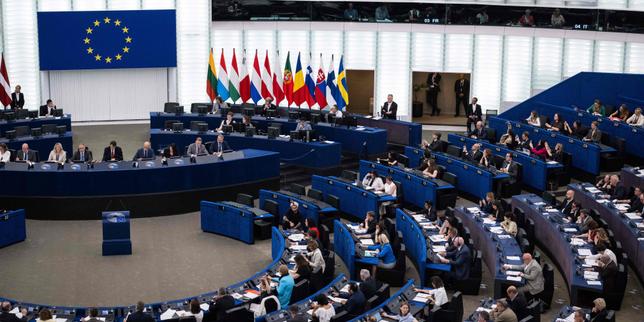
The marble of the European Parliament in Strasbourg is designed to absorb sound, but it could not muffle the shouting. Four hundred and eighteen votes to two hundred and eighteen. A gap of exactly two hundred hands raised in the air, and just like that, the geography of human displacement shifted.
When the gavel fell, the right side of the hemisphere cheered. The left side chanted a single word over and over: shame.
Between those two sounds lies a new piece of European law. Officially, it is a regulation on the return of rejected asylum seekers. It is a dense, gray thicket of legal prose, sub-clauses, and administrative timelines designed to fix a bureaucracy that European leaders widely agree is broken. Currently, fewer than thirty percent of people ordered to leave the European Union actually go. The system is slow, expensive, and politically toxic for governments watching populist parties rise outside their windows.
But laws have a habit of hiding their physical consequences behind neat vocabulary. The new phrase of the year is "return hub."
To understand what a return hub is, you have to leave the Strasbourg plenary and look at a map. A hub is an outpost. It is a detention center built outside the borders of the European Union, funded by European money, but placed on someone else’s soil. Under this new rule, if a person crosses a border, applies for asylum, and is rejected, Europe no longer needs to find a way to send them back to their hometown. Europe can send them to the outpost.
Consider a hypothetical man named Malik. He is not a statistic, though he will become one the moment his thumbprint is scanned. He left a city that was shelling its own suburbs, walked through two deserts, paid three different men for the privilege of sitting on a leaking rubber boat, and collapsed on a beach in Greece.
Under the old rules, if Greece rejected Malik’s application, the state faced a logistical mountain. They had to prove where he was from, convince his home country to issue travel documents, and arrange a commercial or charter flight. Most of the time, that process dragged on for years. Malik would exist in a legal twilight zone—unable to work legally, unable to leave, waiting.
Now, look at the new blueprint. Greece plans to have its first external hub operating by the year 2027. Under the new framework, once Malik’s final appeal is denied, the legal obligation shifts. He is put on a plane, but not to his homeland. He is flown to an outsourced facility in a cooperative third country—perhaps a nation in the Western Balkans or North Africa that has traded its land for European development aid.
Malik is now in the outposts of anywhere. He is no longer Europe’s administrative problem. He is outside the fence.
The political logic behind this is straightforward and, to a large segment of the European electorate, deeply persuasive. For years, the inability to enforce deportations has made European borders look like fiction. Governments in Germany, Austria, Denmark, and the Netherlands are under immense domestic pressure to show they are in control. Magnus Brunner, the EU’s commissioner for migration, framed the vote as a reclamation of sovereignty: it is the state, not the human smuggler, that must decide who stays.
There is a cold efficiency to this argument. If the incentive to cross the Mediterranean is the chance to disappear into the European interior, then removing that disappearance from the equation breaks the business model of the traffickers.
Yet, the mechanics of externalization are fragile. To make a map work this way, you need partners willing to hold the people you do not want. Italy tried this on a small scale with centers in Albania, a project that became an expensive legal tug-of-war with judges who questioned whether the migrants' fundamental rights could be guaranteed in a country outside the EU’s legal umbrella.
The moral friction of the new law is found precisely in that legal handoff. When Europe exports its borders, it also exports its scrutiny. Human rights organizations and left-wing lawmakers argue that once an asylum seeker is moved to a third-party hub, the transparent oversight of European courts vanishes. The responsibility becomes fluid. If an abuse happens inside a fence located in a country that is not a member of the bloc, who answers for it? The state running the camp, or the parliament that signed the check?
This is the compromise Europe has chosen. The pressure within the continent’s domestic politics has grown so intense that the traditional consensus on asylum has begun to crack. Nations like France have expressed deep skepticism about the cost and feasibility of these centers, while Spain has opposed them entirely, warning of an erosion of human dignity. But the center of gravity has moved. The alliance between the traditional center-right and the populist right has proven strong enough to turn what was once a fringe policy idea into the law of the land.
The law will take time to materialize into brick and razor wire. Treaties must be negotiated with third countries; budgets must be carved out of an already stretched European framework. But the direction is set. Europe is building an archipelago of waiting rooms beyond its rim.
For the people who will eventually occupy them, the legal debates in Strasbourg will matter very little. They will find themselves in clean, modern, administrative spaces, managed by contractors, situated in landscapes they never intended to see. They will be safe from the immediate dangers they fled, but they will be entirely disconnected from the futures they tried to buy with their lives. They will remain there, suspended between a home that is no longer safe and a continent that has decided its walls must begin several hundred miles before its borders.
The complexity of these new border policies and the political shifts driving them are examined further in EU greenlights controversial return hubs in 'strictest-ever' new migration law, which details the legislative debate and the reactions from civil society organizations across the continent.