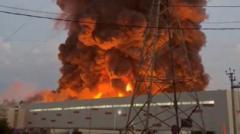
The Digital Front Line
Pressing a button on a smartphone screen triggers a chain of events so predictable it almost feels like magic. You tap. A warehouse miles away hums to life. A cardboard box receives a barcode, slides down a conveyor belt, and lands in the back of a delivery van. Within forty-eight hours, a package sits on your doorstep.
For millions of people, online shopping is not a luxury. It is the steady heartbeat of modern survival. It is how winter boots arrive for growing children, how small merchants stock their shelves, and how everyday life maintains its rhythm when the world outside turns chaotic.
Then the sky hums with a sound that does not belong to delivery logistics.
A long-range Ukrainian drone punches through the morning sky, targeting a sprawling distribution hub owned by Wildberries, Russia’s dominant online retailer. The strike does not merely destroy inventory or scorch concrete. It severs the invisible threads connecting hundreds of thousands of ordinary consumers to the goods they depend on every single day.
Chaos.
The Giant in the Supply Chain
To understand why a warehouse strike cuts so deep, you have to understand what Wildberries actually represents. Founded by Tatiana Bakalchuk, a former English teacher, the platform grew from a modest apparel reseller into a commercial behemoth handling millions of orders daily. It became the digital marketplace for an entire nation, dwarf competitors, and reshape how goods move across vast distances.
When a retailer reaches that scale, its facilities are no longer just private real estate. They are critical infrastructure.
Imagine a single facility spanning hundreds of thousands of square meters. Inside, endless rows of shelving hold everything from basic pantry staples and electronics to winter clothing and automotive parts. Hundreds of workers move through the aisles, guided by algorithms designed to squeeze maximum efficiency out of every second.
When a drone warhead detonates inside a hub of this size, the physical damage is immediate and dramatic. Black smoke billows into the sky. Fire suppression systems trigger. Firefighters struggle to contain blazes fuelled by miles of plastic packaging, cardboard, and synthetic fabrics.
Yet the true crisis begins after the flames are extinguished.
The Human Ripple Effect
Consider a hypothetical seller named Yelena. She runs a small workshop crafting insulated outerwear. She does not own a storefront. She relies entirely on fulfillment centers to store her inventory and process her shipments.
Overnight, her digital dashboard goes dark. Her stock—representing months of upfront capital, labor, and expected revenue—is gone. The system marks her orders as delayed, then canceled. Her small business, built entirely on top of someone else's infrastructure, faces sudden insolvency.
Multiply Yelena by tens of thousands.
On the consumer side, the impact is equally immediate. A family waiting on winter coats in a sub-zero climate receives a brief text notification: Delivery delayed. A local mechanic waiting on replacement components for a customer's car watches the tracking page refresh endlessly without an update.
Modern warfare increasingly targets these soft vulnerabilities. By striking supply networks, military strategists do not just aim to disrupt state logistics; they project war directly into the daily lives of civilian populations far removed from the physical frontline.
Beyond the Scorched Earth
Building a defense against low-cost, long-range aerial strikes presents an enormous challenge. Air defense systems designed to intercept high-altitude military aircraft or supersonic missiles are often ill-suited to detect and destroy small, slow-flying unmanned aerial vehicles flying at low altitudes.
Installing military-grade defensive assets around every civilian logistics hub across thousands of miles of territory is practically impossible.
As strikes on commercial infrastructure become more frequent, companies face staggering financial strain. The costs compound rapidly:
- Direct loss of physical inventory and building infrastructure.
- Insurance premiums surging to unsustainable levels.
- Secondary losses from supply chain bottlenecks and lost customer trust.
- Heavy investment in localized security measures and redundant facilities.
When supply networks break down, prices rise. Availability shrinks. The digital convenience that consumers took for granted transforms into a source of friction and anxiety.
The drone strikes on commercial retail facilities expose the fundamental fragility of hyper-centralized digital economies. When a society routes its commerce through a handful of massive distribution nodes, those nodes inevitably become targets. The tap of a screen remains simple, but the physical world behind the glass grows fragile, uncertain, and burning.